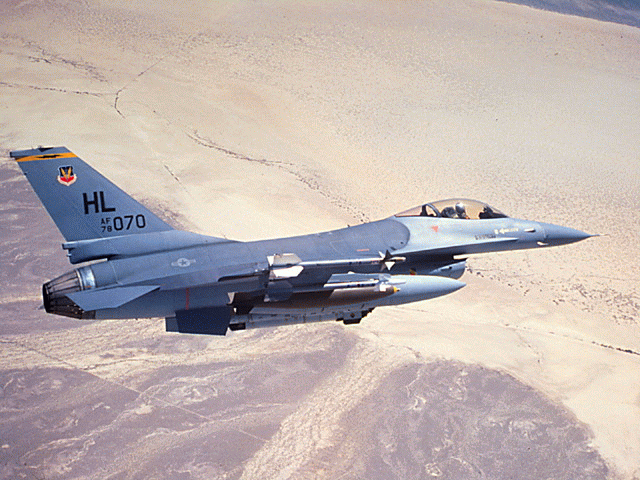
The F-16
In the 1970s the F-15 Eagle was designed to be the mainstay of the Air Force, but at $35 million per plane it is hard to build them in large numbers. So the US Air Force started a design competition that called for an air superiority fighter with high manueverability that was economical to produce.The results were two prototype aircraft, the YF-16 and the YF-17. In a tight competition the YF-16 came out as the victor. Now known as the F-16 Fighting Falcon, it was the first plane in service to be able to withstand a sustained 9G turn (The F-15 can pull 9Gs, it just shortened the service life so a lower G limit was enforced). The reason the pilot can do this is because of two reasons: the first of which is his/her flight pressure suit. This suit, which is worn by most pilots, constricts on the legs whenthe weight of gravity increases in order to keep blood flowing to the brain. The other reason is because the seat is angled at 30 degrees which makes it harder for blood to pool in the legs. With a relatively low price tagof $8.2 million dollars per plane, the Air Force could build a sufficient number of planes in order to compete with Russia.
Although designed to be a dogfighter, in the late 1980s, early 90s,it was discovered that the F-16 was also capable of ground attack. From this developed the F-16C, a day/night air superiority fighter with ground attack ability. This new plane was the most numerable F-16 variant in the Gulf War, this was so the plane could replace the A-10 Thunderbolt II. Although this is a smart move economically for the Air Force, startegically it is a dumb move. During the war the F-16 was shot down so often while in ground attack mode that there was a minimum height from which planes had to attack from: 10,000 feet. This may not sound like anything of great importance, but since the Falcon cannot natively carry smart bombs (however, a special pod may be mounted on the wing), the accuracy of the bombs suffered a great deal. The typical bomb used on the F-16 was the Mk 82 500lb, which wanders 6 feet for every 1,000 feet it falls. So from 10,000 feet the bomb can wander as far as 60 feet from the target, making it very difficult to make an accurate strike.
SPECIFICATIONS F-16A (currently out of active duty service in the USAF)
Wing Span: 32 feet, 10 inches
Length: 49 feet, 6 inches
Height: 16 feet, 6 inches
Weight: 29,896 lbs. loaded
Armament: One 20mm M-61A1 cannon, and it can carry AIM-7 Sparrows alongwith AIM-9 Sidewinders
Engine (on the F-16C): One General Electric F110-GE-100 of 30 ,000 lbs.thrust with afterburner.
Crew: One
Cost: $8,200,000
PERFORMANCE: F-16A
Maximum speed: 1,345 mph.
Cruising speed: 577 mph.
Unrefueled Range: 1,407 miles
Service Ceiling: 55,000 ft.
