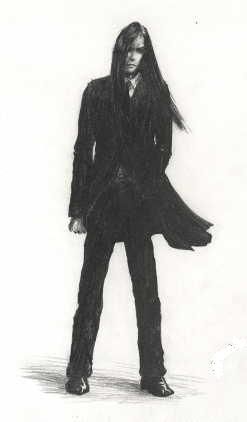
Alceste de Valence or Morethio
Bocelli
|
|
Clan: Toreador Generation: 6th Sire: Genvieve Orseau Morethio Bocelli (later known asAlceste) was Born to Antonio Bocelli and Eli Bocelli in the city-state of Florence on June 2nd, 1752. He was an only child. His father Antonio was a successful member of the petit-bourgeoisie, and engaged in the trade and manufacturing of clothing and foodstuffs. Eli was an unremarkable bitter woman with no notable family connections. Morethio was of 15 years at the time of her disappearance. Her disappearance is still unexplained. From an early age Morethio was groomed to take on the family business, which was of great importance to his father and the dignity of the family. Morethio did manage to learn the basics of commerce and trade, mostly through exposure, yet always his primary interest lay in buffoonery and mischief. As an early teen, rather than partake of the company which his father's money allowed, he preferred to spend his time with local petty thugs and troublemakers. He would frequent brothels using his father's money, and engage in gambling and various other forms of debauchery. He discovered that his good looks and charm could land him most women he desired, and he nearly lost his life in duals as a result. He learned to melee at great personal risk. He would often entice woman for the mere sport of enraging their spouses. In short order Morethio became a terrible embarrassment to the family, and Antonio sought to cover his shame by sending the insolent boy away from local eyes to a foreign school. Morethio was sent to Milano to receive a proper education at his father's expense. Uninterested in his studies, he was frequently truant, and at school managed to make friends with many bad seeds, though these bad seeds were from a far wealthier stock than his friends in Florence. He learned French easily, but ignored the classics, Latin, and Mathematics. Most of his time was spent wandering the streets of Milano. To his surprise, while in Milano, he began developing a taste for street theatre. He admired the vulgarity, the boastfulness, but was also secretly touched by the tragedy, tenderness and feeling he occasionally saw in the performances. Around this time he saw the great Actor Camelio Ravezzi, before he had risen to fame. In a back alley theatre, Morethio witnessed a performance of pure aesthetic perfection, a moment of artistic mastery, the likes of which he had never seen before: in utter awe, in a single moment, Morethio's life collapsed into one desire: to himself become such a virtuoso, to master the stage like none other. He sped home. The next day, he wrote to his father asking for more money, saying that he had been robbed. He then went to the market and bought dozens of bizarre and varying costumes. For the next month he forgot school entirely, and each day he would live as an imaginary character, dressing in suitable costumes, exploring the city as an aristocrat, as a clergyman, as a noble's servant, a hero, a villain, anything that would let him act. Soon enough he began auditioning for small theatres, and his talent became apparent. Morethio dropped out of school entirely, though he didn't tell his father, and spent all his time and energy in the pursuit of acting. He lived the life of an artist, without having to worry about making an income. A small troupe which he had been working with, which specialized in Italian tragedies, began a tour of the city states. Morethio thus began his travels. The troupe was quite talented, yet only a meager living could be sustained from such a profession. Morethio shared some of his incoming wealth with the troupe to ease their lifestyle as they traveled, yet one day ill news came: his father had gone bankrupt. Large fires in the east end of Florence had entirely destroyed his father's buildings and manufacturing facilities, leaving the family in-debt and destitute. While Morethio wasn't used to this lowered standard of living, he was completely absorbed in the joys of acting. The troupe continued its travels, and began moving West, in hopes of touring France. His acting steadily improved, and he became the central attraction in their plays. When passing through the city of Torino, his voice and talents caught the attention of the Toreador Genevieve Orseau. That night Morethio was abducted and Embraced. For a few days she instructed Morethio on the basics of unlife and the Masquerade. Morethio sent word to his troupe to wait for him, which they did with much misgiving. Despite the severity and shock of his circumstances, he attempted to continue with his acting tour. He insisted on traveling alone, and only performing at night. The group began touring France, but nervousness in the troupe increased as Morethio's strange behavior and preferences persisted. Members started to leave the troupe. One night, in a small town outside of Paris, a Parish Priest saw the troupe's Act, and somehow knew Morethio to be Satan's child. A small mob of fanatics burned the troupe's cart, destroyed all of their props and drove their horses away. His unlife of acting seemed to be over. The troupe was disintegrated. Destitute and jobless, and in a foreign country, he slept in the basement of an abandoned farm, and at night turned to petty theft to sustain his now-meager lifestyle. Inspired by a character in an Italian drama, he slowly became attracted to the idea of the highway robber. With vampiric powers at his disposal, he found it fairly easy to startle the horses of approaching carriages and scatter the mortal inhabitants. He took care not to kill if it wasn't necessary, yet often it proved a part of the profession. As the months rolled by, he contemplated how to improve his situation, how he might succeed as a great actor despite his poverty and undeadness. One night a strange and risky opportunity presented itself. He was prowling the roads outside of Paris, when he saw a particularly fancy ornate covered carriage approaching: a typical extravagance of the nobility. He leapt on the driver and guard from an overhanging tree, throwing them off. The guard was easily knocked out. The carriage driver had run off into the woods. Morethio then stopped the horses, and swung open the carriage door. Inside were a prim and proper lady, who had already feinted, and a young aristocratic man, who was terrified and cowering in his seat. He dragged the young man screaming into the moonlight, intending to feast on his tender flesh and empty his pockets. As the moon lit the man's features, Morethio saw the most startling sight: that this young man looked virtually identical to Morethio's physical self! What a perfect act this could be! To play this young aristocrat in the high salons of Paris! Could it be pulled off? Morethio tied up the young man, pilfered the carriage and the lady, and then carried the young man off to the abandoned farmhouse. For two days Morethio teased and talked with the young aristocrat, who's name was Alceste de Valence, learning his speech patterns, the details of his life. Finally, Morethio drained him, took his clothes, and buried him behind the barn. The next day Morethio, now playing Alceste, traveled to Paris and found his new home, a splendid Mansion near the Louvre. The servants were alarmed and excited that Alceste had survived the horrible highway robbery. The servants had been temporarily fooled, but fooling the family would be much harder. Fortunately, something happened to ease this private Masquerade. Alceste's mother, Nicolette de Valence, was a ghoul of a Paris Vampire. She was also a highly ambitious woman, who's only concern was family status. Through great conniving and scheming she had arranged for her son Alceste to marry into the highly renowned family of the Comte de Bougar. Alceste was to marry the Comte's daughter Christina. In the past, Alceste had refused, again and again. He was a reclusive young man, who rather didn't like women, or people in general, and detested the idea of spending more time in petty social functions. In short order his mother Nicolette discerned that Morethio was impersonating her son, and that he was also a Vampire. After confronting Morethio, and learning most of the true story, she saw for herself a grand opportunity, and an alliance was struck: Morethio could remain Alceste with her blessing and assistance, as long as he married Christina de Bougar and helped his Mother with her political maneuvering. Morethio (now referred to as Alceste) managed to slide into his new persona and social life with minimal suspicion. Most people were delighted with Alceste's change of demeanor, despite his new health problems. His new mother instructed him in Etiquette and the other niceties of noble life. In the following year Alceste was amazed by the style and decadence of aristocratic life. Never had he witnessed such refinement. What grabbed him most was the grandeur of the arts, and his new wife Christina, a patron of the arts, kept him in contact with the finest artists and exhibits. This eased his convergence with the Paris Toreadors.
While previously Alceste had only
really appreciated the art of acting, now he discovered in himself a tremendous eye
for beauty. Endless hours he spent leering at sculptures and pawing at tapestries. He went to every exhibit, the most hideous to the most
heavenly. He even began to dabble in sculpture
and painting, setting up a private studio with the finest materials. He also frequented the theatres, got to know
the directors of the theatre houses, and some of the finest actors. This debauchery was far superior to
gambling and womanizing! And this was only the beginning! |
Back to Paris: Dead in the City of Lights Back to Clan Toreador
|