QI
QIAO JIE £¨ÆòÇɽڣ©
Celebrated on the 7th night of
the seventh lunar month, Qi Qiao Jie is one of the more romantic Chinese festivals.
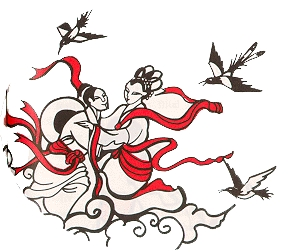
it commemorates the annual reunion of the cowherd (Niu Lang /Å£ÀÉ )
and the weaving Maiden (Zhi Nu /֯Ů ). It is a time to
emphasise the joy and beauty of love; it is also an occasion to reiterate and demonstrate
appreciation and care for one's beloved.
ORIGIN
Version 1: Niu
Lang and Zhi Nu were both faries living on opposite sides of the Milky Way ("Silver
River" in Chinese). The Jade Emperor of Heaven (Óñ»Ê´óµÛ)
felt sorry for the two faries and hence arranged
for their marriage. The couple became enthralled with each other after their
marriage that they neglected their work. The Jade Emperor was annoyed and decreed
that henceforth, the couple could only meet once a year on the seventh night of the
seventh month.
Version 2: Zhi Nu
was the 7th daughter of the Jade Emperor. One day while visiting earth, she met and
fell in love with Niu Lang. After their marriage, Zhi Nu's absence was discovered by
her mother, the Jade Emperess (»ÊĸÄïÄï) and Zhi Nu was ordered to return to
Heaven. The Jade Emperess took pity on the couple and she thus allowed them to meet
once a year. So, on the seventh night of the seventh moon, mapies would form a
bridge for the fairy wife to meet her mortal husband.
OBSERVATION
Celebration is declining in recent years. In the 50's and 60's, many Chinatown
streets turned into fairyland of lights as different "Qi Jie Hui" (Seven
Sisters' Association /Æß½ã»á , comprising of mainly single females) competed with
each other to put up the most beautiful "shrines" to Niu Lang and Zhi Nu.
The
"shrines" were mainly made of paper and fresh fruits, flowers and cosmetics were
offered. Also, devotees took pains to make miniature clothes, shoes, and artifacts
from paper and embroidery for display.