 |
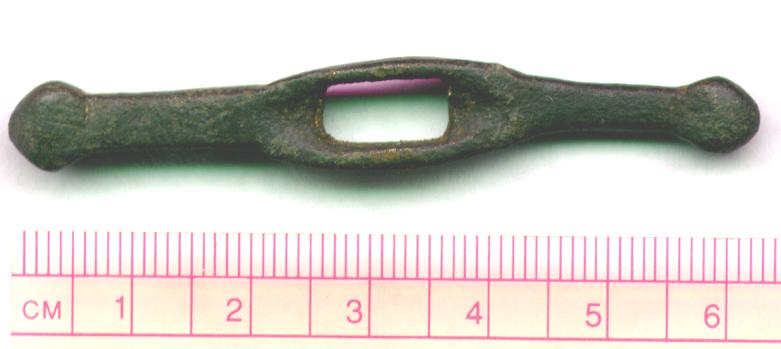
(27 KB) A classic cross-guard (quillon) from a quillon dagger of the
14th Century AD. This quillon has been identified as an Oakeshott Type II guard for the hilt of
a dagger, and is made of bronze with a marvelous dark-green patina. It was found in Dorset, England |
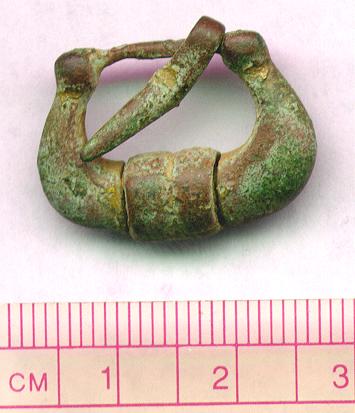 |
(24 KB) A very nice example of a 13th-14th Century bronze roller buckle.
The roller was placed on traditional buckles in order to ease the
wear on the belt as it was drawn through the buckle. The sheet metal roller is still in place
and the pin is intact. This example is from England. |
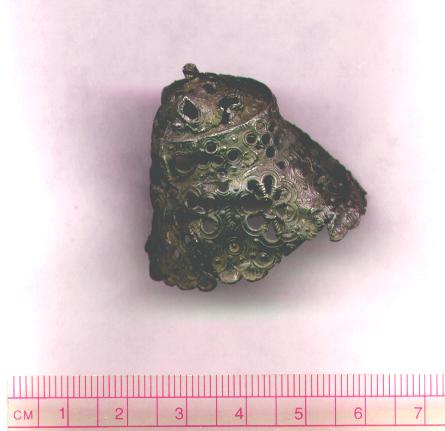 |
(21 KB) This is an example of the fantastic craftsmanship
of the religious houses of the second half of the 14th Century (1350-1400 AD). It's most
of a highly ornate open-work shell holder, cast in pewter. It was most likely made at the
Shrine of Our Lady at Walsingham. The holder was found near Walsingham in Norfolk,
England. |
 |
(6 KB) The bronze frame of a roller buckle. This style of buckle was favored
for several hundred years (from the 13th to 15th Centuries). This particular design dates
from between 1350 and 1400 AD. The sheet roller is now missing. It is from Southern England. |
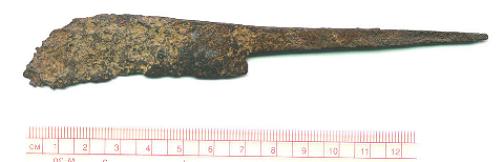 |
(11 KB) An iron blade from a 14th Century whittle
tang knife. The blade has a single cutting edge as has always been common among
utility knives. This blade was dredged from the River Thames, near London. |
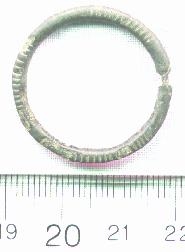 |
(7 KB) An example of a bronze ring brooch with incuse line & ladder-work decoration
around the ring. The now missing pin would have allowed the brooch to secure a scarf or other light
weight article of clothing. This example was found in Dorset, England. |
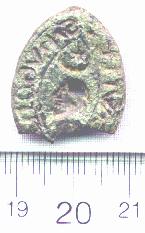 |
(8 KB) A bronze, lozenge-shaped seal matrix depicting a bearded (Saracen?)
head in profile under a crescent moon and star and bearing the partial legend:
S'HUGON ... EWILL (Seal of Hugon ... ewill). The seal was the medieval equivalent of a person's signature, and would have
been a guarded personal effect of the owner (like your wallet). The bottom portion of the seal is missing and the seal
has been 'holed' to prevent unauthorized use after the owner's death. This is a very
interesting piece of personal history from England. |
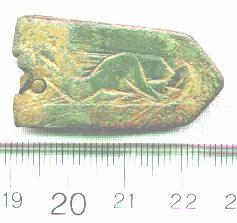 |
(10 KB) A bronze chape (strap-end) with a fantastic, stylized animal figure
engraved. Belt chapes with designs such as this are not too common, since they were largely used for utilitarian purposes.
This chape undoubtedly came from the strap of somebody or something important. Found in Cambridgeshire,
England. Circa early 13th Century. |
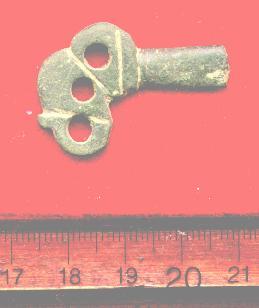 |
(10 KB) The strap attachment part of a bronze riding spur. Straps would have been attached to
the holes via bronze clasps. This one dates to the 14th Century AD, a time when nobles and knights would have
been the only ones wearing spurs. Found in Dorset, England. |
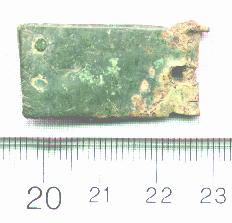 |
(9 KB) A utilitarian bronze belt buckle plate. This plate was wrapped around the buckle and
rivited to the leather belt, allowing the buckle to swing. Part of the buckle and some
of the belt leather remain. Circa 14th Century from Dorset, England. |
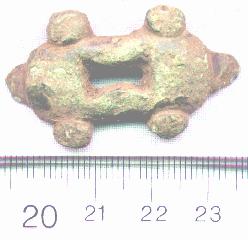 |
(10 KB) The bronze handle guard (quillon) from a kidney
dagger of the type popular in Europe in the late 14th Century. This one was found in
Hampshire, England. |
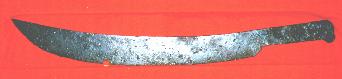 |
(13 KB) The iron blade from a short sabre of the kind attributed to the Hungarian
cavalry of the turbulent 12th and 13th Centuries. This blade is 53 cm long
and dates from around the time the Mongols overran eastern Europe. The wooden handle
has long since disappeared but the 3 rivets remain. The blade was excavated from a site in southeastern Bavaria. |
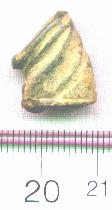 |
(5 KB) An interesting bronze knife pommel (end cap) in the shape of a horse's hoof. This pommel dates from
the period of the English Civil War (circa 1650 AD). Ornate knife pommels such as this are rare, having been limited to the higher
priced knives owned by persons of wealth. This example is from Dorset, England. |