|
Karsten's WebSeum Pre-medieval gallery 
This gallery features artifacts from civilizations pre-dating the middle ages. There is a focus on Roman, Egyptian and Celtic cultures. New items will be added as quickly as possible. All scales are in centimeters. Click the image for a larger view. |
| Pre-Roman (prehistoric, celtic, etc...) | |
|---|---|
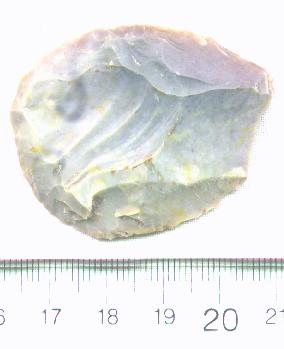 |
(11 KB) A chert (flint) thumbnail scraper from the Cissbury Hill Fort in Sussex, England. Pre-iron age cultures would have made use of natural materials for utensils. Chert, like obsidian, can be chipped to a fine cutting or scraping edge. Circa 200-1500 BC. |
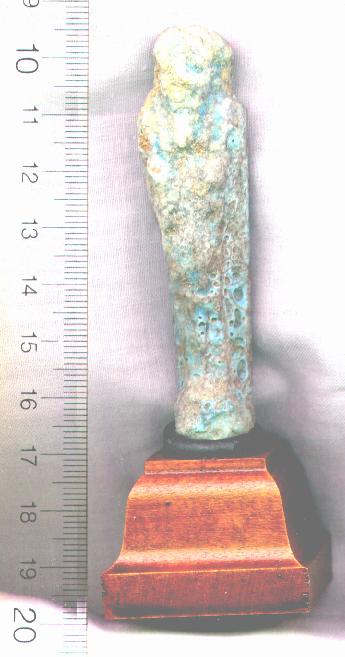 |
(32 KB) Green glazed Egyptian ushabti wielding a crook and flail. From the Ptolemaic Period (332-30 BC). It is held that Egyptians believed that the dead had to work in the afterworld, unless they had substitutes. Ushabtis were placed in the tomb to do the work of the deceased. It was common to have one ushabti for each day of the year. Ushabti wielding a crook and flail are thought to be overseers. |
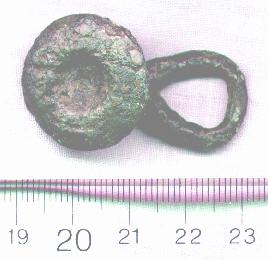 |
(12 KB) Very large, Celtic bronze toggle-type cloak fastener with an indentation for a stone or jewel. It is likely that this piece was used to fasten a heavy cloak. From England circa 1st Century BC. |
| Roman (1st to 5th Century AD) | |
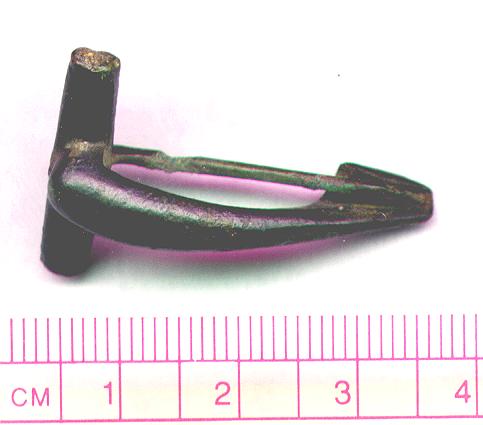 |
(21KB) A beautiful bronze brooch as worn by the Romans during the 1st and 2nd Centuries AD. The Romans commonly designed implements of daily life with animal motifs. The dolphin and dolphin-derivative (like this one) brooches were often cast in the shape of the dolphin. This one was found in Lincolnshire, England and still has its pin intact as well as a nice dark green patina. |
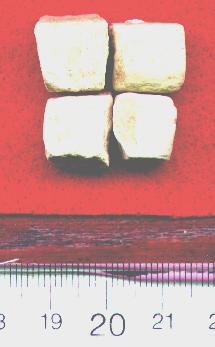 |
(10 KB) A set of 4 tesserae (paving stones) originally forming part of the ornate pavement at a Roman villa near Gloucester, England. Circa 2nd Century AD. |
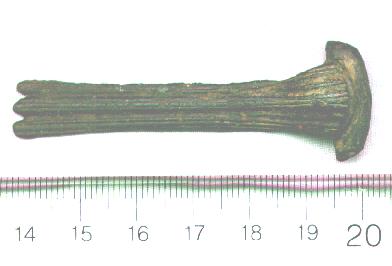 |
(11 KB) An exquisite bronze Langton Down brooch with a stylized bow and traces of enameling. This brooch is named after the place where the first of its type was found. This rather substantial brooch would have been used to fasten heavier clothing. This one was found in Dorset, England, and dates to the 1st Century AD. |
| Dark Ages Anglo-Saxon and Viking (6th-10th Centuries) | |
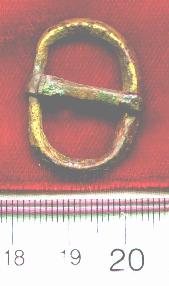 |
(8 KB) An Anglo-Saxon bronze strap buckle complete with pin. Judging by the number of this type of buckle being found by metal detectorists, this was a very common style in 8th Century AD England. This buckle was found in Dorset, England. |
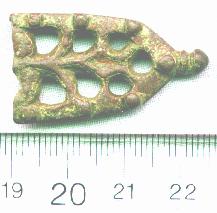 |
(10 KB) A fantastic Viking strap-end. In bronze, this strap-end depicts the tree of life, an image at the very heart of Viking culture. This strap-end was found in Lincolnshire, England and dates to around 900 AD, around the time of Viking settlements in England. |