

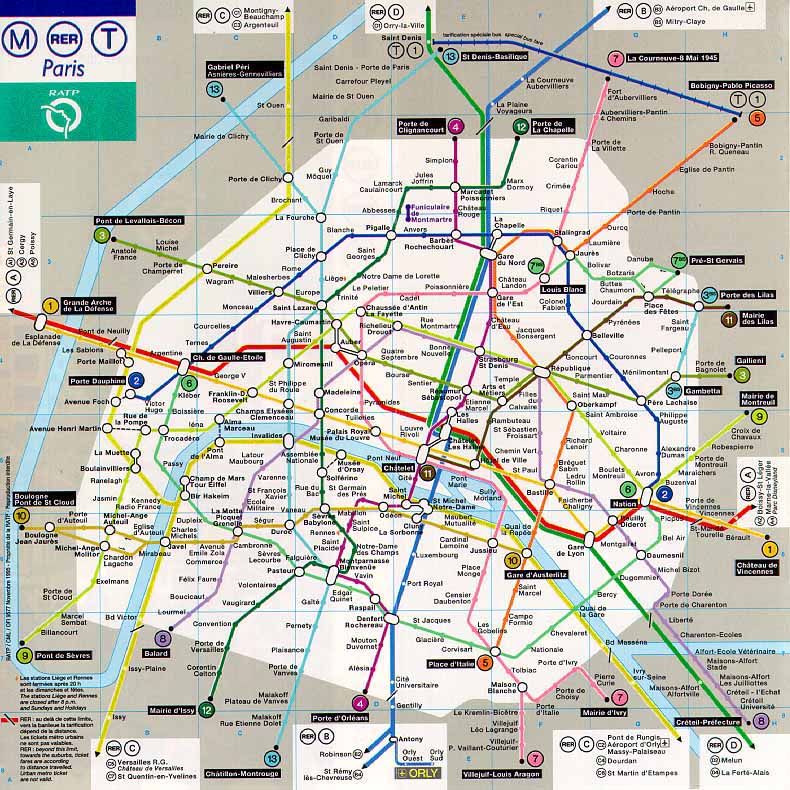
Inaugurated in 1898, the Paris Métropolitain (le métro) is one of the world's oldest and most efficient subway system, able to whisk you within walking distance of nearly any spot in the city. Stations are marked with an "M" or the "Métropolitain" in lettering designed by Art Nouveau pioneer Hector Guimard. Trains run frequently and connections are easy. The first trains start running at 5am; they last leave the end-of-the-line stations (the portes de Paris) for the center of the city at 12:15am. The one exception is the last train leaving from Porte de Balard; it does not travel the length of the line to Porte de Charenton but only goes as far as République. For the exact departure times of the last trains from the portes, check the poster in the center of each station marked Principes de Tarification (fare guidelines).
Free pocket-sized métro maps are available in most stations.
Transportation maps are posted on train platforms and near turnstiles;
all have a plan du quartier (map of the surrounding neighborhood).
Connections to other lines are indicated by orange "corrrespondance"
signs, and the exits by blue "sortie" signs. Métro
lines are numbered (1 is the oldest), but reffered to by their final destination.
Transfers to other lines are free is made in the same station, but it is
not always possible to reverse direction on the same line with out exiting
the station and using another ticket. Click on the icon above "plan
du métro" for a full-sized map of the Métro system.
Individual Métro ticket is 7.50F; packet of 10 tickets (a Carnet)
is slightly more reasonable. Cost of RER tickets depends on distance traveled.
Within central Paris cost is the same as Métro tickets, and the
same ticket is also valid on both systems. Both the Métro and the
RER (Réseau Express Régional) are run by the RATP
- Régie Autonome des Transports Parisiens. The RATP also
runs the busses.
Les Liens de Métro


Le Page du Métropolitain / Le Café Francophile, Copyright ©1996-1999 Rachel L. Doner. Tous droits réservés.
