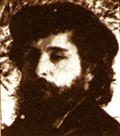
Claude Monet
1840 - 1926
Probably, the most typical Impressionist painter. Monet began his career as a caricaturist, summing up his subjects with the same economy he later used in rendering the fleeting effects of light and colour in nature. Introduced to open air, painting by the French artist Boudin, Monet rapidly developed as a landscape oil painter. His first major figure painting, Déjeuner sur l'herbe, painted 1865 to 1866, was a re-working with natural light effects of Manet's painting of the same title. Monet continued to paint figures but they never dominated his work. Monet was also influenced by and appreciated the bright colours, high viewpoint and interlocking, assymetrical compositions of Japanese prints.
Sincerity and spontaneity in the rendering of nature were crucial ideals of Impressionism and, by the late 1860s, Monet, working with Renoir, was developing the techniques and speed needed to represent fleeting outdoor effects. Few of his paintings were finished in a single sitting; often he got no further than a rough blocking-in before the scene relatively changed, the work then being completed in subsequent sittings. Monet mainly used tinted, pale grounds, particularly greys, cream and beige. He prefer a thin layer of preparation which left the canvas grain exposed. Over this he dragged dry, stiffish paint from which, like Degas, he had first soaked the oil binder, to create ragged vibrant flicherings or colour across the surface. His colours, like his ready-prepared canvases, were bought ready made, as the mechanization of paint grinding was commonplace for artists' colours from the 1830s. Collapsible tin tubes, invented in Britain in 1840, had been introduced in France but in 1855 still cost more than the traditional paint bladders. While the lack of tin tubes had not deterred earlier outdoor oil painters, their invention clearly simplified their work.
Monet's pale grounds and opaque paint layer were combined to create a scintillating representation of transient outdoor light. Until the late 1880s, he preferred to paint in full midday light or shadowless overcast skies, thus avoiding strong shadows and tonal contrasts, so his use of light effects promoted a brilliant two-dimensionality. Monet's painting increasingly concentrated upon capturing coloured, atmospheric light and reflections.

Claude Monet. Effet d'Automne à Argenteuil (Autumn at Argenteuil). Oil on canvas. 1873.
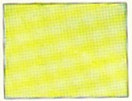
1. A pale ground was applied to a fine-weave canvas allowing the texture to show through.
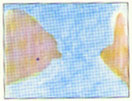
2. Broad areas of local colour were blocked in using a thin scumbled paint.
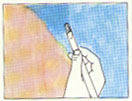
3. The irregular build-up of the opaque paint layer allowed the original blocking-in to remain visible in places.
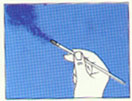
4. Wet paint was applied into wet or over dry to blend the colours.
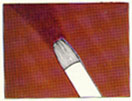
5. Stiff, dry paint was dragged across the surface in broad strokes of wet over dry creating a latticed web of colour.
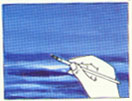
6. Reflections and water were achieved by this same opaque layering technique rather than the more traditional opposition of opaque highlights and transparent glazes.
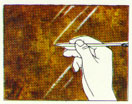
7. Textures were differentiated by varied brushwork. Impasto layers were lightened by scratching through using the wooden end of the brush to expose the pale ground.