Max Ernst
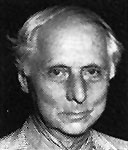
1891 - 1976
Max Ernst, one of the leading artists in both the Dada and Surrealist movements, can be regarded as perhaps the major technical innovator in twentieth century painting. He adapted and invented a vhole variety of techniques. Vox Angelica, painted in Arizona en 1943 during his exile from Europe, summarizes his various often picturesquely named, techniques -collage, illusionism, frottage, grattage, decalcomania and oscillation.
Ernst's first major technical contribution came in 1919 with his adaptation of collage to the transformation of commercial catalogue sources. His first actual "invention" was frotage, with which he experimented in Cologne in 1920 and 1921, and then developed in France in 1925 in response to the 1924 First Surrealist Manifesto by the poet Andrè Breton. Ernst's description of frottage conveys something of the spirit which accompanied the invention. When sitting in a seaside inn, Ernst became "obsessed" by the appearance of the well-scrubbed floorboards, so, in his words, "to assist my contemplative and hallucinatory faculties, I took a series of drawings from the floorboards by covering them at ramdom with sheets of paper which I rubbed with a soft pencil". Frottage, which Ernst used extensively, is a drawing technique. In the winter of 1926 to 1927, Ernst adapted it to painting in a technique he called grattage, which involves scraping pigment over canvas placed on a heavily textured surface. The next significant automatic technique came a decade later with the invention of decalcomania by the Spanish Surrealist artist Oscar Dominguez. This technique involved painting gouache onto a piece of paper, covering it with another sheet and pressing it lightly with the hand. Next, the top sheet was peeled off slowly, like a transfer, and the process repeated until the colour was almost dry. During 1939, Ernst experimented with a similar technique using oil paint and canvas. Ernst's last -and least successful- technical innovation was oscillation, in which a paint-filled tin can was suspended from a piece of thread or string and swung in varying directions over a flat piece of canvas. The Surrealist automatic techniques sought to eliminate the conscious element from the performance of the pen or brush as a way of stimulating or forcing the artist's inspiration.
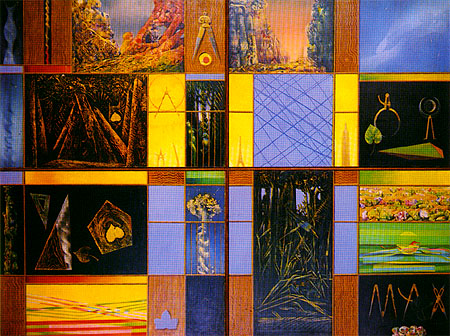
Vox Angelica - by Max Ernst - 1943.
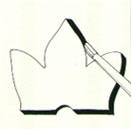
Vox Angelica sums up all the main techniques with which Ernst was
associated. Collage is referred to parodistically in the illusionistic
painting of the leaf, for example, which has been painted so that it
appears to be stuck on.
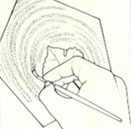
Frottage also features in a parodistic way. The appearance of floor-
boards was created by painting rather than by rubbing through paper
with a soft pencil.
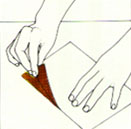
Ernst adapted the technique of decalcomania. The technique involves
pressing a sheet of paper or similar material on to the paint-covered
surface and peeling the sheet off again.
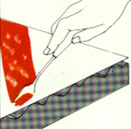
Grattage involves scraping pigment over canvas which has been placed
on a heavily textured surface.
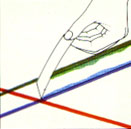
Ernst may have used adhesive tapes to create the straight, overlapping lines.
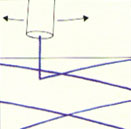
Oscillation involves paint being dripped from a can swung on the end of a
piece of string.
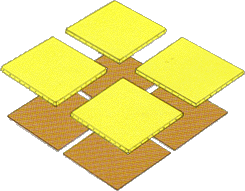
Vox Angelica was painted on four canvases assembled in the same way as
had been the parts of Grünewald's masterpiece, the Isenheim Altarpiece
from a section of which Ernst's work took its name.