Diego Velázquez
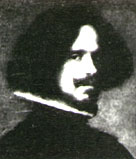
Diego Rodriguez de Silva Velazquez was born in 1599 in Seville where he lived and worked until 1623 when he was offered a post at the court of Philip IV in Madrid. Velazquez remained attached to the court until his death in 1660, but made several trips to Italy where he paid particular attention to the works of Venetian painters.
Velazquez has been a source of influence and inspiration to many artists, including his fellow countryman, Goya, more than one hundred years later, and, later still, the French Impressionist Edouard Manet in the nineteenth century. The earlier paintings of Velazquez are reminiscent of Caravaggio in their treatment of light and shade, handling of paint and attention to realistic detail. Velazquez always leaned towards a dark and dramatic style of painting. Even in his early genre paintings however. Velazquez also showed the dispassionate and objective vision which was characteristic of him.
Although few preparatory drawings of Velazquez's paintings exist, it is probable that some were made. Preliminary studies in oil were often done. This is seen in the care and detail with which many of Velazquez's paintings are executed. Many of Velazquez's canvases show that he frequently made minor alterations during painting. As he painted, he frequently wiped his brush clean on the canvas, which he later covered over as can be seen in some of his early pictures.
Velazquez probably tempered his pigments with linseed oil of a reasonably fluid consistency, only using a thicher medium for dabs of highlight. The smooth, blended brushwork in many of Velazquez's paintings indicate that, like Caravaggio, Velazquez preferred to use soft hair brushes rather than coarse bristle ones.
Velazquez's technique changed considerably during his career. By the time he was painting portraits of Philip IV of Spain in Madrid in the 1630s, his palette had become somewhat cooler in tone and his handling of paint freer, as he developed a technique of using light, feathery strokes of paint.
"The Water Seller of Seville" was painted in Seville around 1620. It was one of a series of works featuring ordinary people, eating and drinking in dark interiors. Such scenes, known as "Bodegones", were popular in seventeenth century Spain.
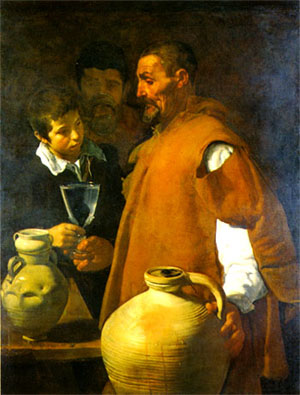
"The Water Seller of Seville" - 1620 - Diego Velazquez - oil on canvas 42x31 4/5 in.

1. Velazquez often chose fine, regular weave canvas which he
covered with a dark brown ground using a palette knife.
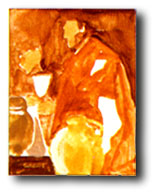
2. The main composition and areas of light and dark
would be blocked in using a fairly large bristle brush.
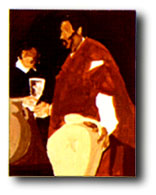
3. Using softer brushes, Velazquez would develop the
somewhat roughly applied large areas of colour.
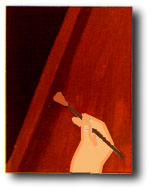
4. The softness of the water seller's tunic suggests that
Velazquez went over the area with a blending brush.
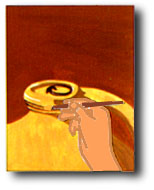
5. Small details like the ridges on the pitchers, would be added
with a fine pointed brush probably made of ermine or stoat.
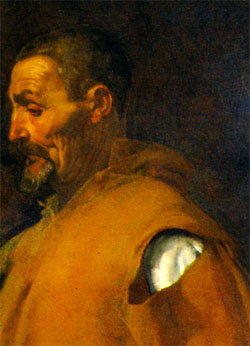
This detail is a good example of Velazquez's study of the play of light on the weathered skin of the water seller. The whole face was painted quite thickly, but the highlights on the nose and forehead were picked out with thicker oil paint than the rest of the face. The upper paint layer of the collar of the tunic has become transparent with time, to reveal the smaller first collar underneath..
If you wish a more detailed picture of "The Water Seller of Seville", please send an email, and I will give it to you in jpeg format, and of course, completely free. : )