|
Sunday,
September 5, 1999 -- Vol. 1, No. 3
"Boys, you're gonna be ridin' a thousand miles day and
night" |
|
| SHHH!! SECRET SANTA!! |
|
What is Secret Santa?
Secret Santa is where you receive an e-mail friend’s name to buy them a gift(s) for
Christmas!
Why is it a Secret? So that the person who
receives the gift(s) is surprised by whom it is from as well as by being surprised by the
gift(s).
When is the Deadline? The deadline for
joining Secret Santa is Oct. 31. This is so that there will be plenty of
time for everyone to buy a gift(s) for their e-mail friend, and to mail it to them, so
they will receive the gift(s) before Christmas.
How will Secret Santa be Accomplished? Numbers
will be drawn by Ella, and Scott will match the numbers. Only Scott will know what friend
got who. He will then send you an e-mail letting you know who you are to buy a gift(s)
for.
What do you need to do to Participate?
All you need to do is send your name, mailing address
and things that you like (to give a friend some ideas of what to get
you), and choose a number between 0-100. If by chance
you should choose a number that someone else has already chosen, Scott will e-mail you
telling you to choose another number.
Where do I need to send this Information?
You will send it to Scott at [email protected].
How Much do I have to spend on a Christmas
gift(s)? The amount is limited to $10.00 to $15.00.
Beside the gift(s) you send your friend, you must also
include a little story describing the gift(s) that you and a Young Rider decided to choose
for your friend. Send the story along with your gift to your friend. If you don’t
have a printer, then this is what you can do. Put a note in with your gift(s) telling your
friend that you don’t have a printer, and also tell them to let you know when they
have received the gift(s), so that you may e-mail them your story.
After Christmas, please send your story to Ella, so that
she may print them in an issue of PEG. Also, after you receive your gift(s), you can add a
little part in response to the story you receive. |
|
| Outback
Tales |
By
MAJA
A DAY ON THE STATION
A typical day on our station starts early in the
morning. I usually rise at about 4.30 a.m. and swim some laps of the pool before I
start the coffee pot then shower and dress for the day. By the time I get back to
the kitchen I have time to pour myself a cup of coffee and sit on the porch (we call them
verandahs here) and watch the sunrise on the distant horizon. Breakfast is usually a huge
affair all thirteen of us (since Josh is living here now too). It's a big
meal usually consisting of cereal or rolled oats in winter, then bacon, eggs, grilled
tomato, sometimes even steak and toast, then fruit and coffee. The boss's wife packs
everyone a packed lunch of sandwiches, tinned fruit and chilled thermos of ice water
which we all take in esky's in our cehicles or our saddle bags.
There are many tasks that fill the day for the jackaroos on such a large station, every
day, just not always on their horses. Much as I hate to say it the days of a jackaroo
depending on his horse are numbered, these days they use small choppers, trail bikes and
trikes that look like small dune buggies. My boss, the owner of the station, tries to keep
his staff working in the traditional manner by alllowing us to use our horses whenever we
can instead of the faster mechanical techniques.
As assistant manager, I usually spend at least part of my morning doing some of the
accounts and assisting the boss with the future planning for the herd and the bloodline of
our stock. The boys spend their days working the stock, mending fences, doing
carpentry work around the station, repairing the machinery and any other tasks that
require attention. We have just started to run horses on our station and we also have a
small flock of emus which we are experimenting with farming. This is teamed with our
lucrative cattle operation to make the station quite a profitable operation.
In the afternoon, I usually spend my time working with the horses, which is
quickly becoming my part of the operation. For the last few years, it has been a
worthwhile task for us to round up the brumbies (wild horses) that run on our station,
breaking the most promising horses and selling them at auction. I love to work with them,
there is so much power and intelligence in a wild horse, it takes a lot to bring a horse
to saddle, I don't like to call it breaking them. There is no joy in breaking the will of
such a beautiful powerful creature. It is much more satisfying to get inside their mind
and get them to work with you. That is the true testament to the skill and talent of
the horsebreaker.
Tea (or evening meal) is usually served at about 6 p.m. and is usually soup or chilli,
followed by a steak and three veges meal, and usually pie and ice cream or the cook's
specialty Lime Pie for desert. It might seem like we eat a lot on the station, but
we all work hard and physically usually working up a huge apetite. The majority of
our fresh fruit and veges are grown on the station, we slaughter our own meat and
chickens, farm our own eggs, the cook even bakes our own bread, biscuits and cakes.
The evening is spent in a variety of ways. I like to watch my TYR tapes,
some of the boys play cards, scrabble is a favorite of ours, one of the boys plays a mean
guitar and sings not bad country music. After a long day or a lot of hard but fulfilling
work, bedtime is often not much later then 8 or 9 p.m. |
|
| Cody's Contest! |
 |
By Lynn's request I'm posting the winner of the Kid & Lou contest.
It's "First Night of Love" by Lisa R located at TYR's Bedtime Stories website!
Congratulations, Lisa!!!!
|
|
|
 |
| Rock Creek
Barn |
Rock Creek |
Rock
Creek Station, Nebraska |
By
Lyn
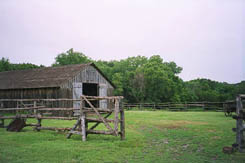
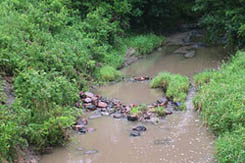
This was a trip that had been in the back of my mind for at least six
months, after finding a pamphlet on the State Park during a visit to the Pony Express
Museum in St. Joseph. I received an unexpected day off from work and decided to go,
despite the predicted rain for the afternoon.
 |
Rock Creek Bunkhouse |
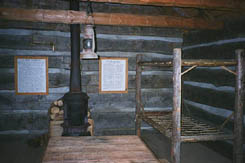
The Rock Creek Station is located south of Lincoln,
between Beatrice and Fairbury, just south of a small town called Jansen (population 124).
It took me just a little over two hours to get there, which will probably be shortened now
that I know how to get there. It’s not clearly marked.
The State Park has a picnic area, and camp- ground
facilities for trailers, tents and horses, and includes a horse trail for their use. But
of course I was there for the history. After buying my park permit I was allowed to walk
through the museum and watch a 15-minute video. The video covered the history of the
station and it’s most notable occupant, James Butler Hikock. It also talked about the
restoration process and rebuilding of the station itself.
They had some wonderful display cases with artifacts
found during the archaeological dig and others donated from around the area. Other cases
were dedicated to David McCanles and his family (one of his descendants is an astronaut).
He’s the man who sold the East branch of the station to Russell, Majors and Waddell.
He’s also the man James Butler Hickock shot.
The story goes that McCanles sold the East branch of the
station to the Pony Express, but retained the West branch, which is where he lived and ran
a toll bridge from. As the Pony Express floundered monetarily, they failed to finish
paying him for the land. McCanles, his son Monroe, and two of his employees tried to
collect the money from stationmaster Horace Wellman. It was during a confrontation that
Hikock shot McCanles and his two employees. Monroe managed to escape and run home.
There are two basic stories as to the actual killings,
the most common being that Hickock shot an unarmed McCanles when the man was just trying
to negotiate payment, basically an ambush. Hickock’s story was one of self-defense.
Rock Creek was not a town like The Young Riders shows
it. It was a stopover for both the Pony Express and stage lines. It was also a stop on the
Oregon Trail. You can still see the ruts worn in the ground by hundreds and thousands of
wagons traveling the Trail. |
|
| Teaspoon's Travels |
Just the facts,
ma'am |
| Research Adds Realism To Your
Stories |
By Stacie
To learn interesting facts and/or do research for
the Young Rider Era, you should check out the Mathis Library site at http://redrival.com/mathias/index.html.
It contains many historical facts on different topics including Daily Life, Pony
Express, Native Americans, Historic People, Civil War, Medicine and Health,
Transportation, Architecture, Timelines, Maps, and everybody's favorite,
TYR. The Nature, Animals, and Writing Aids are still under construction.
To see how much you know about the Old West, check out
Lou's article and see how well you do. |
|
| Lou's Lies |
| Can You Separate Old
West Fact From Fiction? |
|
|
|
True or False? 1.
Red was a common color for schoolhouses because it was so popular.
2. In case someone out there is not sure what is meant by 'outhouse',
an outhouse is an outdoor 'loo', a place to take care of nature's bodily functions once
you've outgrown diapers that is.
3. What did they use for bathroom tissue? They used
leaves, plant material and corn cobs.
4. All grave markers were made of stone because bronze
wasn’t durable against the elements and it was more expensive.
5. As one walks through a graveyard, reading the inscriptions on the
stones, one can not help but find story inspirations.
6. Men do not drink alone or drink at home. They drink
in a saloon because they need each other’s company, even if only to pick a fight.
7. The old tale, however, that respectable women always entered the
western saloon has to be taken with more than a grain of salt.
8. Most cowboys only drank fancy or mixed drinks. Those who drank
straight stuff—rye or bourbon were said to have an "educated thirst."
9. Soldiers were not welcome in the saloon because of three reasons:
the cowpuncher suspected the soldier of veneral disease, resentment because they policed
the early West and because the cowpuncher despised any man who had to obey and stand at
attention.
10. Another custom prevailing at the bar was to address a man by his
"full name", and to find out where he came from. Curiosity was polite and
healthy.
Answers in the next issue! |
|
|