
And Beyond

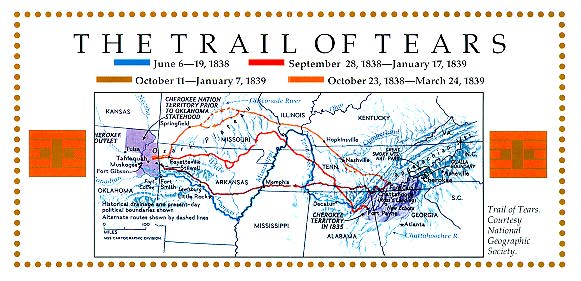
After the Removal Act of 1830 and all the fighting the Cherokee did to preserve their homelands failed, they were herded into the stockades the U.S. Army had set up to hold them until the drought was over and they could make the long journey to the Indian Territory.
The Army comanded 13 seperate groups of Cherokee and the government also hired out to contractors who were paid $65.00 for each person in their care. The money was to be used for food and medicine that was needed along the trail- though little of it was. Two groups traveled by river and the others made their miserable treck by land, across Tennesee, Kentucky, Illinois, and Missourri until their 1000 mile journey landed them in the Indian Territory- that is, those who survived. Reports have stated that Cholera broke out in one group and people were dying hourly. Out of another group, it was reported that only 489 people out of 800 survived the journey. And yet another group that traveled by river reported that 311 people drowned when an overloaded flat boat capsized. I have heard many different numbers, but the most common is between 1/4 and 1/3 of the Cherokee Nation parished on The Trail and another 1500 people died while in confinement in the stockades. Most were not even allowed to give their dead ones a proper ceremony. The majority of the people who died were left on the sid eof the trail. This distinct torture of these proud and prominent people, as far as I am concerned, is one of the most hideous things that took place in our history.
Even after all they endured, the Cherokee Nation did not falter in their new land. As soon as they reached the Indian Territory, they set to work building houses, schools, and churches. They set up their government and called their capital Tahlequah. Tahlequah is till, today, the cultural center of the Cherokee Nation and the one source for the documented evidence of their history.
Just as they were forming the new nation and rebuilding themselves as a people the Civil War began along with a whole new set of problems. Some Cherokees fought for the North while others fought for the South, though to the U.S. Government, the whole Nation was aligned with the confederacy. The South had promised the Cherokee if they won the war, they would be allowed to for an "all Indian state". So, when they South surrendered to the North, the Cherokees were penalized like the South. More than half their land in the Indian Territory, that was guaranteed by the "perpetual treaty" was taken from them. The land that was left was nothing but war-scorched earth, not fit for anything or anyone to inhabit.
The Indian territory and the Cherokee Nation became nothing more than history when Oklahoma became a state in 1907. The people found themselves, once again, being forced to abandon their age-old practice of "common ownership". They were forced to live by the white man's rules of private enterprise. For some it worked, for others it didn't. Some thrived among the white man and others succombed to the alcoholism and poverty that surrounded them.
Contrary to popular belief, the Cherokee Nation is still alive and well today. They continue to be a proud and productive people and can be found in the United Keetowah Band of Cherokee indians in Oklahoma and in the Eastern Band of Cherokee Indians in western North Carolina.


For more about me!!
My Tribute To Lane Frost
My Outlaws of the American West Page

Thank You to Lady Kali for this beautiful background!!
Visit her many creative pages!!


This page hosted by

Get your own Free Home Page
