

She'll never be 'King of the Road,' but she's
By Country America Senior Entertainment Editor Neil Pond
already 'Queen of the Row'
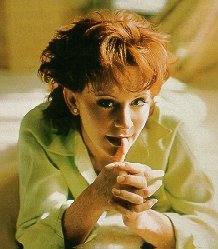
"Every time I see you," she says, "you've got a smaller recorder."
I've interviewed Reba about a dozen times throughout the years, a period of time during which tape recorders, it's true, have gotten increasingly compact.
"Well, every time I see you," I tell her, "you've got smaller hair."
Reba laughs and nods her head--which happens to be sporting the shortest, sassiest haircut she's ever worn. "A lot of people liked my long hair," she admits. "But it was getting unhealthy and kind of scraggly." She says her hormones kicked in after her pregnancy with son Shelby, eight years ago, rewiring her hair circuits and making it grow bigger, thicker and wilder. Finally, Reba decided she'd had enough. No more big hair. In a series of increasingly shorter cuts, her once-raging follicle forest was downsized to a mere patch of thatch.
"It looked healthier when I cut it first to my shoulders, then to my ears, and now this. It's a really short, drastic cut, but I like it the best." Fan response has been positive. But there's one fan in particular, she feels, who'll probably take the new look harder than most. "The woman who had me, big hair and all, tattooed on her back," says Reba with a sympathetic smile. "She's going to be sick."
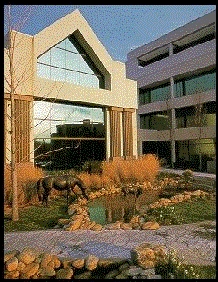 Reba's hair certainly isn't the only thing that's changed about her since she made
her debut on the charts back in 1978. She came to Nashville as an outsider--an
Oklahoma ranch wife--and a greenhorn to the industry. Today, she's the corporate
figurehead of a Music Row empire that handles every management aspect of her
own career and offers professional services for other music-biz clients. Just as her
Starstruck Entertainment office building became an architectural gem on Music
Row when it opened in 1996, so has Reba herself ascended to a place of respect,
prominence and power.
Reba's hair certainly isn't the only thing that's changed about her since she made
her debut on the charts back in 1978. She came to Nashville as an outsider--an
Oklahoma ranch wife--and a greenhorn to the industry. Today, she's the corporate
figurehead of a Music Row empire that handles every management aspect of her
own career and offers professional services for other music-biz clients. Just as her
Starstruck Entertainment office building became an architectural gem on Music
Row when it opened in 1996, so has Reba herself ascended to a place of respect,
prominence and power.
"She's always been this presence, you know, at the helm of women in country music," says fellow entertainer Martina McBride.
"I always feel like she's our leader."
"She's just always seemed to be the epitome of class and style, and yet really down to earth. For as long as I can remember, she's been on top, the biggest female star in country music. If you could aspire to any level, Reba was as big as you could get."
Trisha Yearwood is another star who followed Reba's footsteps to Nashville. "She was also a small-town girl with a big dream and no contacts in the music business, and I was inspired by her determination," says Trisha. "I felt like, if Reba did it, I can, too."
As Reba's resolution to succeed inspired others, it also led her to greener pastures of stardom outside Nashville's traditional parameters. In addition to her forays into Hollywood, Reba also recorded music that blurred the boundary between country and pop, and her lavish, theatrical concerts often seemed closer to Broadway than Nashville. These flights of ambition left some people wondering: Has Reba forgotten who--and what--brought her to the dance?
"I don't care if people think I'm pop, country, rock and roll, whatever," she says, "because when I sing, it's going to be country. I'm a very country person. I'm very proud of my country roots. And I am a country singer."
Trisha and Martina, both of whom appeared with Reba on the song and in the video for her 1995 hit "On My Own," rise up in support of Reba's right to occasionally color outside the lines. "She's Reba McEntire, and she's earned the right to do whatever she wants to do as an artist," states Martina. "She's obviously been very true to country music for a long, long time, and for someone to accuse her of trying to forsake it is very small-minded."
"You get to be Reba McEntire by taking risks, in your live show, in your choices as an entertainer," adds Trisha. "Being different always draws criticism, yet being different is what makes you special. I respect any artist who follows their heart, and Reba's always done that."
Reba admits that some of her pure-country fans have occasionally voiced disapproval as she's pushed country's envelope. "Some of my more traditional fans will say, you know, 'You're leaving country.' Why would I want to leave country?!" she says with a look of exasperation. She says she never straddles the country/pop fence because she longs to hop over. She straddles it to invite--or even entice--pop fans over to her side.
"If there's a huge pop fan out there who hears me sing and likes one of my songs, I've accomplished something," she says. "I have broadened my audience, and I'm always striving to do that."
"Country is not what country was 20 years ago, it's a
very broad spectrum, and I'm glad of that."
Reba can speak with authority about country music yesterday and today because
she's experienced both eras first-hand. No other country entertainer consistently
on the charts today had hit records as long ago as she did. Her first charted hit,
"Three Sheets in the Wind," was in 1978--before Garth Brooks, before George
Strait and long before any of the current crop of mega-selling women came along.
And other superstars of the '80s, like Kenny Rogers and Dolly Parton, haven't
matched anything near Reba's multi-platinum success in the '90s.
One of the keys to her professional longevity, she feels, is the fact that her career
has been marked by a series of small, incremental decisions that each built upon
the other. "Everything has been a little step up," says Reba. "Nothing in my career
has been a big leap." Sometimes, too, she's simply had to let her instincts rule.
"You think, 'Man, we're wasting time here.' But you go ahead and do it, because
something is saying, 'Go do it.'"
Then she got the call, some weeks later, from the producers of a movie called
Tremors. They wanted her for the film, based on seeing her that night on Sajak's
doomed show. Tremors became Reba's first movie, and it got her foot in
Hollywood's door. She's gone on to do eight made-for-television or
theatrical-release movies.
"You just never know," she says. "Little steps. Little steps all the way."
Reba has also taken little steps with her physical
appearance throughout the years, in fashion, hairstyles
and even cosmetic surgery--though she politely refuses to
divulge details. It's partly vanity, she admits, but also
partly occupational necessity.
"Man, if I didn't have a career, I'd probably weigh five
hundred pounds, because I love to eat," she says.
"I wake up in the morningthinking, 'What can I eat?' My regimen is so strict now. It's fruits and
vegetables
and a little bit of carbohydrates from midnight to lunch. That's a vanity
thing--because when I get on stage, I want to look thinner.
"When I was younger, I was competing with
Tammy and Barbara and Dolly and Tina Turner
and
everybody else. And now that I'm 20 years
older, I'm still competing--for a movie
or a stage show or a person's attention, along
with Shania and LeAnn Rimes,
who's 15 years old�Lord, I could be her
grandmother! We're all in competition. I
have to stay appealing to the public, not only
audio-wise, but visually."
Both on store shelves and on stage, it's going to
be a big summer for Reba. She's
got a new album, If You See Him, which hits the
stores June 2. Its title track is a
powerhouse duet with Brooks & Dunn. You'll
be able to see them perform it
together all over the place this summer, as the
two acts have once again teamed up
for a blockbuster tour. And, as anyone who's seen Reba in concert knows, she
aims high--and delivers.
Read more of Neil Pond's personal interview with Reba in the current issue of
Country America. This country diva talks about her home life with son Shelby
and husband Narvel, about her feelings on winning country music awards and
on plans for the future. Plus, learn about why Reba decided to turn down a plum
role in the blockbuster movie Titanic.
 She got pegged for her first movie role, for instance, after deciding to follow
through on that very go-do-it instinct. Booked on Pat Sajak's floundering
television talk show in 1989, she learned that same day that the series, suffering
from awful ratings, was to be cancelled. In other words, practically no one was
watching the show. But Reba guested that night anyway; she'd been taught by her
hard-working, ranch-tending parents that once you say you'll do something, you
by-gum do it.
She got pegged for her first movie role, for instance, after deciding to follow
through on that very go-do-it instinct. Booked on Pat Sajak's floundering
television talk show in 1989, she learned that same day that the series, suffering
from awful ratings, was to be cancelled. In other words, practically no one was
watching the show. But Reba guested that night anyway; she'd been taught by her
hard-working, ranch-tending parents that once you say you'll do something, you
by-gum do it.