
Every Day in Tennessee History
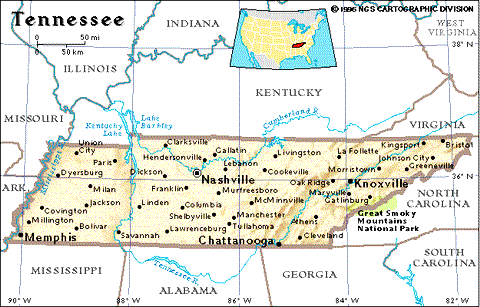
Excerpts for January:
JANUARY 1
1863, Stones River Battlefield. After one day�s fighting James B. Mitchell of the 34th Alabama Regiment of Infantry noted the grim aftermath of battle in his journal:
"There was a great deal of pilfering performed on the dead bodies of the Yankees by our men. Some of them [Federals] were left as naked as the day they were born, everything in the world the had being taken from them.
I ordered my men to take their fine guns and canteens if they wished, but nothing else. The only think I took was fine canteen which I cut off a dead Yankee who was lying on his face in our path as we marched along.
Thomas Jefferson Walker, a Haywood County native and member of Company C of the 9th Tennessee Infantry left this horrifying anecdote about the Battle of Stones River:
While we were lying in the rear of our first line of battle, a soldier was shot, and in his death struggle it sounded just like the death squeal of a hog that had been struck in the head with an ax! Our whole line burst out into a great roar of laughter, although men were being shot and killed every few moments in our own ranks!"
1877, Nashville. In his message to the legislature Governor James Davis Porter drew attention to five commissioners appointed by Resolution No. 52 in the 39th legislature. They, Messrs. Bronson, Bayless, Albert Akers, Nathan Adams land Volneuy S. Stevenson were sent to Paris, France, to attend the Geographical Congress and Syndicate of Trades in August 1875. They had not yet made a report, although through them Tennessee received a certificate of participation. There seems to be no readily accessible document to identify the five commissioners nor to shed light upon their activities in Paris at the Congress. Perhaps they were well connected men who went to France on a pleasure junket at the State's expense.
1893, Nashville. African-Americans celebrated the thirtieth anniversary of the Emancipation Declaration with a parade, a trade display and banquet at St. John's Methodist Church.
1895, Memphis. Activity was high at the Shelby County Court but the hustle and bustle was explained by the Clerk: "New Year's Day is a red-letter day in divorce circles. There are two classes of people who get divorces. One is the class that thinks it can do better if it tries again: the other knows it can do worse and don't care much anyway."
JANUARY 2
1792, Knoxville. An advertisement in the Knoxville Gazette read: "DRUMMER BOY, fond of whisky. Run off from the Malitia [sic], his Captain will pay $10 reward for his return, or will be pleased if he is kept in jail until payment can be made."
1869, Shelbyville, Bedford County. A fierce battle was waged in the city between 60 masked riders, aged from 16 to 20, and African-Americans who defended their school and school teacher, John T. Dunlap. A frenzied gun battle raged for five minutes in which the riders got the worst of the bargain, losing three wounded, one killed and a number of horses. Dunlap had been taken from his home by the Ku Klux Klan some four months earlier and whipped. The Negro school was large and flourishing. Many locals feared Dunlap was indoctrinating the Negroes with Radical Republican principles and so the attempted burning of the school took place. Blacks were forewarned and so were forearmed. Their courage in the face of the night riders has been unheralded until now. Opinion in Shelbyville regarded the battle as "an inexcusable outrage," according the Nashville Republican Banner of January 7.
1966, Nashville. A three judge Federal panel ruled unconstitutional today a Tennessee law banning nudist camps. District Judge Robert L. Taylor of Knoxville and Judge Harry Phillps of Nashville, a member of the U.S. Court of Appeals for the Sixth Curcuit wrote the majority opinion. They held that the statute passed in 1965 was "too vague and indefinite to comply with the due-process-of-law provisions" of the Fourteenth Amendment. The third member of the panel, retired Judge Leslie R. Darr of Chattanooga, wrote a separate but concurring opinion. The Tennessee Outdoor Club, Inc., and the American Sunbathing Association, Inc., filed their successful suit in September, 1966.
JANUARY 3
1863. Confederate forces retreated from Murfreesboro to a point some 36 miles to the south.
1883, Nashville. In his message to the General Assembly Governor Alvin Hawkins urged the legislative body to appropriate money so that a solid stone base could be made to replace the wooden structure that supported the equestrian statue of Andrew Jackson on the Capitol Grounds. I...urge upon you the importance of providing for the erection of a suitable base at as early a day as practicable [sic."
JANUARY 4
1843, Nashville. The capitol city again experienced an earthquake. (There was another later on January 16). Clocks were stopped, crockery thrown from shelves, and a number of chimneys were down. A large four-story brick house which stood at the upper end of Vine street, had its fourth floor occupied by some tailors, who, when the shock came, were busily plying the needle and goose. They felt the house shaking and it terrified them so much that they ran down the stairs into the street. In a few moments the walls of this house cracked, but no one was hurt. On South Spruce street a German family were engaged in their usual domestic pursuits. It was their first expeience of an earthquake and when the irons and board refused to be steady, tin pans fell from their shelves and the parrot toppled of its roost and screamed, they joined their voices with the bird's and fell to praying, sure the end of the world had come.
JANUARY 5
1869, Nashville. There was a lively dog fight on the Court Square in front of Jim Steele's "Phoenix saloon." Steele's yellow Irish bulldog,"Jim" was pitted against Captain Hanner's white bull terrier, "Jack." The fight went on for nearly an hour and after "Jim" had "been pretty badly chewed up about the nose, ears, neck and back" "Jack" was declared the winner. Betting and excitement was intense.
1901, Nashville. An article in the Nashville American entitled "How a Colored Man Started a Publishing House in Nashville and Made a Fortune," told the story of the Reverend R.H. Boyd who originated the National Baptist Publishing Board. The corporation's manufacturing plant provided work to 107 workers and was situated at North Market Street.
JANUARY 6
1816, McMinnville. The editor of the newspaper the Mountain Echo apologized to his readers that his first issue was so small in size but he had no larger size paper to utilize. He hoped, "nevertheless, that the citizens of this section of the country, seeing the utility and great convenience of having a press established among them, will give him much encouragement...as will enable him to prosecute his business with advantage and pleasure to his patrons and himself."
JANUARY 6
1877, Nashville. Governor James Davis Porter addressed the topic of mob violence in the Volunteer State. According to his Excellency:
"It is to be regretted, that in a few localities, the County jails have been violated, but the removal; and murder of prisoners by armed mobs. The power with which the Executive is clothed has been employed to bring these outlaws to trial and punishment, and the local authorities are exhibiting a commendable zeal in their efforts to discover the authors of the outrage.
The provisions of the Criminal Code are adequate for the punishment of jail-breakers and murderers; all this is wanted is the development of a public sentiment that will stimulate and give courage to local officials."
A proper public spirit did not develop for about another century.
JANUARY 7
1819, Meigs County. James Christian, known to many as "Uncle Jimmy" was born. As a plowboy he discovered many objects of Indian antiquity, including graves, skeletons, earth ware and in general the remains of the Mound Builders along the Tennessee River. Although not a trained archaeologist -- there were few if any in that day and age -- he collected numerous objects. He moved to Illinois in the late 1860s to continue farming and his relic collecting. He died in 1892.
1869, Franklin. A party of masked men went to the home of Mrs. Bennett, in Williamson County, and took a negro women out of the house and into an adjacent lot and flogged her. The Franklin Review says she had on several occasions badly mistreated an orphan girl who lived with Mrs. Bennett. The hapless woman was told that such conduct would not be tolerated.
1890, Nashville. Out of more than nine thousand school age children in twenty schools, nearly two thousand were absent as the influenza epidemic menaced the city.
1915, Nashville. Tennessee's thirty-second Governor Ben W. Hooper (Republican, 1911-1915) sent his Special Message to the Legislature in which he gave the following terse assessment of the effectiveness of the Nuisance Law of 1913, designed to severely limit saloons, brothels and blind tigers: "conditions in Nashville and Knoxville are good, in Chattanooga deadlocked, in Memphis improved but still bad."
1919, Troy, N.Y.. Dorothy Lavinia Brown, MD., the first black woman to practice general surgery in the South and the first black woman to be elected to the Tennessee Legislature, was born.
JANUARY 8
1815, The Battle of New Orleans took place. American forces under the command of General Andrew Jackson killed some 2,500 of Britain's finest troops while losing but a handful of their own. The great irony of the battle was that it was fought after the Treaty of Ghent, signed earlier in December, 1814, ended the war with Britain (also known as the War of 1812). Communications were slow in the nineteenth century. This victory gave Jackson name recognition that came in handy during his first, second and third bids for the presidency.
1890, Nashville. The first Jackson Day Ball was sponsored by the Ladies' Hermitage Association (LHA). Streets in some sections of the city were decorated as the ladies raised money to refurbish the Hermitage. Their actions were motivated by their need to display and maintain their status in society. Not just anyone was a member of the LHA, which is true even today. Of course, not just anyone wants to be a member either. The LHA members insist their organization exists to "protect the reputation of the Jacksons." One wonders why their reputation needed protection. One wonders why it needs protection and from what.
1918,Chattanooga. Police were asked to keep students as private schools out of local poolrooms. Habitues of these places "not only tend to make poor pupils but...they come in contact with a class of boys that do them no good." Some of the students, from Baylor, McAllie and the City High School had been reprimanded by a judge. Apparently the class distinction was enough to provide justification for the city police to watch over the morals of the sons of bankers and planters attending private schools.
JANUARY 9
1824, early Tennessee feminist Elizabeth Avery Meriwether, was born in Bolivar.
1830, the Medical Society of Tennessee was incorporated by the General Assembly.
1866, Nashville. Fisk School, later Fisk University, was founded.
1869, Nashville. The Republican Banner ran a short story under the title "General Tom Thumb and Colonel Charles Decker." According to the story: "During the stay of the Tom Thumb Lilliputa at New Orleans, a few days since, they were called upon by our little Colonel Charles Decker, the Tennessee dwarf. The [New Orleans] Picayune says Decker and Commodore Nutt are right jovial fellows in their small way, and can enjoy a cigar or quaff a cocktail in the most approved style. The meeting between the dwarfs created no little amusement among the visitors at the St. James Hotel, where the Tom Thumb party had taken rooms." Little else is known about Colonel Charles Decker, the Tennessee dwarf, but apparently the Colonel worked in a capacity similar to the circus-side-show capacity of General Thumb. Whether or not Decker worked with the Barnum & Bailey Circus is not known. It would be good to know more about Colonel Charles Decker
1903, Nashville. While lecturing the Engineering Association of the South at Vanderbilt, Dr. L.C. Glenn illustrated his talk with pictures of a mastodon recently excavated in North Nashville to illustrate his talk. It was entitled "Mastodons and Fossils of Tennessee."
JANUARY 10
1832, Washington, D.C. Congressman William T. Fitzgerald wrote to his wife telling her of his recent dinner at the White House with President Jackson. "I have just returned from dining with the President. The Hour of dining here in the fashionable circles is the same hour at which we take tea. There were about twenty there, about equal numbers of male and female. The process of eating is long and tedious and disagreeable. Your plate, knife and fork are changed more than 20 times, sometimes steel, sometimes silver and sometimes gold plates of different kinds are brought every time....I have received [two dinner invitations] since I have been here -- but [was only able to attend] that of the President...."
1895, Chattanooga. The Chattanooga Poultry Association, whose aim was "to encourage a better class of poultry in this section" held a chicken fair January 9-10. The event was widely attended and on the 10th it was the decided opinion of all that "Chickendom in the South was centered in East Tennessee."
JANUARY 11
1781, Nashville. The first recorded birth of a white child in Middle Tennessee took place. Felix, son of James and Charlotte Robertson, was born at Freeland's Station. He would later receive his medical degree from the University of Pennsylvania in 1806.
1793, near Springfield. Cave Johnson was born. He was named for a famous preacher in Kentucky. His father served with Jackson in the War of 1812 as a General and his son thus served in the quartermaster corps. He later studied law, served as a United States Representative, Postmaster General, President of the Bank of Tennessee and he settled claims of the United States against Paraguay in 1860. He was pro-Union at the time of the secession crisis and remained so, yet quietly, while the war raged. He died in 1866.
JANUARY 11
1799, Philadelphia. The United States Senate, in the face of overwhelming and compelling evidence to the contrary, decided it had no jurisdiction in the case of the impeachment of William Blount charged with treason against the United States participating in the failed foundation of the State of Franklin
1855, Nashville. The Board of Aldermen passed an anti-prostitution ordinance that made it a "penal offense for lewd women to expose their persons at their front doors or to use vulgar language to persons passing by."
1918, Chattanooga. It was announced that the U.S. Army was recruiting 2,000 pigeons to act as messengers on the battle field. They would be part of "the new 'wireless system.'" Local pigeon keepers were urged to contribute birds.
JANUARY 12
1784, Sevier's Island. Brother Martin Scheider, a member of the missionary Moravian Brethren, wrote about his experiences: "Having forgot on the other side my tow and dry chips, and here being all wet, it was almost midnight before could cook my supper. The wild geese and swans flew about me in great numbers. I could scarce get any sleep and spent the night in much perplexity, for the water grew higher and more rapid and roared beside me most frightfully. There is almost nobody living in the neighborhood of whom I could expect any help, and I saw before my eyes that I would not get over safely, but yet I believe or Savior could help me."
Sparta. The editor of the Sparta Expositor recounted the following tale to illustrate his dislike for waltzing. "An old member of the legislature, when he saw the fashionable waltzing at the inaugural ball, made the following sensible remark: Well, I don't know what they call such as that now; but in my raising such wrestling was called hugging."
1895, Lucy, Tennessee. Mr. Haywood Graham took an ax and chopped his wife into pieces. He killed her as she made breakfast. He was declared insane, she was declared dead.
1918, Randolph, Tennessee. The Mississippi River froze over so that people could walk across the river to Arkansas.
JANUARY 13
1886, Memphis. Riverboat traffic on the Mississippi was suspended due to an unusually heavy ice flow.
1892, Nashville. Three men detrained and aroused the suspicions of city police officer Smith. Knowing they were being pursued, two of the band leaped into a passing carriage. They and escaped after speeding "several blocks at a breakneck speed." The other, arrested by Officer Smith, was found to be carrying a cornucopia of burglar's tools, including chisels, bottles of acid and a revolver. He was taken to the city jail.
1900, Nashville. City police arrested thirteen people who refused to be vaccinated for small pox.
JANUARY 14
1867, Troy, Obion County. State Senator Almon Case was assassinated while on horseback. Originally from Ohio, he had been a Unionist during the Civil War and was now serving in the legislature with the Radical Republicans. His assassin, Frank Farris rode up from behind and shot Case at close range. Many northern papers and magazines noted the incident, including the New York Times and Harper's Weekly. His assassination led the Tennessee legislature to pass "An Act to Organize and Equip a State Guard."
1882, Gallatin. About 12 midnight a fight broke out in Bill Halloran's saloon on the public square. Two men were killed outright and third was severely wounded. Witnesses were unable to determine what started the altercation, although at about 9 o'clock some seven strangers rode into town on horseback and all of them were in the fight. Some believed them to be moonshiners and the fight started "by too much talking outside of the camps. Four of the men were arrested and placed in jail. There were about twenty shots fired, which caused great excitement throughout the town." At last report all was quite again in Gallatin.
1894, Nashville. A report published in the Nashville American, quoted Joseph Frith, manager of R.C. Dun and Company, that there had been five bank failures in Nashville, as well as fifty-two business collapses and losses of more that four million dollars in 1893, the year the greatest depression of the nineteenth century began. "No city has suffered more or had greater reserve power," Frith said.
JANUARY 15
1864, occupied Nashville. Government employees at the Quartermaster Corps warehouse had recently organized themselves into a "Military Fire Department," according to a story in the Nashville Dispatch. They used three old hand-pump fire engines named the Franklin, Rescue and Lafayette, as well as two hose carriages formerly the property of Nashville volunteer fire companies.
1882. Continuing heavy rains swell the Tennessee, Cumberland, Ohio and Mississippi Rivers. In Nashville the rainy conditions did not stop curious citizens from walking down to the Cumberland for a look at the raging river. "Many went to the capitol with the view of taking in the entire scene from that elevation and went away disappointed, the dense fog of the afternoon having prevented a bird's eye view. "Many went to the river with umbrellas and remained for hours. Some went in buggies and went from bottom to bottom, others in dug-outs or yawls. Everywhere one looked small boats could be seen, some being used for pleasure and others to move furniture from the many flooded houses. In one instance, a captain of police visited a woman with several children and advised her to get out of her house before the Cumberland would wash away her home. "She...said 'I have a canoe and I know how to paddle it.'" 8.5 inches of rain had been measured from January 1 to January 13.
1885, Nashville. The first entirely African-American fire company, No. 4, was established with Charles C. Gowdy as captain. It may well have been the first black fire company in Tennessee, if not the nation.
JANUARY 16
1861, In Cleveland, John Coffee Williamson wrote in his diary that he went to visit a phrenologist and "acted the fool and paid him five dollars." Phrenologists were said to be able to determine a man's character by feeling the bumps on his head. It was all in error, although some people actually believed in it. Here Williamson, by all means a man of normal intelligence, acted a fool to show how wrong the phrenologist could be.
1886, Collierville. Mrs. Mary Hamner, wife of Memphian W. F. Hamner, died of an overdose of laudanum she was taking to relieve a severe toothache. Such opiate pain killers were not regulated in the nineteenth century, and many people were accidentally killed by taking overdoses of such medicines as laudanum. Some hapless souls committed suicide by swallowing an overdose.
1979, Governor Ray Blanton pardoned convicted murderer Roger Humphreys and 51 other convicts. House leader Ned Ray McWherter was upset, saying: "I didn't want him to do it and I've asked him not to do it...I just deplore it." Humphreys shot his wife and her lover.
JANUARY 17
1796, Knoxville. The Tennessee State Constitutional Convention began. The purpose of their efforts was to create a state constitution as a step in making Tennessee a state.
1868, Wayne County, Mississippi. African American Medical Doctor Edmond W. Rodgers was born. After struggling to obtain a public school education Rodgers entered the Meridian Academy and graduated in 1895. In 1897 he entered Meharry Medical College and graduated with the class of 1901. He began his successful practice in Chattanooga, on April 1, 1901 with an office at 211 1/2 East Ninth Street.
1886, Memphis. Pauline Livingstone, owner of Memphis saloon at 13 1/2 Winchester street and known in the city by here sobriquet "Iron Clad," one of the most famous and infamous members of the Bluff City demimonde, died today.
1918, Knoxville. One hundred sticks of dynamite were exploded in an effort to break up the ice on the frozen Tennessee River. Buildings were rattled and some windows were broken as a result of the explosion, which some believed was an earthquake.
1979, in Nashville, Lamar Alexander was sworn in at 5:56 P.M., three days early to prevent Governor Ray Blanton from pardoning other criminals. Alexander, it was reported, appeared visibly nervous.
JANUARY 18
1794, Nashville. Rachel and Andrew Jackson were married by her brother-in-law Robert Hays, the justice of the peace. This was their "second" marriage that resulted from confusion over Rachel's estranged husband and a divorce decree from Kentucky and their first marriage in Natchez in 1791. Many accused Jackson of living with another man's wife, or that the two were living in sin. The difficulty would cause Andrew and Rachel embarrassment -- Andrew would challenge John Sevier to duel in Knoxville, in 1803 over a critical remark Sevier made concerning Rachel. In the 1827 presidential campaign, slander arose over their first marriage which Jackson claimed killed his wife in 1828.
1829, Nashville. Andrew Jackson left for Washington, DC, for his inauguration as the seventh president of the United States. He left on board the steamship "Fairy."
1863, Fayetteville, Headquarters of the Volunteer and Conscript Bureau. Brigadier General Gideon J. Pillow, the "chief conscript catcher" for the Confederacy in Middle Tennessee mad this proclamation:
TO THE PEOPLE OF TENNESSEE AND THE CONFEDERATE STATES:
Having been directed by General Bragg to organize a volunteer and conscript bureau for the purpose of recruiting and strengthening his army and making it self-sustaining, I appeal to you to come promptly to its support.
Upon that army depends the safety of your homes and all that you hold dear. We are no longer in doubt as to the character of the Lincoln despotism. The ruin and desolation which is everywhere felt in the track of its armies attest its vandalism
The late proclamation of the tyrant and usurper, proposing to free all our slaves and taking them into his Army, and inciting the slaves to insurrection and massacre of their owners and their families, places him and his Government without the pale of civilization. Men who will not resist such a despotism do not deserve to be freemen. [Sic?!] I will receive all who come to me as volunteers and allow them to select the company and regiment which they will join; and they will be entitled to the bounty and all the privileges of volunteers. Those who will not join as volunteers will have to come as conscripts.
Report yourselves to Colonel Campbell, Fayetteville; Major Nicholson, Shelbyville, or to the commanders of existing regiments, and you will be received and enrolled as volunteers.
Recruiting officers will be sent to all the States having troops in the Army. Those tendering themselves as volunteers will be so received.
I will also receive organized companies of volunteers from within the enemy�s lines, or behind his positions. Such companies will be organized into regiments by order of the President.
What is of interest here is that Pillow plays the race card so that he might mitigate the class prejudices and hatreds of the lower class of whites, essentially nonslaveholders, those he was to draft. For those who were doing the drafting, class conscious slave owners like Pillow, it was easy to appeal to racial prejudice to allay class conflicts. The message was, then, " if you don�t join you must want the Negro population to kill white people, especially their owners," as Pillow plainly indicates in his flatulent message.
1865, occupied Memphis. According to a story in the Memphis Bulletin, T.B. Johnson, a recent Confederate deserter, found himself at the Recorder�s Court. Maggie Montgomery "a lady of easy virtue" testified that Johnson had :
"called at her house on a recent occasion, drank wine, and shared her bed, and departed without paying her claim for services rendered. She claimed that inasmuch as houses of the stamp kept by her are licensed by the city, it is the duty of the city to prevent and punish imposition on the keepers of said housed, as practiced by the defendant, and she therefore looked for redress....His honor, however, failed to see the case in that light, and informed the exasperated nymph that it was not within his jurisdiction.
That being the case Ms. Montgomery preferred charges of drunkenness and disorderly conduct against Johnson. The judge fined him $18.00, and he was happy to have an end to the affair. It was rumored also that Johnson had not paid the hack who took him to and from Montgomery�s bordello."
JANUARY 19
1862, near Mill Springs, Kentucky. Confederate General Felix K. Zollicoffer while inspecting his lines was killed. In the driving rain he apparently mistook the Union force as his own and rode up to U.S. Colonel Fry, leading the 4th Kentucky Federal Regiment, he asked: "You are not going to fight your friends, are you?" Colonel Fry, perhaps a bit nonplused, pointed over Zollicoffer's shoulder to the Confederate soldiers and said to the confused Confederate General: "Those are your friends." Zollicoffer's aid, recognizing the mistake, fired at Fry but killed his horse. Springing to his feet the Colonel shot and killed Zollicoffer. After the battle, which the Confederate forces lost, Zollicoffer's body was laid out on a few fence rails and soon after the Union soldiers discovered his rank they cut up his uniform hoping to get a souvenir. Soon, it was said, his remains were stripped bare. At this battle the 1st Tennessee Regiment, C.S.A., lost one half its men, killed or wounded. Yet, they fought well and captured four Federal 12 pound "Napoleon" cannon. The moral is: know your friends and your enemies and you won't be caught dead naked.
1990. Tennessee's "Radical Hillbilly," Myles F. Horton, died. His Highlander School, established in the early 1930s, taught social activism in Grundy County where it was founded November 1, 1932. The Highlander was famous for training Martin Luther King and countless others in organizing for social change, non-violent civil disobedience and labor organization. He was born in Savannah on July 5, 1905. He was buried next to his wife and father at Summerville in Grundy County.
JANUARY 20
1815. General John Coffee wrote to his wife concerning the Battle of New Orleans twelve days earlier "...we had engaged about fourteen hundred men and the enemy about three thousand....our whole loss...has been about fifty killed and twenty wounded and about one hundred ten prisoners...." He claimed about 4,000 British enemy were slain. "Surely," he wrote, "Providence has had a hand in the thing...."
January 20, 1864, Memphis. Special Field Orders, No. 6, were issued by Major General William T. Sherman. According to the Special Order, the commanding officer at the Bluff City was empowered to organize "the loyal citizens of Memphis into a brigade of four regiments for home or local defense and may issue to them arms, accouterments, ammunition, and undress [sic] uniforms...."
The barracks for these proposed regiments were to be located near Fort Pickering, two at the railroad depot, and the last at or near the Navy Yard. All volunteering for the home guards were to be exempt from conscription, and all were required to take the oath of allegiance to the United States. These volunteers were to do local guard duty, defend the city as might be required, and to drill.
1886, Nashville. At about 8 o'clock, as a moving crew began placing the office of undertaking firm Combs & Co. in its new location, a butchered body was found. The race of the deceased was unknown and its left thumb and head had been removed. Mr. Combs speculated that novice grave robbers, eager to sell the corpse to medical teachers, had found the entire body difficult to carry and so cut it up, taking the head after realizing that their butchery had ruined the body for any use in anatomy classes. Black men in "Hell's Half Acre" claimed the corpse was a Negro who had been killed by two women. There were other theories as well but the detectives of the Nashville Police Department firmly believed that no progress could be made in the bizarre case until the head was found.
JANUARY 21
1863. Artist Willie Betty Newman was born near Murfreesboro, on the old Rucker Plantation. Married but it failed in 1881. She studied in Paris, France and was back in Nashville about 1900 where she rendered portraits of the rich and famous, including Governor Frazier and J.T. Moore. She also did a posthumous portrait of James K. Polk and John C. Bell. She died in Nashville on February 6, 1935.
JANUARY 22
1813, Canada. During the War of 1812, near Frenchtown, General James Winchester's invading army was surprised by a combined attack of British and Indian forces. After surrendering he was captured with those who were not wounded. The army of some 550 Tennesseans and Kentuckians was marched to Quebec and imprisoned for some fifteen months. The wounded Volunteers were summarily killed by the British Indian allies. General Winchester returned to his home in April, 1814.
1870, Carroll County. According to a story in the Nashville Union & American of January 26, residents of Carroll County had since November 1869 been the victims of a crime wave characterized by offenses ranging from rape, arson and murder by "masked parties and it was natural that there should not be a very great love entertained for this roving band of Ku-Klux going through the country...." On this day the murder of a leading citizen occurred, Colonel Coleman, at his home near King's Bridge, between Huntingdon and Trezevant. Four masked night riders demanded he come to the door and he did, it was said, because he recognized the voice calling him. As he stepped out he was shot to death. The Colonel's son ran outside and began firing which sent the riders off into the cover of darkness. However, on Sunday morning, the 23d, "a crowd of negroes [sic] rode into Huntingdon upon horses that were known to belong to parties in the neighborhood where the shooting took place and, being closely questioned, one...made a full confession of the murder...and detailed his connection with that and other depredations and also disclosing the names of all engaged in Ku-Kluxing throughout the country." We are expected to believe that Negroes donned masks and rode through the Carroll County countryside committing various crimes to slander the good name of the Ku Klux Klan. Inasmuch as the Union & American was a Democratic Party organ and so opposed to civil rights for Negroes. Thus it appears as though this story was either a deception designed to discredit the Republican Party, or an exaggeration of a serious crime committed under different circumstances. In any event, the Ku Klux Klan stood for white superiority and never would have allowed African Americans to participate in its terrorist activities.
JANUARY 23
1832, Jackson. In the midst of a scare that a slave rebellion was brewing, the editor of the Southern Statesman commented that there was no need to worry because "we believe that there was never a slave population better satisfied with their condition than that of the Western District....at present well-clothed, well-fed, unannoyed by constables, regardless of who is President and in no wise distracted with the nullifying doctrines of some of our southern politicians, nor the tariff, nor anti-masonry, nor the Georgia question. They [the slaves] appear comparatively happy in this humble station of life." No doubt he never took the time to ask the slaves.
1937, Clarksville. After being stranded as a result of one of the worst flood seasons on record, members of Civilian Conservation Corps Co. 1474 were reached in the late afternoon with needed supplies.
JANUARY 24
1850, Murfreesboro. Mary Noailles Murfree was born. She was a notable writer in the local color school. Because women were not supposed to be writers, she had to use the pen name "Charles Egbert Craddock," to publish her books. She wrote for thirty years, using the Tennessee mountains and the Civil War for her novel settings. Her first novel appeared in 1878 and she wrote continually until putting up her pen in 1914. Her work was of the local color genre of literature. Perhaps her most famous book was In the Tennessee Mountains (1884).
1913, Nashville. William R. Webb ("Old Sawnee") was elected to the U.S. Senate by the state legislature. He served the rest of the recently deceased Senator Robert L. Taylor's term, which was only one month and a day. Webb, a solid Democrat, died on December 19, 1926.
JANUARY 25
1863, Federal Army reconnaissance mission resulted in a skirmish in Cannon County.
1864, occupied Nashville. According to the Daily Press, on the 21st "a soldier, a mere lad in years, was enticed into one of those dens of infamy on 'Smoky Row,' and after being plied with liquor to the state of stupefaction, was robbed of $165 in money. Soldiers beware. Death and destruction follow in your footsteps and a dishonorable death in a life of misery awaits you on the threshold of every abode of lewdness."
1899, Ripley, Tennessee. Tennessee blues legend "Sleepy" John Estes was born. His family soon thereafter moved to Brownsville and as a child John lost one eye while his eyesight deteriorated until he was by 1949 completely blind. His guitar teacher was "Hambone" Willie Newbern, a local blues performer. In 1927 he formed a team with harmonica player Hammie Nixon that lasted for over fifty years. He began recording in 1929 and recorded extensively thereafter. In 1964 both Estes and Nixon toured Europe and Japan with the American Folk Blues Festival. A film, "The Legend of Sleepy John Estes" (1963) brought him much fame. He died in Brownsville in June of 1977.
1954, in Memphis. Negro Edward O. Cleaborn received the Distinguished Service Cross posthumously. Cleaborn was honored by an official observance in Memphis, for covering the retreat of his comrades, including wounded friends, while under fire on a ridge near the village of Kuri, Korea. Cleaborn's parents, presented with the Distinguished Service Cross, were told how their son had wiped out the red machine-gun crews threatening Company A of the 24th Infantry Regiment. He mowed down enemy infiltrators which had outflanked the platoon, staying at his post firing his weapon until it grew hot enough to burn his hand. Everyone made it back, everyone except Private Cleaborn, a true Tennessee hero.
JANUARY 26
1821, in Carthage. An unknown New York Yankee, traveling in Tennessee, wrote of his experience in Carthage. "This modern Carthage is not destitute of Helots. It was my lot to fall in company with one of them a few miles from this place, who honored me with his company to town -- came to lodge in my room, bringing his decanter of whisky...[he] got most particularly drunk -- harangued, swore & fought imaginary battles until one o'clock -- then went to bed [and he] repeated it all in his sleep -- naked -- swore a page or two -- and slept again. Next morning by sunrise he was bawling most vigorously in my ear to know if I was asleep. I found it to no avail to remain silent, nor was he satisfied with my answer in the affirmative but continued talking for an hour, altho' I was still most obstinately silent and addressing myself to sleep."
1869, Shelbyville, Bedford County. An Institute for Negro Teachers was held at Central Tennessee College, a public secondary school. Early in the day the audience was composed largely of white school children. During the proceedings John Dunlap, a white teacher entered with some of his black pupils. His presence caused a commotion and many of the white children tried to leave the building. According to one observer, George L. White: "One lad...about fourteen years, when remonstrated with by the County Superintendent in regard to his bad behavior, and when told that the instruction was for all those who wished to become teachers, replied in the following characteristic language: 'Be them niggers agoin to be teachers?'" Dunlap was a dedicated teacher, and much despised in Bedford County by the Ku Klux Klan. For example, he had been whipped by the KKK in the summer of 1868. Interestingly, according to White, about "the first of the year [1869], the Ku Klux [sic] came into town (Shelbyville) again after him, but they were fired upon by Negroes in ambush, and driven out of town faster than they came in, with some of their number wounded." Thus some Tennessee Negroes were capable of fighting terrorism and expelling the KKK in order to insure their hopes for an education.
1886, Memphis. There was an exodus of some 200 Negroes from Alabama and Tennessee to Arkansas, part of a group that was headed West to settle and farm.
JANUARY 27
1863, near Chattanooga. U.G. Owen, MD. with the Confederate Army, wrote to his wife that if she was to visit him she "must bring all the money that you have convenient. You can borrow some from your Pa. I have not been paid off in some time but hope to be in next month [sic] when I will have plenty of money." He continued that "I saw two young soldiers hung last Friday for desertion & bushwhacking our army. They were both youthful but I suppose were dealt with according to their just deserts. I know some of my old neighbor boys would go the same way if our soldiers ever get hold of them for several of them have deserted our army & joined the Yankees."
1900, the Philippines. The gunboat U.S.S. NASHVILLE, it was reported, had been active in the American imperialistic binge by putting down the Filipinos by throwing shells into the freedom fighting forces of the Filipino leader Aguinaldo.
1939, Nashville. A medical student accused of cheating on an examination shot and killed his professor, Dr. W.E.A. Forde, and then turned the gun on himself. The funeral was held on January 30.
1957, Washington, D.C.. Senator Estes Kefauver announced that he would begin a complete investigation into the growth of monopoly in America. Despite his intentions he never quite finished the job.
JANUARY 28
1808, Williamson County. State Senator "Bigbee" N. Perkins (1815-17), and in the House, (1841-43), was married to Mary Harden Perkins, daughter of Thomas Harden and Mary Magdalen (O'Neal) Perkins. The couple would have a large family consisting of twelve children. He came to Williamson County at an unknown but early date and acquired large landholdings along the Harpeth River near the contemporary Forest Home and established his home "Montpier," where he engaged in the buying and selling of slaves and planting cotton. He was appointed by President Thomas Jefferson in 1805 as register of lands in the Mississippi Territory. He died on January 6, 1848.
1845, Columbia. President-elect James K. Polk left his families home in Columbia for Washington, DC and the White House. The soon-to-be eleventh President stopped and spent the night at the Hermitage on January 30. Andrew Jackson was declining and would die on June 8, 1845.
1912, on the Ocoee River. Ocoee No. 1, a pre-TVA hydroelectric plant, operated for the first time and ushered in a new era of electrification for southeastern Tennessee. Ceremonies and celebrations were held in Chattanooga. It was placed on the National Register of Historic Places in 1989.
1924, Hardeman County. Mrs. J. F. Casselberry became Tennessee's first female sheriff. Her husband died while in office and she was to serve out the remainder of his term. It was not known if she planned to run for the office later.
JANUARY 29
1879, Spiritualist lecturer Amy Gray failed to enthrall her Memphis audience. She and the actors in her company abruptly left the city and, it was predicted, would not soon return.
1888, Knoxville. The calm of Sunday morning was abruptly disturbed by a fearful tragedy that occurred in the shadow of St. John's Episcopal Church was enacted as Jim Rule, the son of Captain William Rule, managing editor of the Knoxville Journal, was attacked as he approached the church by the sons of Dr. West, John D. and William and one of their companions, Will Goodman. A letter obliquely critical of Dr. West's medical education had appeared in the previous day's Journal over the signature "X.Y.Z." and the West party demanded to know who wrote it to gain satisfaction. They positioned themselves on the corner of the church-yard at Walnut and Cumberland streets waiting for Jim Rule to show. He appeared with his wife and sister Cora who went into the church. Will and John D. accosted Jim with questions about the identity of the letter writer but Rule said that they must wait until Monday to get an answer. Rule said they should go away and let the affair be settled at some other time than Sunday in front of the church door. Then that the West brothers drew pistols and knives and "commenced to crowd in on him." Jim drew his revolver but moved backwards to avoid a conflict. The West boys continued to crowd Rule, forcing him down the sidewalk. One shot rang out, then another, then another and in a moment of heated confusion the three chased Jim, who tried to retreat but he was struck down to his knees. As all of this occurred the congregation at St. John's began its worship services and when the choir ended singing "O' come, let us sing unto the Lord," Jim's wife began her first solo with the choir. When Mrs. Rule heard the clamor she ran outside where she saw "one of the most horrible spectacles that ever fond wife looked upon." Jim was on his back and was being stabbed continually by John West while Will fired at Jim with his .38 caliber Smith and Wesson pistol. Rule, nevertheless, defended himself and fired his .38 twice at his assailants, giving John D. West a fatal wound. As male members of the congregation came to Jim's rescue the two West brothers ran away in different directions. John D. later died, while his brother Will was arrested about a mile north of the junction to Broad and Crozier streets. John made a death bed confession. Jim rule, while suffering multiple stab and bullet wounds, was expected to recover. William Rule had six years earlier fought a "pseudo-duel" in the streets of Knoxville with the editor of a rival newspaper.� This and similar episodes in Knoxville formed the basis for Mark Twain's satirical essay on "Journalism in Tennessee."
JANUARY 30
1835, Washington D.C. President Andrew Jackson while on his way to a funeral, was assaulted by a man with a brace of pistols but both weapons failed to fire. While Jackson defended himself he was assisted in wrestling the would be assassin to the ground by David Crockett. The two Tennesseans, political enemies, later attended the funeral of Representative Warren R. Davis of SC. The assassin was one Richard Lawrence, who eventually died in the Maryland lunatic asylum in 1861.
1843, Nashville. Thomas Washington, a slave, was executed by hanging for the crime of killing his master. Return J. Meigs, his anti-slavery attorney, had successfully argued that the killing was justified on the grounds of self-defense. The state Supreme Court, to no one's surprise, held that it was, nevertheless, murder and so would not stay the execution. Meigs' son, John, recalled of his father's effort that "the case excited a very wide attention on account of his vigorous defense of...the poor fellow....The slavery debauched mind of the people could not bear the ideal of the innocence of a slave who was really defending his own life but who dared to raise his hand against a master."
1863, Fort Henry. Private Charles Schreel, Company E, 71st Ohio confided in his diary: "I am on guard duty today guarding prisoners. The prisoners are all tired of being in the guardhouse. Some of them are willing to take the oath of allegiance if they get permission to go to their native homes again. There are also some of our men in the same guardhouse. Some of them ...for disobeying their officers and some of them are in for stealing government property and some for fighting. It is now 11 o'clock and I must go and guard the poor and ignorant fellows again. I pity those poor fellows because they can't take care of themselves. This is what makes me go on guard duty tonight and arouse me from my slumber at the midnight hour. Weather cool and clear."
1930, Nashville. In excess of 150 Tennessee Road Builders Association members registered at the Andrew Jackson Hotel. The banquet, held later that week, "was a lively affair, due in part to the fact that no program of speech-making was tolerated. Several impromptu [speeches] were introduced at times and added to the hilarity of the occasion. The entertainers, the singers, and the dancing girls contributed a program which did not allow a lagging moment." Those whacky Tennessee road builders really knew how to live, huh?
JANUARY 31
1835, McMinnville. An advertisement in the McMinnville Central Gazette read: "Committed to the jail of Warren County a Negro [sic] man named CHARLES [sic], who says he belongs to John Blevins, living in Madison County, Ala., and that he was formerly the property of Jesse Allen of Warren County....The owner is requested to come forward, prove his property and take him away. Signed, G.W. Jewell, Jailor [sic]."
1868. African Americans in Tennessee won the right to hold political office.
1930, Memphis. Berry Bibbs, a Madison County landowner and racketeer confessed that he planned the Medina Bank robbery on January 24. There were two other failed attempts, one in which the bank was closed and another was foiled because the driver of the get-away car crashed in a ditch. They were not professionals.
1976, Memphis. It was reported in the Commercial Appeal for February 1, 1976, that Al Bell, the chief executive officer of the bankrupt Stax Records said he believed the company might rise again to its former glory. At a "Snack and Rap" session at then Memphis State University Bell said: "I see hope coming my way. There is no doubt about it, Stax can be successful again. Bell was then under indictment for conspiracy to obtain $18 million in fraudulent loans. Nevertheless, his spirits were high as he proclaimed "you will see Stax rise once again." (Earth to Al, earth to Al...come in, Al....)
Return to the Tennessee History Resource Page