Bluegrass: A Crash-and-Burn Course
Bluegrass really originated as music from the southern states settled by immigrants from the British isles. Among the musical inflences was music of Celtic and Scots culture, which relied heavily on plucked instruments like the guitar and fiddles of various types. Bluegrass even includes some of these old fiddle tunes and the folk songs sung by these immigrants to the New World.
Enter the banjo: This instrument, incidentally, came from the slaves brought over from Africa and introduced to the southern United States. It already enjoys great popularity in New Orleans ragtime music and during the Civil War it was often played by soldiers resting at their camps in a style known to banjoists as "claw-hammer" where the player simply strums the strings like a guitar with just the hnads. Thanks to the innovations of Earl Scruggs, the well-known banjo virtuoso whose theme from "Beverly HillBillies" is wel known, and the new techniques which he introduced with finger-picks, the banjo player plays with a techniques known as rolls. Ask a banjo player and they'll explain them to you if you'd like to learn.
The mandolin entered in perhaps before the banjo; the man known as the "Father of Bluegrass Music," the late Bill Monroe, played this instrument most often. This is tuned like a fiddle, but the strings are doubled (there are two strings per note, so there are eight strings altogether but only four tones sounded by the open strings) and it is played with a pick (or plectrum for more technical people). It, like the fiddle (or violin), is primarily Italian in origin, but counterparts of the mandolin can be found in many countries in the same way that fiddles have counterparts in other parts of the world.
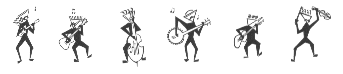
Finally, add a double bass and you've got the basic ensemble for a bluegrass band: guitar, fiddle, mandolin, banjo, and bass. Sometimes an instrument called the dobro is used; this is Jerry Douglas' chosen battle axe. The dobro looks like "a guitar with a hubcap on it." The "hubcap" is a resonator plate that gives it its distinct sound. It sounds very much like a steel guitar of the Hawaiian islands and is likewise played with a steel bar and it is played parallel to the floor with a strap holding the body up for support.
Very seldom will anyone hear or see piano in bluegrass music; it has been done but not often. Drums are also not used with the exception of a washboard! Also, electric instruments, with the sole exception of a bass guitar, are pretty much forbidden; don't ever come to a bluegrass jam session with an electric guitar unless you'd like to draw that much unwanted and very bad attention to yourself.
The music is almost never written down. Of course lyrics are written down, but the music is quite simple in form. Each song has a chord structure and the musicians will improvise over the chords like jazz musicians do. The songs are usually sung in three-part harmony on the refrains with a single singer on the verses. The harmony is almost always really close-nit; the notes being sung are never too far apart from one another and sometimes you will hear a lead line with a high tenor sung up high. This is where bluegrass music gets that lonesome, keening sound.
Bluegrass was up until recently a mostly male music; women almost never participated and the men would sing high falsetto parts on the high duet parts. Now that women are more active in bluegrass, there are many more possibilities in harmonies and singing that bands are beginning to explore.
The early champions of bluegrass were Bill Monroe, Ralph Stanley and the Stanley Brothers, Lester Flatt and Earl Scruggs and Don Reno and "Red" Smiley. These musicians were the ones to give bluegrass the establishment as its own kind of music. Later, bands such as the Seldom Scene, the Country Gentlemen, the Johnson Mountain Boys and the McPeak Brothers came along in the 1970s and brought further attention to instrumental virtuosity and tight-knit vocals that are so much a part of bluegrass.
This musical tradition carries on to the present day to a younger generation of musicians. The East Coast Bluegrass Band is just one of many that are still keeping in line with the traditional sound of bluegrass music.
If you have any questions about bluegrass that are more specific, email us at this address.