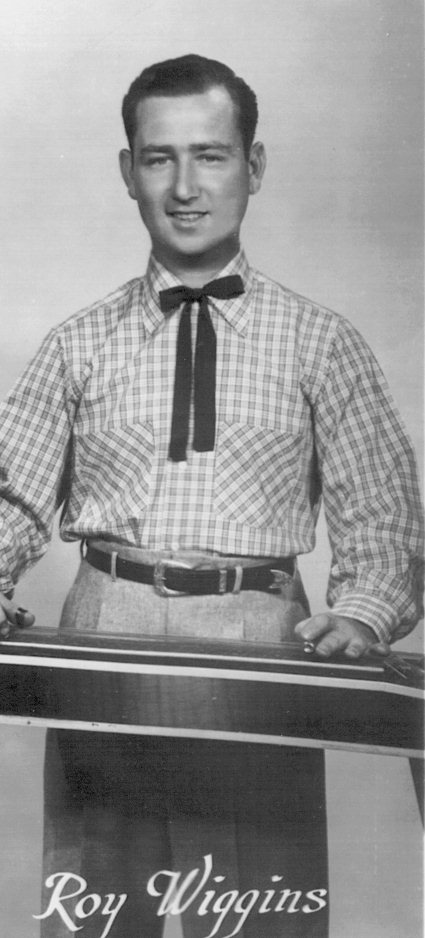
Additional Information On Roy Wiggins
Additional Information On Roy Wiggins
Hello Roy Wiggins Fans:
In a September 1999 issue of the magazine GOLDMINE, Mike Streissguth,
the author
of the biography Eddy Arnold: Pioneer of The Nashville Sound
has
written the following detailed obituary on Roy.
"Little Roy" Wiggins, steel guitar player
Country music lost one of its most distinctive sounds with the death of steel guitarist "Little Roy" Wiggins on August 3, 1999. Wiggins was probably the most-heard country steel player during the 1940s and early 1950s when he backed Eddy Arnold, the era's best-selling country singer. When fans heard the ringing "ting-a-ling" of Wiggins' introductions, they knew Arnold's voice wasn't far behind. Certainly, Arnold would have thrived without Wiggins, but more than a few folks purchased Arnold's RCA Victor records to hear his skillful steel man.
"He was important because he influenced many people to start playing the steel," said Dewitt Scott, president of the International Steel Guitar Hall Of Fame, which enshrined Wiggins in 1985. Riding the crest of Arnold's success, it was inevitable that Wiggins would significantly influence up-and-coming steel guitarists. His followers could find him on major Arnold hits such as "That's How Much I Love You" (#2 country, 1946), "Bouquet of Roses" (#1 country, 1948) and "Don't Rob Another Man's Castle" (#1 country, 1949), and on the country troubadour's many popular radio spots.
Born June 27, 1926, in Nashville, Ivan Leroy
Wiggins turned to the steel after hearing the Grand Ole Opry's Burt Hutcherson
picking the instrument. "He played in the neighborhood at somebody's
home and mother and dad took me, and I thought then that it was the prettiest
thing I ever heard," recalled Wiggins in 1995. By the age of 13,
he was backing the Opry's Paul Howard. He played a spell with Pee
Wee King's Golden West Cowboys before Arnold recruited him in 1943.
With Arnold, Wiggins appeared on one of the first recording sessions ever
held in Nashville (December 4, 1944, in the studios of WSM radio).
Except for a fleeting tenure with Red Foley in the late 1940s, Wiggins
and his steel shadowed Arnold for the next 15 years. However, when
Arnold turned to a more country-politan sound in the late 1950s and 1960s,
he dropped the steel from his stage shows and recording dates. Severed
from Arnold's musical circle, Wiggins often backed country star George
Morgan, who memorialized the instrumentalist in his "Mr. Ting-A-Ling (Steel
Guitar Man)" (#56 country, 1973). Over the years, Wiggins recorded
instrumentals for Starday, Dot and a host of smaller labels. In the
1980s, he relocated from Nashville to Sevierville, Tennessee, where he
managed a record store and continued to play his beloved guitar.
Plagued with heart disease and diabetes, he passed on in his sleep.
--- Michael Streissguth
Press "Back" On Your Browser To Return To Preceding Page
