According to an order by Habsburg queen Maria Theresa (1740-1780), the male
Sz�kely population was subject to recruitment to serve as border patrols, under the
command of the Habsburg military authorities. The Sz�kely people resisted to join the
forced military draft and they organized a revolt against it. As a retortion, Habsburg
officers Bukow and Siskovich made a blood bath near the village called Mad�falva
(Siculeni, Rumania today), in 1764. The terror-attack came under the darkness of the
night, when the Habsburg mercenaries sneaked in the village and massacred 200
unsuspecting Sz�kelys. They were buried in a mass grave, called V�szhalom (Engl.
Hill of death), and as a result, thousands of terrified Sz�kelys fled across the
Carpathian Mountains, over to Moldova, which was in Rumanian territory. These
people later became known as the Cs�ng� sz�kelyek (Engl. Sz�kelys who wandered
away), and they still exist in Moldova today. History recorded the bloody event as the
Massacre at Mad�falva (Lat. Siculicidium).
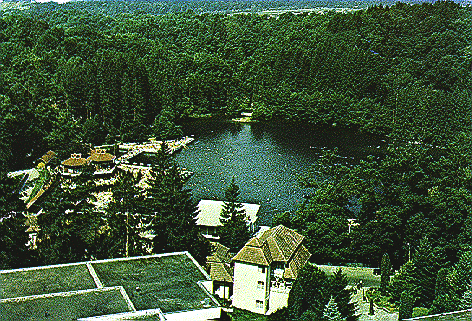
SZOV�TA The village of Szov�ta (Sovata, Rumania today) lies in
the Transylvanian salt mining region. Szov�ta, as part of
Austria-Hungary, received its characteristic architecture during the
19th century. It is a spa village and has 5 small lakes, i.e, Medve t�,
Mogyor�si t�, Fekete t�, Veres t�, Z�ld t� (Engl. Bear lake,
Hazelnut lake, Black lake, Red lake, Green lake). Shown here the
Medve t� (Bear lake), the waters of these lakes are so concentrated
with salt that we can float on the top of the water and cannot
submerge.
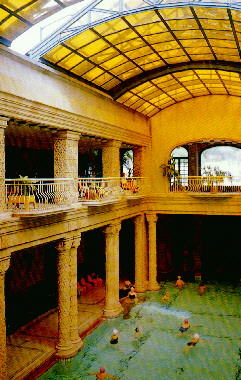
People use the healing effects of the lakes' waters for their rheumatic
and gynaecologic problems. The mud of the Fekete t� and Veres t�
have healing activity as well.