VOID VOID VOID
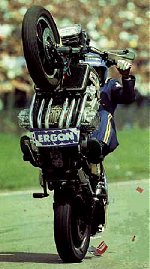

THE SECRET TO WHEELIES !
The "Secret to Wheelies" can be summed up in one short phrase "Practice on Hills". The logic behind this is you practice carrying your front wheel just slightly off the ground up relatively steep hills and then progessively decrease the grade until your competent on level ground. The simplistic explanation for this is the hill limits forward speed making your bike SEEM like it has more torque and has the psychological advantage of reducing panic because your front wheel is only a foot or so off the ground.
The secret to not flipping over backwards is just as simplistic;"Learn To Use The BACK BRAKE!" If you progress to higher speed wheelies this is the only technique to save your ass.
Assuming your practising with a low to medium powered off road bike your takeoff technique involves quickly shutting the throttle to compress the forks and then immediately applying throttle as the forks rebound. Whether or not you should pull and exactly how much throttle to apply depends on the bike your riding. It's best to start cautiously as most flips occur at takeoff. Your goal at this point is to "obtain" and "maintain" the balance point which you will recognize as a position whereby the front wheel will feel like it is floating and requires little or no throttle. Keeping this position involves blipping the throttle in a series of short but gentle tweaks. Again if the bike stars over backwards you must apply back brake to return to a more prefered altitude.
The second technique for lofting the front wheel is through the use of the clutch. This is the prefered method on most Sport and Steetfighter style road bikes. Be forewarned until you perfect it this method can destroy clutches in short order but is the best approach for fine control at takeoff. In 2nd gear (possibly 1st)at low revs dip the clutch and open the throttle at the same time. The revs will rise somewhere between peak engine torque and peak engine power and the front wheel will come up. NOW PAY ATTENTION; dipping the clutch at peak torque will get the front up more violently but going higher up the rev range towards peakpower makes the wheelie happen slower and more controllably. Higher speed wheelies are more stable because of the gyro effect inherent in a moving motorcycle but the risk increases in direct proportion to the speed. These are usually accomplished by way of clutchless upshifts at or near peak power. Your choice of wheelie bike can help or hinder your progress. Any supermotard/MX/Dualsport bike will wheelie because of the higher center of gravity but if your choice of a mount is a Goldwing your on your own. Longer wheelbase motorcycles are more controllable during a wheelie but initially more difficult to lift at takeoff then shorter wheelbase bikes. (Think of the difference in hand balancing a yardstick on end compared to a pencil.) Motocross bikes will lift perhaps too quickly with good traction and are best kept below the peaky powerband. The bike of choice may well be any 600cc four stroke single as the engines compression braking allows a greater margin for error while riding the balance point. In summation wheelies are spectacular and can be painfull when done wrong so make use of any of the above instuctions at your own risk. Good Luck!.........Definition of Luck......."When Skill Meets Opportunity"