Bob Miller's XR600 SuperMotard/Dual Sport

( Text, Photos and Review by BOB MILLER )
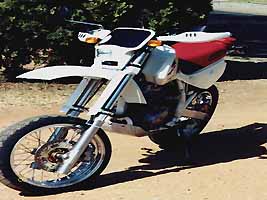
This is a quick review of all the fun / problems / experiences I've had with my XR600 and also a bit of advice about building a "supermotard" out of this bike. I bought a 1998 XR600R in Febuary of 98 with the intention of building a bike that can be used both off and on road without compromise. The reason why I wanted to do this was two fold, firstly I require transport to work and back daily and secondly I thoroughly enjoy riding off road every other weekend or so. To do this there was really only one way to go, namely, get an off road bike, not a dual sport,and buy an extra set of wheels for the road. Note:I say wheels not tires.
The XR was chosen mainly on the basis of cost, i.e. for its' equipment it's the cheapest bike around. As a 6 foot plus large person any of the smaller bikes (250's or 400's) were ruled out on the grounds of lack of power (XR250, KLX250 & 300), or costs (YZ400, XR400, any KTM, Husaberg, or Husqvarna).The other offerings from Japanese manufacturers are more dual sport and way too heavy for off road use (KLX650, DR650). I only looked at the 4-strokes as any 2-stroke worth its weight off road will not have an autolube system,and mixing oil is not a lot of fun, plus I like 4-strokes. So the XR it was. The 1998 XR600R has not changed a lot since 1991, from that point on it got twin disks, aluminum swing arm and 43mm fork with only small changes having been made since. I know the 98 model has different exhaust valves for today's lean burn fuels but this is the type of change that I am talking about, very small. The 1988, 89 and 90 models have a nicasil plated cylinder, something worth bearing in mind if you have one of these bikes and are contemplating a rebore. So with this type of commonality in models, there are a massive amount of "upgrades" available for the bike plus every Honda dealer on Earth normally has a cheap and plentiful supply of consumables.

Converting the Bike:
To use a bike off road properly and expect it to survive it had to be built like a tank. No problems there, the XR is. But to make sure it can match the necessary requirements for street use is another story. The normal equipment that comes on dual sports lasts all of ten minutes off road. I needed something a little stronger. I made the decision that some amount of work must be done to change the bike from one environments setup to the other. As where I ride is very rough it is inevitable that certain things (indicators, etc.) will get damaged. I do not throw it away regularly but the possibility of a fall is always there. So with that in mind I did the following modifications:
Wheels and Brakes:
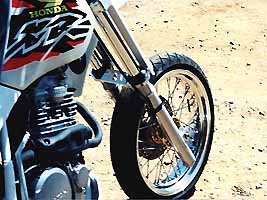
The stock wheels I kept for off road use. I knew I would be buying complete motard wheels so that was OK. I did swap the rotors, I put the Talon rotors on the off road wheels and the stock rotors on the Super Motard rims. This is because the Talon rotors are almost twice as thick as the stockers and are much more resistant to rock damage off road. The IRC Volcanoduro knobbies are pretty much OK off road but the rear wears fast and its 110/100-18 profile makes nipping the tube on rocks always a possibility, a Michelin Baja AP10 in 140/80-18 profile will be its replacement, it's much higher even though it's an 80 profile. I had to remove the black plastic cover that fits in the center of the front hub due to the slightly different design of the Talon rotor. I run a 15 tooth front ALL the time (stock14/48). The rear is a 44 on the road and a 48 off the road.
Baja Designs DOT kit:
Baja Designs is specialist US company that does all sorts of off road conversions and hop ups. The 'DOT' kit I bought fits to the standard wiring loom and has a small dry cell battery that fits on top of the airbox. It also comes with all the switches and equipment for legality. I had to replace the rear fender as the original comes with a two wire system that cannot support a brake light as well as a running light. Fitting was easy and with this in place the headlight does not brighten and dim when reving the motor. The quality of the kit is very high, and I mean very. The components are the best and they have not broken after a lot of tough rides. But the main purpose of this mod is street legality.
Rear View Mirror: (legal stuff and to see where I've been....)
Fork Brace:
The fork brace from Scott Summers Racing Components is another quality item that stops fork flex over rocks and ruts in an off road environment. I am really not that fast a rider so as to make the forks flex, but I did feel an improvement after fitting. This requires that the fork boots be removed (slider type covers are provided), the fender trimmed and the brake hose retainer on the fork be removed.
Front and Rear Fenders:
The UFO rear fender was installed to remedy the lack of brake light in the original fender as described previous. The front fender was trimmed a-la Super Motard styling. I change it for a full one in the off road environment.
Side Stand:
The side stand was shortened. Tricky one this, you have to get it just right as if it's too short then the bike will fall over with the knobbies on and if it's too long it will not stand the with motard tires on.
Skid Plate:
The White Bros heavy duty skid plate I got at a good price but it has a downside- if you ride in muddy areas (off road) it gathers the mud between it and the frame like an ice cream scoop. It does a great job at protecting the frame from rock dings and casing jumps but it can add another 5 kilos of mud to an already heavy off road bike. I run the stock aluminum tube version off road now. I have also noticed I rarely hit the actual frame off road, more often then not I hit the foot pegs or foot peg supports.
Hand Guards and Frame Guards:
UFO frame boot guards are good as they stop the MX boots rubbing all the paint of the frame above the pegs, they are also cheaper then the aluminum or stainless versions. Polysport plastic hand guards protect the fingers off road. Cheap and effective. I also fitted the additional spoilers to them. Good for the cold winter mornings as well.
Rear disk & Chain Guard:
The chain guard from the left side of the swing arm was removed to allow easier fitting of the big rear tire. Removal of the rear brake disk guard was also for this purpose.
Air Intake Mods:
I removed the mesh from the air filter cage. This had an interesting effect on the motor. The stock air filter cage has a sheet of stainless steel gauze across the inside, then a lump of steel wool, then another sheet of gauze across the back to keep the steel wool in place. Apparently this is a back fire screen. When this is removed it allows more air through but also seems to reduce the engine braking. Meaning when you close the throttle the throttle the motor doesn't 'suck' the bike to a stop as quickly. The stock air filter is fine, K&N jobs are good for street use but when they get clogged off road the bike stops.
Speedo / Odometer Swap:
A small round speedo was fitted in place of the stock odometer. I needed a speedo for legality. It does tend to over exaggerate with the 17" supermotard wheels but that's OK. It's fun to imagine your doing 200 kph.
ProCircuit Exhaust:
This mod is well worth it. Scott Summers says that the biggest gains in the XRs are from a good exhaust system and the ProCircuit version helps a lot. I saw another 6 bhp with the pipe in place and the jetting done and I live at 1 mile high altitude. The pipe fits easily and looks good. It is also lighter than stock but not that much. the stocker, contrary to rumours, is not that heavy. The pipe comes without any SuperTrapp plates so it's up to you what you do for noise suppression. The 8 plates make good power with acceptable noise levels, I run 14 which is not that much louder and I don't have to take them off for off road. An interesting fact: with 14 plates and a solid end cap, the bike makes 1/2 bhp MORE than with no plates at all! The only difference is that the bike makes power quicker with the plates off.
Renthal Handlebar and White Bros."Brake Snake":
A Renthal CR high bend handlebar was installed. Very tough bar this, better then the stock one and a lot cheaper than a Pro-Taper. Cut to about 30 inches in width. The White Bros. Brake Snake proves useful as it stops the rear brake pedal from being pulled outwards in an off road fall. It's a small stainless steel cable that fits over the front of the brake lever and around the frame.
Results-Off Road
The XR despite being so 'old', has won many off road championships right up until 1998 in the capable hands of Scott Summers. I think he has won nine Grand National Cross Country titles in the US. That's not a bad record for a bike that first saw light in 1985. Myself coming from a Yamaha WR250, the XR is a lot heavier and requires a lot of work, specifically in really tight situations. The true domain of this bike is open country with speeds not lower then 30 km/h. It loves two track roads and is easy to ride there. Compared to a 2 stroke, even a 250, you tend to cut the amount of gear changes in half over most given areas. It can be a little ponderous in thick dry sand. There is very little need to fan the clutch, it has no water cooling but it doesn't over heat (not yet touch wood, but if you hit deep water slowly with a hot engine you can get poached) so that's one less thing to worry about. Also you don't have to worry about forgeting to put 2 stroke oil in the gas. The gas tank is a little too small at 10 litres, an increase to 13 would be ideal. The motor is reliable and easy to work on. It has grease nipples on the rear suspension linkage to aid maintenance if you ride in wet off road situations. Unfortunately the steering head doesn't have a grease fitting and because the hot engine oil circulates in the frame around the head stock this grease needs frequent checking.
Results- On Road SuperMotard Style
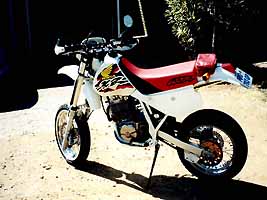
The 17" rims definitely quicken the steering, but not so that it creates a problem. I have had no negative effects on the steering with these wheels. I am running a 120/60-17 Michelin Macadam front as well as matching rear in size 150/70-17. The rear is too high and will be replaced as soon as it is worn out. I have a concern with the low profile on the front as it may allow rim damage if I hit a pot hole or something. I will change that to a 70 profile in the future. The rear 150/70 , aside from looking too big, makes no real difference in regard to the slight profile difference compared with a 150/60. I have noticed that running a light bike, +/- 130 kilos, on tires that were originally designed for bikes that are up to 100 kilos heavier, tire pressure is crucial. If you want to practice rear wheel steering pump up the rear to 3 bar (300kpa) and off you go. But you'll be in a world of trouble if it starts to rain. The feeling is that of riding as if on ice! I would have preferred to get a 160/60 on the rear but that tire is too wide on the 4.25 rim and it would also require some mods (sprocket spacing, wheel offset) to fit in the swing arm. A 150/70 or/60 is the max without the mods (Michelin). The gearing (15/44) allows good speeds with low revs but hampers wheelies a bit. Also the stock chain is 5 clicks from the max on the snail cam adjusters. I have to keep it there as the off road rear has a 48 tooth sprocket and that is just 3 clicks from the minimum.
Results-General
Starting the XR is easy once you get the knack. Freezing cold or red hot doesn't matter. Only when restarting after you bail is there a problem but that happens to all bikes. Maintenance is cheap and easy. Get a Haynes manual but be careful when reading the valve clearance specs, they quote two different figures for the SAME bike in different parts of the manual! (In the front it is 0.05 intake and 0.10 exhaust well in the engine section it says 0.10 intake and 0.12 exhaust, all very confusing !?!) Oil usage has been 20W50 mineral for run in (5000k's) then synthetic. By run in I mean total bedding of all engine parts . With mineral I change every 2000k's (1500 for pure off road, max) or 4000k's with synthetic. Replace the filter as well as they really are cheap anyway. Air filter is serviced when it looks dirty or every 500k's on road. I am about to install an 11:1 Wiseco .5mm oversize piston . I have heard that the HRC 628cc kit makes 58HP, my bike currently puts out 46HP (Dynojet 100, correction factor of 1.2 due to 1 mile high altitude). The biggest gains in order of least to most expense are: filter (then jetting), muffler (then jetting), piston (then jetting), headers (then jetting), cam (then jetting), carb (then jetting). As you can see jetting is critical, remember 4 strokes CAN seize. In conclusion its possible to write reams about how much fun a big single is to ride. The modern dualsports such as the BMW Funduro and the Suzuki Freewind have missed the point of "Super Motard" as has the KLX250 dirttracker (engine way too small). Bikes like the XR and the Huskies are the way to go. The bare minimum for legality equals a lot of fun. Maybe one day Japan will wake up and give us what we want..........
THE END.......Literally