Voltage and current, a tutorial.
Lots of people, even motorcycle mechanics, have problems with the conceptions voltage and current. And most books are very good at confusing even more. So let me try to make things a bit more understandable.
Another word for voltage is potential. And exactly that is the right word. It is like when you are standing on the roof of a high building, on the edge. That's a place where you have the potential to drop down and fall dead. But as long as you are standing still without jumping, nothing happens, you just have potential. A measure for your potential is the height. The height of the building (h) is your potential relative to the ground. But if you plan to jump on a balcony halfway the building, you have a potential 1/2*h relative to the balcony. And if you jumped and landed on the balcony, your potential relative to the ground is again 1/2*h, while your potential relative to the top of the building is negative -1/2*h. Thus potential is always relative to something, and in this example the difference in height between two points.
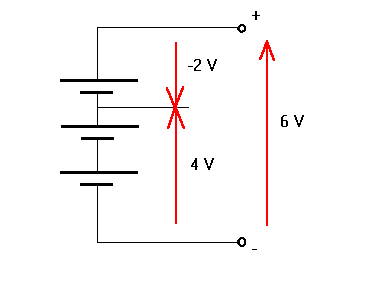
That's how you can look at a voltage source, a battery or a dynamo. The voltage is analogue to the height difference. A normal lead acid, three cell 6 Volt battery, has a potential of 6 Volts between the two terminals, and 2 Volt between each cell. The picture shows that when you stand at the + terminal, you have a potential of 6 Volt relative to the - terminal. And if you stand between the two top cells, you have a potential of 4 Volt relative to the - terminal and -2 Volt relative to the + terminal. Now you also know how to measure voltage. You need a voltage meter with two leads, and you always measure the voltage difference between two points. One other helpfull hint: all the points who are wired together have the same potential.
The other important concept in electronics is current. That is when something is realy going to happen. Lets go back to the building. You are not alone anymore on the top, there are millions of you, standing on the roof, eager to jump and fall dead on the ground. There is one problem though, an isolator is preventing you to jump. Between you and the ground is for example a big block of plastic. Now someone opens a channel through the plastic block all the way to ground, and you guys jump to the ground. A current of guys is falling. A measure for the current is the number of guys per second, who pass a certain point in the channel.
In electronics, you don't have guys, but electrons. And not a channel but a conductor. Thus the current through a conductor are the number of electrons who pass per second, the unit is Ampere. To measure the current, you must cut the conductor, insert a meter in between and start counting how many electrons are passing through the meter. It doesn't realy matter in what direction the electrons are flowing, but we say that electrical current flows from positive to negative voltage. One other hint, everywhere in the channel is the current the same. If the channel splits, two smaller currents will flow through each new channel, but together they are the same as before. So when the two channels are reunited the current will still be the same as before the split.
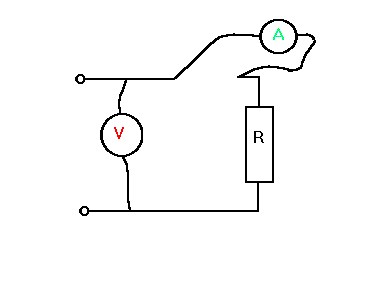
We haven't yet talked about the channel itself. If it is very wide, a lot of guys per second (current) can pass. If it is filled with molasses, the current will be less. This is the concept of resistance. The resistance of a conductor depends on the material, the thickness and the length. (The latter is a bit difficult to explain with the jumping guys example). So a short, thick length of copper has a very low resistance. A long, thin strand of plastic has a very high resistance. The unit of resistance is Ohm.
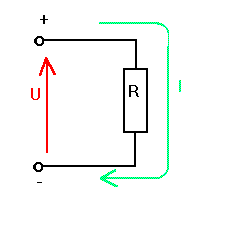
These three concepts, voltage, current and resistance, belong
together. If the voltage is high, the guys will fall faster, thus
the current is higher. If the resistance is high, the current
will be lower. Mr Ohm has put them together in a law, Ohm's law:
V = I * R
V is voltage I is current R is resistance
With algebra you find the other forms of this formula: I = V / R
and R = V / I.
No matter how much guys have gatered on the roof of the building, as soon as a current of falling bodies runs, the supply will come to an end. What we need is not just any building, but a special recycling building that puts enough energy in the fallen bodies, to get them fit on the roof again. That also happens in a dynamo or a battery. In a dynamo mechanical energy is used to get the electrons from the negative to the positive lead. In a battery it is chemical energy and works until no usable chemicals are available anymore.
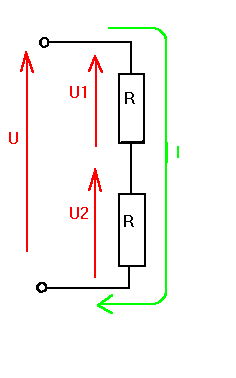
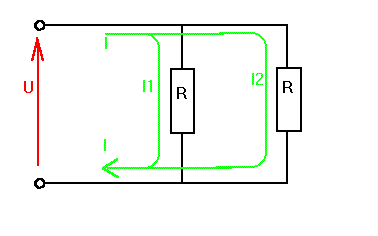
You can put electrical components (light bulbs, resistors, coils, batteries etc) in all kind of circuits. Two very common configurations are serial and parallel. These figures show them, and how the voltages and currents are behaving. Typical for the serial configuration is that the current through both components is the same, while in parallel the voltage over both components is the same.
Only one thing needs some explaining. The electro magnet. When a current is flowing through a wire, a very weak magnetic field develops. You can make that field stronger when you take a long wire and wind it around an iron core. The strength of the magnetic field depends on the current and the number of windings. Elctromagnets are used in the dynamo and in the mechanical regulator.
That's about all the knowledge you need to understand the electronic system of an oldfashioned BMW motorcycle.The rest of the tips are in the dynamo article.