REARDRIVE AND SPEEDO RATIOS
Reardrive:
When I connected a sidecar to my R69, it turned out to be a slow ride. Topspeed was reduced to around 100 km/h, while the lower gears didn't feel too stressed. It didn't feel like I had to pull each gears to the end, just when I switched from third to fourth gear, it didn't pull up anymore. Topspeed in third was almost the same as in fourth. Well, that is no surprise. The Steib TR500 is a heafty barge, and the R69 was still geared for solowork. So I had to look for a solution.
In some sources it is adviced to change the gears in the gearbox for the sidecar ratios. Those are the same gears as used in the R26 and I have those in stock. But that solution doesn't change fourth gear, so I don't expect it to help with my problem. There is no way around changing the rearwheeldrive gearratio. And that's not cheap. Luckily, today there are good quality gearsets available from BMW Mobile Tradition, Mark Hugget or Rabenbauer. You can choose between a 27:7 (1:3.86) or 26:6(1:4.33) set. The first was used in some model years of the R60, the latter is adviced for the R50, R69 and R69S. That would be a simple choice if it made sence to me. I suspected that the 26:6 gearing was develloped in Munich with the hills and mountains in South Germany and the Alps in mind. I live in The Netherlands, which is completely flat, and I don't mind to switch down into third gear when the need occasionally arises. And also, when I compare the torque and power curves of the R60 and the R69, I see that the R69 is stronger throughout the revrange. So why not a 27:7 set, that might allow a little higher topspeed and lower revs at cruising speed? Thus I decided and ordered the 27:7.
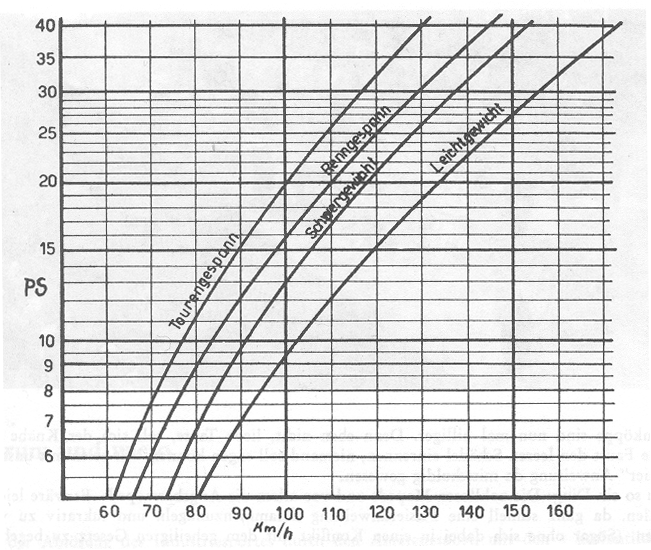
Later I found some interesting graphs. In a german book (Besser machen, Carl Hertweck) is this diagram that originates from the magazine "The Motorrad" around the early fifties. It was used to keep people honest about claimed hp figures and topspeeds. It indicates how much hp you need to reach certain speeds with several motorcycle configurations. Leightgewicht means a small bike with a light rider. Schwergewicht is a big bike (and the R69 was a real big bike in these days) with a 100 kg rider. Renngespann is a race sidecar outfit, and tourengespann is more like my outfit. I have no idea how precise this diagram is, but it doesn't look too odd when I compare it with the topspeeds of the solo R69 and the R25.
This diagram allowed me to make some calculations with the powercurves that I found in the book "1000 tricks fuer schnelle BMW's" from H.J. Mai. There are also powerdiagrams in the booklet "BMW Zweizylinder R51/2-R75/5" from Schrader Verlag. Remark, both these books indicate that the R69 has 37 hp instead of the official 35!
To compare the curves I had to make a conversion. I transformed the powercurve from rpm to roadspeed for the several different gearsets and two tire sizes. The result is in this diagram. To convert from rpm to speed I used this formula:
speed = (rpm * 3.6 * tire_size) / (ratio_gearbox * ratio_reardrive * 60)
- speed in km/h.
- tire_size is the circumference of the tire. 1.96 meter for a 3.50 * 18". 2.03 meter for the Block K. These sizes come from the Metzler technical manual
- ratio_gearbox is 1.54 in fourth gear.
- ratio_reardrive is 4.33, 3.86 and 3.13 for resp 26:6, 27:7 and 25:8 gearsets.
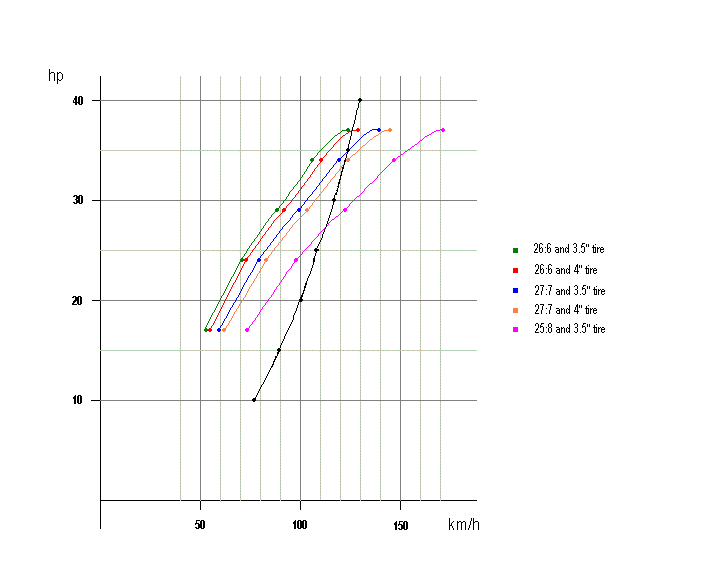
In this diagram, the engine is strong enough, as long as its powercurve is to the left of the black limit curve, the curve that comes from the Motorrad diagram. Topspeed is where the curves are crossing each other. Of course everything depends on the position of that black curve. With a windscreen it becomes worse, lighter sidecars are better, wind in the back is good too, etc. This diagram isn't very precise, so don't try to read more out of it. It's just an example for your own calculations.
Looking at this diagram, you can see I felt a bit depressed at first. The 26:6 isn't such a bad choice afterall, especially not with a Block K. But looking closer reveals that the change in topspeed is very small between these 4 choices. You need a lot of power for a little bit of speed. That is because at these speeds the windresistance is most important and that resistance increases relative to the power of the speed! You can see that even the 25:8 ratio gives more then 110 km/h. That doesn't make it a good choice though, because it reaches topspeed at about 4000 rpm, only just more then half of the designed max. rpm. The engine is not designed for maximum load and full throttle operation at so little rev's.
So far the theory. In practice my bike manages about 115 km/h on a flat road with little wind and without a windscreen. That indicates that I don't have all those 37 horses available. But that is not a problem of course, it is an opportunity....
Speedo:
When you change the rearwheel drive your speedo won't show the correct speed anymore, because it meassures between the gearbox and the reardrive. To compensate for this, speedo's with different ratio's are available. For the 27:7 rearwheel drive, a 0.9 ratio is used. But when I ordered that speedo, it seemed to be not in stock. That let me think a bit about what speedo's were available, and what this ratio actually means.
The W that you see on the speedo face means "Wegdrehzahl". It tells you how many meters the bike should ride for one rotation of the speedocable. So with a W = 0.9, the speedocable should rotate 900 times for 1 km distance. Important datapoints to calculate your speedoratio are the tiresize, the ratio of the rearwheel drive and the reduction of the speedo intake point. The last one is situated at the gearbox output flange. It is a small wormdrive with a 6 to 13 reduction or 1:2.17. The formula:
W = ratio_gearbox / (tire_size * ratio_wormdrive)
With a 27:7 gearset and a 3.50 * 18" tire:
W = 0.907 = 3.86 / (1.96 * 2.17)
But when you want to use a Metzler Block K (4.00 * 18") tire the solution is:
W = 0.876 = 3.86 / (2.03 * 2.17)
This is almost the 0.86 speedo for a R50S. I plan to start using a Block K as soon as the old tire is worn out, so it doesn't seem to be a bad choice. This one has a 20 - 180 km/h face, so it leaves me some room for tuning ;-) Only the gearswitch points are not in the correct position, however I never use those anyway.