SOME HISTORY
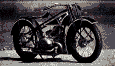 After the second
world war, The German motorcycle manufacturers weren't allowed to
build engines with more than 250cc displacement. The BMW plant
was heavily bombed, so they were rather late with their first
postwar bike, the R24. Not the famous boxer engine, but a very
modest single. Nonetheless it was a huge succes, and allowed BMW
to make enough profit for their first postwar boxer, after the
restrictions were relaxed. This bike the R51/2 made from 1950 -
1951 was nearly the same as the prewar R51. The bike had a twin
tube frame with plunger rear suspension and a telescopic
frontfork. It had an engine with two camshafts, driven by a
chain, wich allowed short pushrods. In 1951 the new boxers were
introduced, the R51/3 and the R67, and the R68, the first BMW 100
mph runner, followed in 1952. These had a new engine in virtually
the same old frame.
After the second
world war, The German motorcycle manufacturers weren't allowed to
build engines with more than 250cc displacement. The BMW plant
was heavily bombed, so they were rather late with their first
postwar bike, the R24. Not the famous boxer engine, but a very
modest single. Nonetheless it was a huge succes, and allowed BMW
to make enough profit for their first postwar boxer, after the
restrictions were relaxed. This bike the R51/2 made from 1950 -
1951 was nearly the same as the prewar R51. The bike had a twin
tube frame with plunger rear suspension and a telescopic
frontfork. It had an engine with two camshafts, driven by a
chain, wich allowed short pushrods. In 1951 the new boxers were
introduced, the R51/3 and the R67, and the R68, the first BMW 100
mph runner, followed in 1952. These had a new engine in virtually
the same old frame. 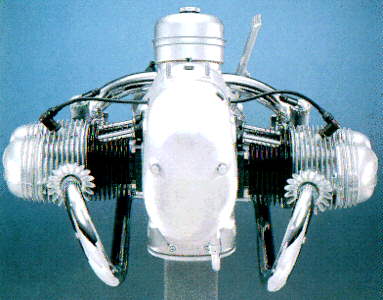 This engine is of interest to us, because it is the
same as used in the '/2' series until 1969, with detail
modifications of course. This engine featured one camshaft,
driven by helical cut gears. A magneto on front of the camshaft,
a DC dynamo on front of the crankshaft and the oilpump on an
extra gear under the crankshaft. All shafts had very big ball
bearings. The big ends ran on needle bearings, and the small end
had to do with a bronse bush. This layout was retained until
1969, with the excepton of the rear crankshaft bearing on the
bigger, more powerfull machines, which had a swival joint bearing
to cope with crankshaft flexing. The cylinder was cast iron. The
piston and cylinder head were made from light metal. At the back
of the engine a large flywheel was attached to the crankshaft,
wich incorporated the car type single plate dry clutch.
This engine is of interest to us, because it is the
same as used in the '/2' series until 1969, with detail
modifications of course. This engine featured one camshaft,
driven by helical cut gears. A magneto on front of the camshaft,
a DC dynamo on front of the crankshaft and the oilpump on an
extra gear under the crankshaft. All shafts had very big ball
bearings. The big ends ran on needle bearings, and the small end
had to do with a bronse bush. This layout was retained until
1969, with the excepton of the rear crankshaft bearing on the
bigger, more powerfull machines, which had a swival joint bearing
to cope with crankshaft flexing. The cylinder was cast iron. The
piston and cylinder head were made from light metal. At the back
of the engine a large flywheel was attached to the crankshaft,
wich incorporated the car type single plate dry clutch.
In 1955 was the introduction of the R50 and the R69. They had
the new frame but the old engines. The new frame was a sensation
in these days. It was very comfortable and had good road holding
properties. At the back was a swing arm, at last universally
regarded as the optimum configuration for the rear end of a bike.
The mainframe still had the same style as the old plunger frame,
with neat loops next to the rear wheel and rather strange
extensions to hold the rear suspension units. The front was very
exotic. Here was a swing arm , according to the Earless patent.
This was a very hot item, mainly used on racers, and on some
fancy street bikes. But these latter weren't always a succes,
because of their flimsy layout. BMW did it better. They made a
very strong fork from conical tube and used conical roller
bearings to carry the swing arm. They used the same bearings in
the rear swingarm. Also the gearbox was changed in 1955. The
previous models had a two-shaft gearbox, but these newer boxes
had tree shafts. The consequence was a change of turning
direction in the cardan. This was dealed with by changing the
position of the pignon wheel in the rearwheel.
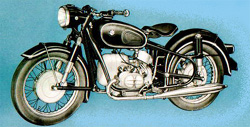 The introduction
of the sportsmodels R50S and R69S, started some big difficulties.
The engines had a lot of reliability problems, like broken
crankshafts, cylinderhead failures and even teared off cylinders.
The crankshaft was too flexible for these kind of power outputs.
The R50S was discontinued in 1962 after only 1634 units produced.
The R69S got a vibration damper on the crankshaft in front of the
dynamo. These engines are recognized by the extra bump on the
front cover. The R69S also got a hydraulic steering damper to
cope with the high speed instability. At the very end, since
1967, the US models were available with a tele scopic frontfork,
as develloped for the /5 BMW's. This model was only available in
the USA, and German customers were rather sauer about this. They
had to wait until the introduction of the /5 range.
The introduction
of the sportsmodels R50S and R69S, started some big difficulties.
The engines had a lot of reliability problems, like broken
crankshafts, cylinderhead failures and even teared off cylinders.
The crankshaft was too flexible for these kind of power outputs.
The R50S was discontinued in 1962 after only 1634 units produced.
The R69S got a vibration damper on the crankshaft in front of the
dynamo. These engines are recognized by the extra bump on the
front cover. The R69S also got a hydraulic steering damper to
cope with the high speed instability. At the very end, since
1967, the US models were available with a tele scopic frontfork,
as develloped for the /5 BMW's. This model was only available in
the USA, and German customers were rather sauer about this. They
had to wait until the introduction of the /5 range.
The development of the single cylinder models was a bit
different. After the R24 without rear suspension, came the R25
with a plunger frame, like the R51/3, but smaller and cheaper
manufactured. Although the R25 and its succesors the R25/2 and /3
sold in huge quantities, the factory didn't spend as much
development effort in these bikes as in the boxers. There were
some thermical problems that were dealt with in the cheapest way,
by painting the cylinderhead black. Later the heads had much
larger cooling fins, and thus the engine was used in the R26. The
engine was quite different from the boxer engines. It also had a
longitudinal crankshaft, but the camshaft was driven by a chain.
It also hadn't a magneto, but it had to do with coil ignition.
The frame of the R26 and R27 strongly resembles the frame of the
R50 etc. In fact it has completely the same Earless frontfork, of
course with different shoch absorbers and springs. The
differences are at the backside. The reinforcement bars near the
swingarm bearings are different, and the suspension units are
more slanted. The 'cardan' of the single cylinder models also
hasn't a cardan coupling, instead it still has the Hardy
coupling. This is a disk of woven fabric, which allows some up
and down movement. The R27 has the very special rubber engine
mountings. BMW had investigated this subject intensily. Because
the R26 had quite a lot of power, the vibrations were very
strong. This was not only very uncomfortable, but it also
inflicted the reliability. These rubber mountings lessened the
degree of vibration to a very acceptable amount, although the
power output was raised from 15 to 18 hp.
Contents