The Abrisz
Usually the engine will run, also when the magneto is not setup perfectly. But there are a lot of circumstances where you need the strongest spark you can get. For example when starting, when it is cold, your piston is a bit worn, the carburettor needs a tune-up etc. In most texts about the BMW magneto's, the autor puts a lot of emphasis on the correct adjustment of the Abrisz. When the flywheel S-mark shows up in the middle of the inspection window, the points should open and the mark on the magnet should point straight to the mark on the magneto body. They call it the right Abrisz point. And they are hundred percent correct.
But what is that Abrisz? Curious souls who can't find a descent explanation of that word in their dictionary should read on. Others who never liked maths or physics can better stop reading now.
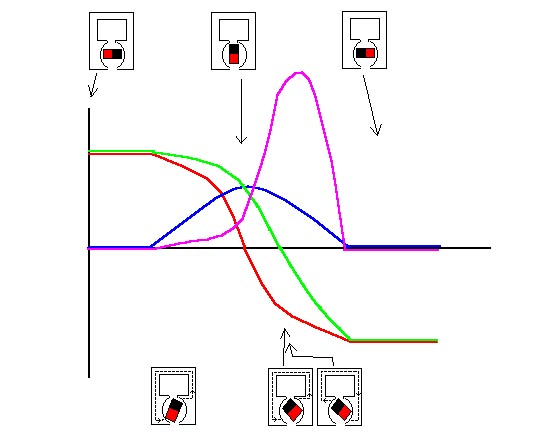
Abrisz means something like "tear off". And what tears here are magnetic field lines. To make everything a little more clear, I made this picture. The picture is not a wonder of graphics art. Neither have I checked everything 100%, but the principals I describe here don't contradict with my own measurements.
The red line describes how the magnetic flux of the rotating magnet devellops during half a camshaft rotation. I have put little magnetos on top so you have an idea of what position of the magnet equalls with the points of the curve. What you see looks a bit like a cosinus with flattened tops because of the wide poles of the magneto body. When the magnet is horizontal, the magnetic flux in the body is maximal. When the magnet is vertical, the flux through the body is null.
The magneto not only has a rotating magnet, but also a primairy coil. The rotation of the magnet is a changing magnetic field, so causes a current in the coil. That current is proportional to the rate of change of the magnetic flux. The current through the coil causes its own magnetic field in the magneto body. That field is directly proportional to the current. I painted that with the blue line. As you see it is null when the magnet's flux is constant, but rises when the magnet's flux is changing. It has its maximum when the magnet's flux is null, because that is the moment of largest change.
The resultant magnetic flux of these two magnetic sources is the green line. It is simply a summation of the two. The funny thing now is that this line doesn't go through zero when the magnet is vertical, but a little later. The devellopers from Bosch have carefully meassured that point and marked it for future reference, for example during tune-up. This point is when the magnetic field lines tear off from one stationary pole and fly to the other side, changing direction in the process. This tearing off of the magnetic field lines is the Abrisz point. I painted the small magnetos at the bottom of the picture, with a thin line that shows how the magnetic field lines change, just before and after the Abrisz point. The distance between the stationairy pole and the magnet-edge at this point is also called the "Abrisz". In old fashioned magnetos it was a datapoint in milimeters, but we have it easier because the magnet and the body are marked.
What is so important about this point? Well, the total magnetic field causes a primairy CURRENT in the coil, that is directly proportional to the change of magnetic flux in the magneto body. I have painted that with the purple line. As you see it has its maximum just at the Abrisz point. That is the best place to open the ignition points for maximum effect.