dynosdynos
Many enthusiasts look to low restriction air filters and or airbox mods to increase air flow.
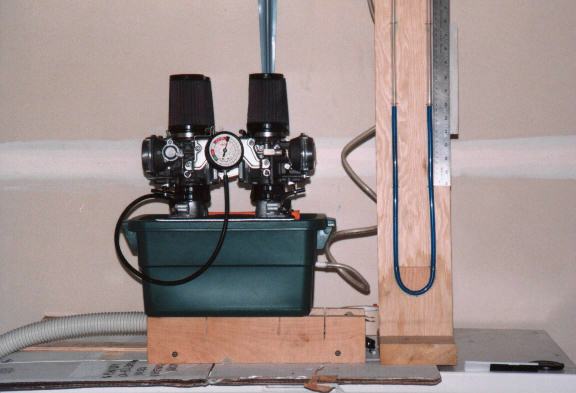
To find out how much the airflow is actually changed with airbox modifications I measured the resistance of a stock unmodified airbox with a manometer. Then by removing the "Y" airhorn piece from the lid I found the resistance to be 32% less than stock. Trimming the airbox lid to match the filter's inside diameter further reduced resistance to 44% less than stock. In other words the stock box is almost twice as restrictive as the modified box.
Interestingly, the pressure readings for the stock box did not change with the stock air filter in, removed or with a K&N filter installed. With the "Y" piece removed and the manometer sensitivity increased (positioned at 45%), I did detect a "slight" improvement with a K&N over the stock filter. Therefore a high flow filter without at least removal of the "Y" piece will offer little improvement of airflow if any at all.
Please keep in mind if you modify your air intake system, the various fueling stages of the Mikuni carbs have to modified as well to maintain an optimum fuel slope.
Do not simply alter your intake (restriction) without appropriate changes to the carbs. For those do it yourselfers who mainly ride on the street, here is my home remedy...
IMHO it's hard to beat the stock set-up on partial throttle
and low end roll-ons. The stock carbs have been well engineered
to work with the stock airbox. But it is at full throttle and
higher rpm's that the problems really show. CV carbs like to gulp
static air and while the Max's airbox is somewhat okay in size
(not great though at 7 liters - 12 would be better) it has way
too small of an intake to be able to fully respond to the air
that the bike needs. However some gains in low and high rpm can
be found...
I am purchasing a small portable manometer to be able to verify
this, but I believe that under full acceleration from any rpm,
the stock box is in a negative pressure mode of up to 20- 30 mb.
And since every 10 mb is good for a couple of hp, we are not
maximizing the bike's potential by leaving it stock. You won't
realize the gain of course unless the fuel delivery is
appropriately adjusted as well.
Simply removing the airbox "Y" for comparison will not
likely yield significantly positive results at low rpm roll-ons.
One reason for this is that the slides require a certain amount
of pressure differential in order to open. Reducing intake
restriction without adjusting the slide rate will slow their
opening... restricting both air and fuel and not necessarily
proportional to each other, resulting in less overall flow and a
less than effective fuel/air ratio.
To compliment a free flow exhaust, I have found as a bit of a
compromise between gains in mid/top end power and boosting the
low end grunt a little as well, is to shim the stock jet needles
.025", and shim the "Y" up 3/16's
of an inch (or as much as your clearance between the dummy tank
cover allows). The bike takes off from 2500 rpm like a raped ape
and keeps pulling up to the red line. Throttle response from
stock is much quicker...
For those who want to go a bit further and open up the airbox,
see my complete article for detailed
intructions on installing a kit. Also Factory Pro offers carb tuning tips.
Back to Top
Many Maxers want their V-boost to open earlier or be on full-time. There are two schools of thought when it comes to the benefits of V-boost activation at various speeds. The first deals with the need for air flow, the second with intake pulses.
Volumetric Effeciency and the need for airflow
The current V-boost activates at around 6000 RPM. This is where peak torque occurs and the engine can best use more airflow. It is also where the engine is operating at its highest volumetric effeciency (VE- how much air is inhaled relative to displacement).
Even assuming a well tuned stock Max has a VE of 115% at 6000 RPM, the required airflow would be about 145 cubic feet / minute (CFM). This will increase to over 195 CFM at peak power (8500 RPM - VE slightly down to about 110%). At 4000 RPM however the VE would likely be down around 90% and the engine would only require an airflow rate of only about 75 CFM (or less than 20 CFM per cylinder).
As you can see, the Yamaha engineers have tuned the V-boost to
provide more airflow when the engine needs it. Simply opening up
the v-boost butterfly valves at a lower RPM on a stock Max will
provide more flow than the engine needs, which may lead to
bogging or overloading.
The Max's Mikuni carb bore of 35 mm
and the vboost pipe diameter of 32 mm provides an slightly larger
equivalent CV carb diameter. A benefit of V-boost is to take
advantage of flow inertia. Rather than each carb stopping air
flow after each intake duration of 276 degrees, either carb will
flow for a total of 552 degrees, providing a minor ramming
effect...According to the John Robinson in "Motorcyle
Tuning-Four Stroke, this combination should be adequate for an
engine of up to about 120-125 rwhp, above that additional flow is
required.
Carb Intake Pulses
There is an arguement for low RPM V-boost activation. A carb doesn't flow constantly. In fact it flows with many stops and starts as the intake valve opens and closes. This process creates carb air pulses. When the valve closes, some of the intake air is still in motion from inertia. It contacts the closed valve and rebounds up the air intake tract. How much this occurs, and how the rebound pulse affects the incoming air depends on the overall intake design and the RPM. The pulses are much more pronounced in low and mid range. This is where V-boost comes in. Opening of the V-boost valve provides the air another place to go (into another cylinder). It also provides a chamber to reduce the overall effect of the pulses. This should provide better low end and mid range throttle reponse. In addtion, it is thought that the multi-port chamber pipes (v-boost tubes) have little effect on high RPM WFO since each carb has little or no air/gas to flow to the second port (almost all of the flow is being used by the primary cylinder) and the pulses are very small in size and duration.
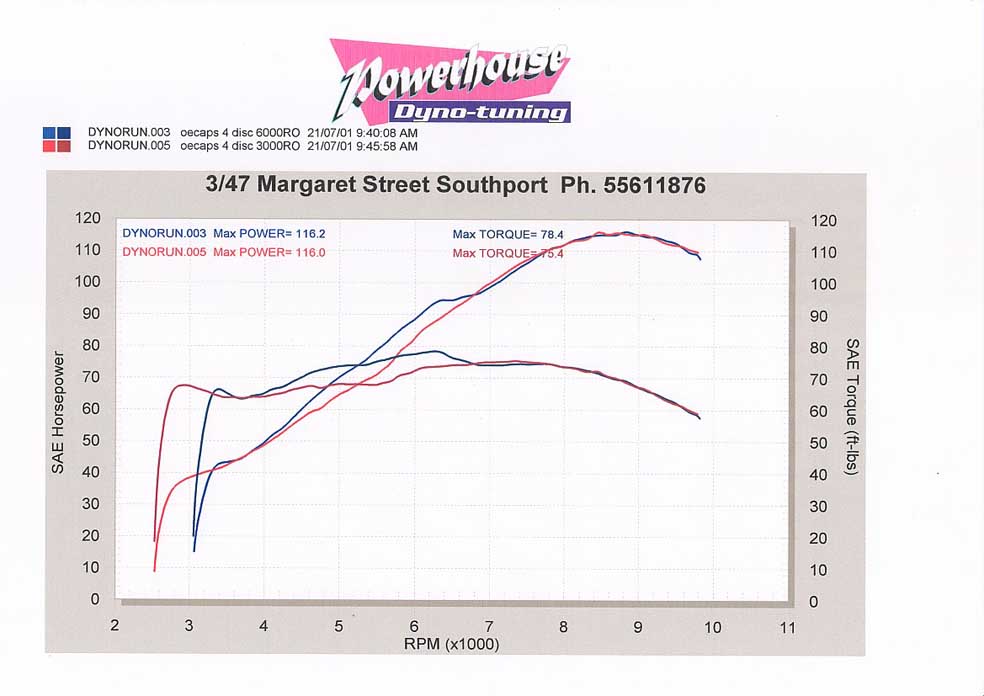
As for the real world results, the stage 7 kit with the permanent cross port, when tuned, may provide a couple of horsepower through-out the power band...however the V-boost feels faster as it opens and the Max comes out of a slight hole.
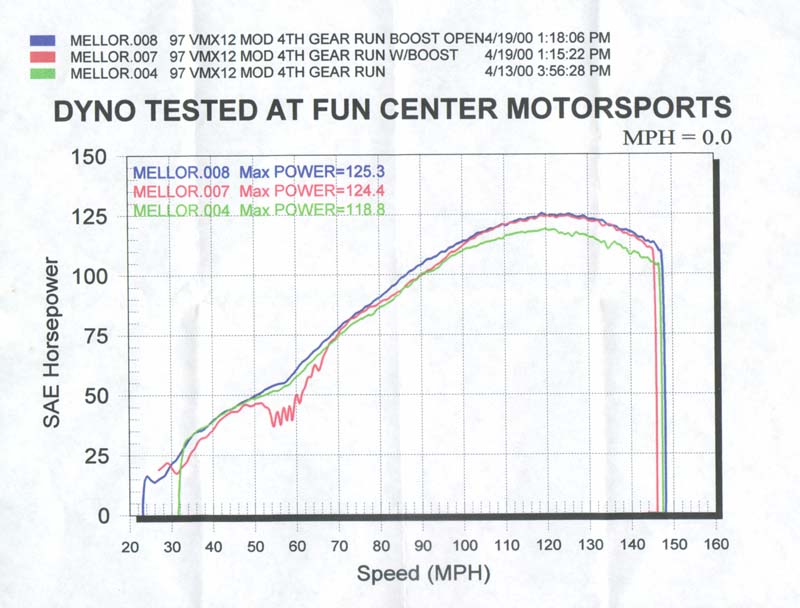
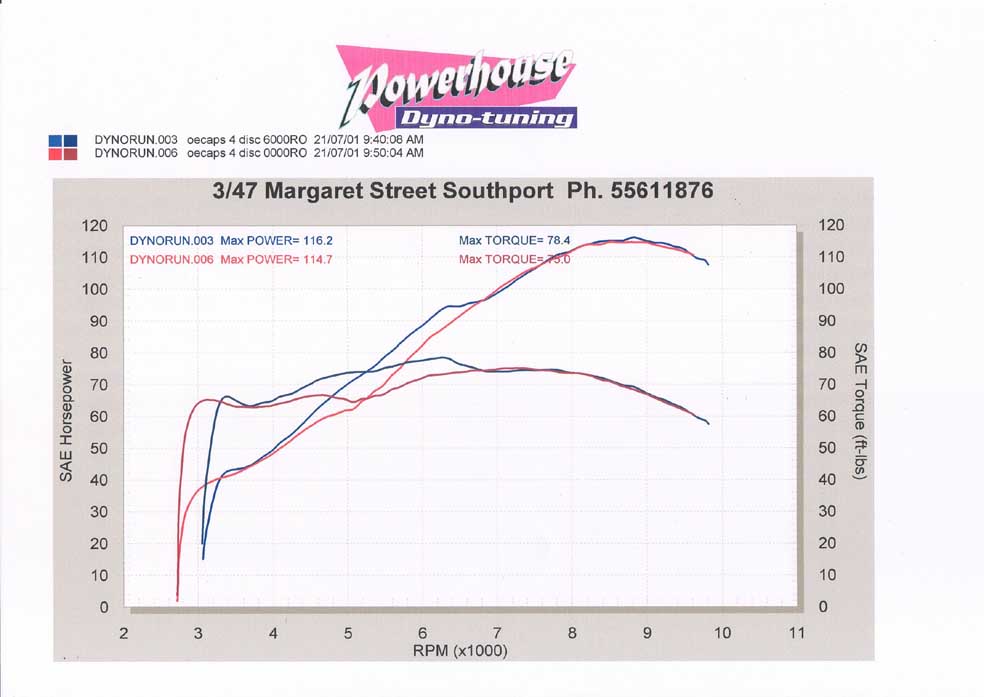
Sample dyno's:
Stage 7 with stock V-boost vs. open all the
time
Stock V-boost vs. open at all times
**
Stock V-boost vs open at 3000 rpm**
**(no tuning between runs - so judge accordingly)
I would recommend staying away from the Stage 7 kit. You will
experience all sorts of flat spots, running problems, fouled
plugs, etc (unless you are lucky, some people find the stage 7 to
be OK, many find it to be lacking). I've got some jetting specs
passed on to me by Dale Walker that work excellent with the
Hindle Pipe, and its very easy and cheap to do, and is completely
reverseable. The stage 7 kit is NOT reverseable. If you don't
like it, you are screwed for the most part. (You have to glue
some air jets in, drill out slides (slides are $120 a *piece*
these days)) Several Stage 7 kits seem to cause the front cyls to
run weaker @ lower RPM than the rear cyls. I think this has
something to do with crankcase pressure being fed into the front
two cyls.
The Hindle pipe, a high-flow air filter, some new main jets,
and a couple of small washers will give you a very nice power
boost, all throughout the RPM's. Give it a try.
Or, if you are really nutty, but a set of 39mm Keihin FCR
(downdraft flatslides) from PCW racing in NY. Want bolt on
horsepower? They are amazing....I just bought a set for my drag
V-Max and threw them on the stock (just for now). I have never
seen such an instanteous boost in power. Instant throttle
response, power ready at any moment. New manifolds, no V-boost.
I'm going to try and get them dyno'ed, although I do have a dyno
printout of a chain drive V-Max w/ these carbs peak HP is 143!!!
and this is well below redline...a nice, wide powerband. (this
horsepower is at the rear wheel). A V-max w/ stage 7 jetting put
out 10 less horsepower. This V-Max also had higher compression
pistons, though, and the chain drive saves some HP.
.... I have read several comments about Stage 7's hard to tune, don't show any appreciable increase, etc. All I know is that 2 1/2 yrs ago I installed a Stage 7 on my Max, no problems with installation, seat of the pants & dyno confirmed no flat spots, gained 12 hp and loved it. I will say that initially I was a little rich in the right rear(the bike, not me) but that was easily solved. The bike continues to run great. So, to those of you that have had problems I'm sorry but to those of you considering Stage 7 don't give up so quick there are some of us out here that have installed them & are happy.
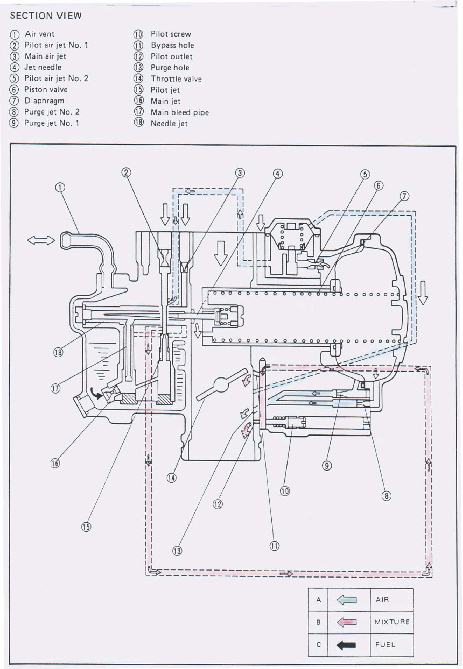
Air going into air jets is NOT intake air... The tiny amount
of air going into the air jets is completely insignificant
compared to the air going through the carb throat
even at idle. Very few people seem to understand the purpose of
air jets in a Japanese carburetor. The air going into these jets
is mixed with the fuel (at more or less equal amounts) to produce
a bubbly "emulsion" of fuel and air. This does two
things: by replacing some of the fuel volume, it allows finer
control of mixture because they can now use a larger fuel jet to
pass the same amount of fuel. See? This makes it easier to adjust
the carb, because each change in fuel jet size or screw needle
has less effect on the mixture. The second thing it does is start
the fuel breaking up & evaporating sooner so it burns more
thoroughly.
I believe the Vmax carbs have 3 air jets. the biggest one
feeds the idle and off-idle jets. The smallest one feeds air into
the main jet & needle. The medium size jet (#190 exc maybe in
CA) mixes air into the idle & off-idle circuit as well. This
medium air jet CLOSES completely when the vacuum rises above a
certain point due to letting off the throttle (coasting). In
other words, the "coasting enricher" works by closing
off this jet.
So the effect of reducing the size of this jet is to make the
idle & off-idle mixture a little richer by reducing the
amount of air mixing into the fuel emulsion when the throttle is
opened & brings the mixture a little closer to where it is
when coasting. The effect on idle can be cancelled out by
readjusting the idle mixture screw. If you have an off-idle
mixture problem (like when cruising at low speed) this is the way
to fix it. Now, if running with the choke partially on gives you
more power (only a theory not proven I know), changing this air
jet down will have the SAME effect because it affects the SAME
fuel circuits the SAME way. It will NOT restrict the breathing of
the engine in any way, the engine does NOT breathe through the
air jets.
The air that comes in the air jet is displacing fuel in the
carburetor circuits, not just going into the engine. Air jets are
not just vacuum leaks. Actually the smallest air jet will have
the most effect at high speed!
All you need is a piece of 25 cent clear plastic hose. Hook it
to the drain valve and open it. The fuel outside the bowl in the
hose will seek the same level as the fuel inside the bowl. The
correct level is measured down from the center of the slide.
There is a mark on the side of the carb to indicate this. If its
wrong you get to take the carbs off to fix it.
The reason a bike backfires is because it is too lean and not
too rich. Your motorcycle has diff carb circuits that control
diff parts of the throttle opening and RPM range. When you put
the K&N in the bike it will lean out the whole range. This
may help you at highway and upper RPM ranges if you really are
too rich there. What I found.(and Im at sea level but it is
Hot&Humid which means my air is thin as far as the bike is
concerned.) is that I had to fatten up the entire range with my
Hindle. Drill out the little adjustment plugs on the pilot
screws. Back them out to about 4 turns to start. (The guy with
the lean condition on the supertrapp mufflers needs to do this
too). This will fix the backfiring and surge or miss down low as
it will fatten it up a little down there. Now take the tops off
the carbs and pull out the diaphram and needle assembly. Shim the
needles up a little with a pack of little washers you can buy @
radio shack for about $1. Now you will have more mid range roll
on power. You dont have to pull the carbs to do either of these
things and your bike should run way better....
The fuel mixture screws are indeed located behind the brass plugs. The brass plugs must be removed to access the screws. Be *very* careful about drilling out the plugs-use a drill stop. If you hit the screws with the drill bit, even for a moment, you risk running the screw down hard against its seat, destroying the screw and possibly the carb seat. Bad.
The fuel mixture screws deal w/ mixture at idle and a little bit above idle. They will determine off idle throttle response and extremely low idle cruising. Turn screws in to lean the mixture out, turn them out to richen the mixture.
Here are some rough guidelines to determine if you are running rich or lean at various RPM's. Examining the plugs is really the best way to get accurate results, but these guidelines will help you shoot for a direction (leaner or richer).
Idle and off idle:
Lean conidition: Poor off idle throttle response, idle that flutters a little after a throttle blip then slowly returns to the idle that you've set, popping back through the carbs when the throttle is blipped.
Rich condition: Off idle response may be good unless plugs are fouled from a way too rich mixture. After a throttle blip the motor will dive down below set idle and will either die if way too rich or may return to set idle if it can recover.
For me, the easiest way to set the idle mixture screws, is to run the motor until warm and idle stable. Run each screw in, one at a time, until the engine stumbles, back the screw out until just rich of peak idle (idle drops again). Then run them back in to peak idle. Repeat for each carb. If your screws are out more than 3 turns, I feel the jet needs to be swapped to the next larger. Your final position should be around 2.5 turns out.
Pilot screw adjustment vs. Carb sync -Terry Campbell
The pilot screw adjustment and the carb sync are really different adjustments all together. If you had never done a carb sync it was probably good advise to do it once before fooling with the mixture/pilot screws .. or anything else. The carb sync is intended to equalize the opening of the carburetor throttle plates, (this is beneficial throughout their range of operation).
The reason you see different recommended mixture/pilot screw setting in the manual for the different models is because these bikes all have different size pilot air jets, (primary ... the one on the top of the carb ... the secondary pilot air jet is the same on all models and it hides behind the slide rubber inside the carb). Air from "both" of the pilot air jets mix with gasoline from the "pilot fuel jet" to produce the mixture that you control with the mixture/pilot screw, (except when you open the throttle a little .. because there is a bypass hole .. but that is another story).
The reason you'll find the screws set differently in each carb is because at the factory, (hopefully), they set these precisely using a CO meter connected to each cylinder via the little 1/4 pipe plugs you see in the factory exhaust pipes. These differences make up for the uniqueness of each carburetor and cylinder it is attached to, (rather unavoidable .. as minute as it might be). Cranking these screws out beyond where they might have been set originally will increase the CO readings for the respective cylinder, (make it richer at idle). Even though there might be other ways to achieve your objective ... this works pretty good for adding additional fuel at off idle ... and at light, (no load ), up to about 1/8 throttle throughout your mid-range, (which hopefully you will find beneficial).
There is a limit to this benefit and if you do more to your intake etc you may find you need to do something more substantial for you light throttle fuel requirements and do something different, (like make one of the pilot air jets smaller or the pilot fuel jet larger etc). As most of these bikes have the pilot screws set on the "lean" side for emission purposes you will hopefully benefit to some extent by backing them out a little. The models with the bigger primary pilot air jets etc are going to require a little more twist to achieve a comparable mixture result, (unless you are doing the ear routine or have your own $125 JCWhitney CO meter).

Home