| DAVID
GOH'S HOME PAGE Last updated: 04 Feb 2003 This page is located on:
|
Motorised Bicycles
(Singapore) Published in the Straits Times newspaper on 04 February 2003
For some motorised bicycles, you need a licence Battery-operated bikes are growing in popularity here, but many users do not know some are classed as motorcycles and they need approval and must abide by motorcycle rules By Arlina Arshad
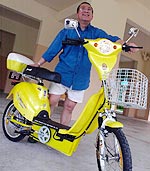
Battery-powered bicycles are a cheap, fast and convenient way to scoot around. They don't have to be registered and you don't need a licence to ride them. Well, that is what people think. But there is a big grey area surrounding these groovy little machines, which are soaring in popularity here. They are no longer classed as bicycles if they can either move faster than 25 kmh or have a maximum power output of more than 200 watts. These more powerful machines are classed as motorcycles, which means they must be inspected for approval and insurance. The rider also has to be licensed and must abide by the safety and traffic rules imposed on other motorcyclists. More than 10,000 motorised bikes have been sold here over the past two years. But distributors say hundreds of owners are unknowingly breaking the law by riding powerful versions of these bicycles on the road, without registering them. Two bicycle distributors who declined to be named said some shops were selling models with outputs as high as 350 watts, but were telling their customers they could use them on the roads without going through any approval process. It is an open secret that this is happening, they said, adding that the practice was not only affecting their business, but also confusing the public. A spokesman for Nan Hua Enterprise said sales of these bikes had doubled since two years ago, adding: 'More and more people are buying these bicycles and the do's and don'ts must be clear so we know what to tell buyers. The authorities should enforce the law and make sure sellers and buyers comply.' The Land Transport Authority's position on battery-powered bicycles is clear: The cut-off is 200 watts. Those who flout the guideline could be fined up to $2,000 and jailed for three months if it is their first offence. However, there is a lot of confusion among distributors, retailers and buyers. Mr Eddie Goh, 41, director of a talent agency, was told to get his motorised bicycle inspected instead when he called the traffic police asking for the do's and don'ts. 'Why should I go through all that hassle? I should know this before I buy the bike,' he lamented. Mr Mohammed Yunos Mohammed Taib, 42, a storeman whose wife sends her two children to school on a battery-powered bike, said: 'She doesn't know whether it's okay to ride on the road instead of the pavement... It moves faster than a bicycle, so people get irritated when she rides on the pavement.' The bikes can pass for mini scooters with their plastic-encased bodies, headlights, mirrors and horns. The only difference is that they have pedals. Mr Terence Tan, owner of City-Angel, which sells 100 battery-powered bicycles a month costing between $300 and $1,500 each, said his customers were worried about the appearance of the bicycles. 'It's a cat that looks like a tiger. They want to know if these bicycles are classified as motorcycles.' Others expressed safety concerns. Mr Mohammed Yunos said: 'I've seen some kids racing on the road with friends and they were going faster than 25 kmh. It's quite dangerous.' |
|||