DAVID GOH'S
HOME PAGE

Last updated: 04 Nov 2002

MOTORCYCLING

D'Singapore Scene

David's SoapBox

HOME

SCUBA-DIVING

MORE STUFF

PHOTO ALBUM

SITE MAP

E-MAIL DAVID

This page is located on:

gc_icon.gif (2851 bytes)

MotorCityPit.gif (2330 bytes)

  Getting a Singapore Biking License

Page created 22 July 1999


Once upon a time...

Like most other countries, getting a motorcycle driving license was quite straightforward.  There was also only one license class for motorcycles.  One applied for a "Class 2" provisional driving license, bought a motorcycle, stuck an "L" (learner) plate on it, and rode about till one was ready to take a driving test and (hopefully) passed it (on the first try)...


That was then; and this is now...

Singapore has made a huge effort over the years to improve the safety level among bikers, and in terms of statistics, reduce the death and accident rate among motorcyclist.

The "L" plate system for motorbikes is gone... learners can only ride in driving schools and nowhere else (it's illegal).  This forces all to go through rigorous theory and practical classes.  The two big ones here are SSDC and BBDC.

Singapore now has a "progressive" motorcycle driving license system.  There are different motorcycle licenses that restricts the size of bike one could ride.  There are now 3 bike licenses, and one must progress through all the lower classes before being able to ride the largest motorcycles and perhaps most appealing motorcycles:

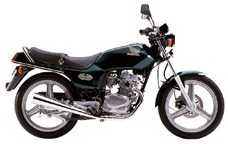
  • Class 2B - for bikes with engine capacity of up to 200 cubic centimetres
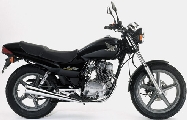
  • Class 2A - for bikes up to 400 c.c.
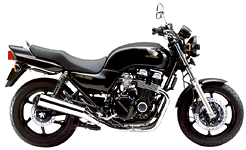
  • Class 2 - for bikes above 400 c.c.
  • (current Class 2B + 2A + 2 = old Class 2)
cb125t-c0.jpg (5809 bytes) cb125t-c0.jpg (5809 bytes) cb750-c0.gif (18950 bytes)
typical Class 2B trainer
Honda CB125T
typical Class 2A trainer
Honda CB250
typical Class 2 trainer
Honda CB750

.


.

    Progressive licensing

Everyone starts off at Class 2B.  One has to go through mandatory theory and practical lessons at the training schools, as well as pass theory and practical tests conducted by the Traffic Police before being issued with a Class 2B license.

During the first year of riding, it is mandatory to put on a special traingular plate, which indicates to other motorists that the rider/driver has only recently passed his/her driving test and is on probation (similar to the "P" plate used in Australia and elsewhere).  During that first year, if one chalks up enough demerit points for various traffic offences, the Traffic Police will revoke the driving license.

One has to wait at least one year before repeating the process (classes and tests) to acquire the Class 2A license. 

This is similarly repeated again one year later for the Class 2

The idea behind this is that of safety: one builds up experience by riding smaller bikes first before progressing to bigger and more powerful bikes... as opposed to a fresh novice rider taking a huge bike and crashing it on the first go, killing himself/herself and endangering others around him/her.

Click here to read more about getting driving licenses from the Singapore Government information web-page


    Extract from "Jama Motorcycle"
Volume 3, Number 1, Spring 1997


Singapore Working Toward Reducing Traffic Accidents

  -  Asia's First Safety Riding Center Using Japanese Know-How

In the early 1980s, Singapore experienced a rapid increase in the number of traffic casualties. The Government of Singapore sent a team to Honda's traffic education center in March of 1982, and made a proposal to establish a safety education facility as a joint venture with local capital.

Thus, the SSDC (Singapore Safety Driving Center) and BBDC (Bukit Batok Driving Center) were established in June of 1985 and April of 1990, respectively.

24,000 motorcyclists and 19,000 automobile drivers entered one of the two schools in '95, with 14,000 motorcyclists and 9,600 automobile drivers graduating. The local law mandates that motorcycle riders must be trained at one of the schools, so those who do not graduate are not able to get licensed.

Comprehensive education in theory and practice

The education is given from angles of both theory and practice. In practice, the students first learn riding posture, braking, cornering (slalom and zigzagging), and balancing in a course in the center. The next step is on-the-road training. A team of 6 students follow a 3.5 km course, led and followed by a pair of instructors with transceivers. They ride a distance of 40 km in 3 hours.

Comparing the traffic accident fatalities of '94 with the figures in '85 when the SSDC started operating, the number of traffic fatalities per 100,000 vehicles, including automobiles, decreased from 54 to 42.

Singapore's Safety Driving Centers

  SSDC BBDC
Opened June 1985 April 1990
Total Area
  • Training Course

  • Classroom,office
  • 27,000m3 30,000m3
    23,000 m3 24,000 m3
    2,800 m3 3,053 m3
    Model Used 2w
  • 4w
  • 131 units 125 units
    66 units 131 units
    2w Instructor
    4w Instructor
    Others
    28 persons 30 persons
    122 persons 208 persons
    28 persons 74 persons

    We have investigated education systems in various countries and found that the Japanese system contributed mostly to the reduction of the death rate due to traffic accidents......"
    (government official comment quoted by The Singapore Science Monitor)

    .


    .


    Hosted by www.Geocities.ws

    1