DAVID
GOH'S
HOME PAGE
Last updated: 03 Sep 2003MOTORCYCLING
D'Singapore Scene
David's SoapBox
HOME
SCUBA-DIVING
MORE STUFF
PHOTO ALBUM
SITE MAP
E-MAIL DAVID
This page is located on:


|
|
HD 100th
Anniversary Features Page
created 16 August 2003, Last update 03 September 2003
Return to D'Singapore Scene
HD bikes may not be my
favourite, but we all love riding our motorcycles and
freedom. Congrats to HD and all HD owners in
Singapore and everywhere. Ride safe and enjoy!

News clippings from
various sources on the 100th anniversary of
Harley-Davidson. Also related articles.
Links:
|
| |
|
|
| top 30
Aug 2003 - Ride on, Harley
30 Aug 2003 - Fans kick-start
Harley's 100th anniversary
30 Aug 2003 - Hogs on parade for
100th anniversary
29 Aug 2003 - Harley-Davidson Thinks
Young as It Turns 100
28 Aug 2003 - Harley fans kick-start
100th anniversary party
28 Aug 2003 - Collectors yearn for
old Harley bikes
28 Aug 2003 - Harley-Davidson Marks
100th Birthday
28 Aug 2003 - Harley Davidson stuff:
Serious business
28 Aug 2003 - Retro-bikes gain ground
27 Aug 2003 - Harley cruises into
second century
27 Aug 2003 - Harley-Davidson
motorbikes rev up in 100th yr
23
Aug 2003 - An American Icon turns 100
19 Aug 2003 - Takin' a tour of
Harleys and beer
16 Aug 2003 - Vintage Motorcycle
Jacket Values Zoom Ahead
|
|
Source
URL: http://straitstimes.asia1.com.sg/world/story/0,4386,207290,00.html
 AUG 30, 2003
Ride on, Harley
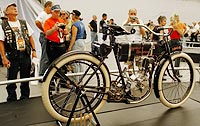
Harley Davidson enthusiasts taking in one
of the early bikes from 1905. They were
at an event in Milwaukee in the US, to
mark the American icon's 100th
anniversary. -- REUTERS |
NEW YORK - As
Harley-Davidson motorcycles roll into
their 100th anniversary this week, owners
and collectors are celebrating an
American icon that has come to represent
cool - at a growing price tag. The 'tough-guy' image costs
buyers of a new Harley-Davidson as much
as US$150,000 (S$263,000) for rare, early
models in Japan, a major market for
Americana.
|
The company - founded in
1903 by William Harley and Arthur Davidson -
embraced that image in recent decades as 'bad'
became marketably 'cool' and rock 'n' roll became
mainstream.
-- Reuters
|
|
| top 30
Aug 2003 - Ride on, Harley
30 Aug 2003 - Fans kick-start
Harley's 100th anniversary
30 Aug 2003 - Hogs on parade for
100th anniversary
29 Aug 2003 - Harley-Davidson Thinks
Young as It Turns 100
28 Aug 2003 - Harley fans kick-start
100th anniversary party
28 Aug 2003 - Collectors yearn for
old Harley bikes
28 Aug 2003 - Harley-Davidson Marks
100th Birthday
28 Aug 2003 - Harley Davidson stuff:
Serious business
28 Aug 2003 - Retro-bikes gain ground
27 Aug 2003 - Harley cruises into
second century
27 Aug 2003 - Harley-Davidson
motorbikes rev up in 100th yr
23
Aug 2003 - An American Icon turns 100
19 Aug 2003 - Takin' a tour of
Harleys and beer
16 Aug 2003 - Vintage Motorcycle
Jacket Values Zoom Ahead
|
|
Source
URL: http://business-times.asia1.com.sg/story/0,4567,92488,00.html
 August 30,
2003
Fans kick-start Harley's 100th
anniversary
 MILWAUKEE -
Blair Kane couldn't celebrate Harley-Davidson's
100th anniversary without his two young
daughters. MILWAUKEE -
Blair Kane couldn't celebrate Harley-Davidson's
100th anniversary without his two young
daughters.
So he tucked them into his Road
King's sidecar and rumbled to Milwaukee with his
wife perched behind him - for all 4,023km from
their home in British Columbia, Canada.
'It's boring in the (family)
truck,' said 7-year-old Stephanie, preferring the
black sidecar stenciled with Two Peas in a Pod on
back.
Kane, a Harley dealership
owner, and his family were among thousands of
Harley lovers who roared into southeastern
Wisconsin to celebrate the motorcycle maker's
centennial. The four-day celebration started on
Thursday with fireworks blasted from the roof of
the firm's downtown headquarters.
Harleys lined the streets, and
their distinctive growl reverberated downtown.
Riders in black leather and denim checked out
other bikes and soaked up the all-Harley
atmosphere.
John Kavanagh, 43, also didn't
let distance deter him from the party. He shipped
his motorcycle from his home in Australia to San
Francisco, where he reclaimed it for the trip to
Milwaukee.
'I have a long history of
riding Harleys. I'll probably ride my bike to the
200th,' joked Kavanagh, who browsed the
motorcycle exhibits along the lakefront.
In one exhibition tent, Elvis
Presley's 1956 orange-and-white Model KH was
parked next to Jon Bon Jovi's red-and-white 1986
Heritage Softail.
In another, a 1960 Sportster
with a fuzzy seat cover and the words 'Mrs Sup
Jr' painted on its blue-and-white gas tank
contrasted with the 1927 olive green Peashooter
racer with its turned-down handlebars.
Gleaming 2004 models in all
colours lined up under another tent.
The celebration, expected to
draw up to 300,000 people, also features a parade
of 10,000 Harleys through the city on Saturday
and a birthday party with music and fireworks on
Sunday.
Harley dealerships and cities
around southeastern Wisconsin marked the
anniversary with rallies or parties of their own
throughout the week.
Tom and Suegayle Lucas of
Detroit turned Harley's 100th birthday into a
monthlong trip across the country on their
pearl-white Heritage Softail. They cruised
through 11,263km in 16 states before pulling into
Milwaukee.
'Our bike has dirt on it from
every state,' said Suegayle Lucas, 56. 'We won't
wash our bike until we get home.'
|
|
| top 30
Aug 2003 - Ride on, Harley
30 Aug 2003 - Fans kick-start
Harley's 100th anniversary
30 Aug 2003 - Hogs on parade for
100th anniversary
29 Aug 2003 - Harley-Davidson Thinks
Young as It Turns 100
28 Aug 2003 - Harley fans kick-start
100th anniversary party
28 Aug 2003 - Collectors yearn for
old Harley bikes
28 Aug 2003 - Harley-Davidson Marks
100th Birthday
28 Aug 2003 - Harley Davidson stuff:
Serious business
28 Aug 2003 - Retro-bikes gain ground
27 Aug 2003 - Harley cruises into
second century
27 Aug 2003 - Harley-Davidson
motorbikes rev up in 100th yr
23
Aug 2003 - An American Icon turns 100
19 Aug 2003 - Takin' a tour of
Harleys and beer
16 Aug 2003 - Vintage Motorcycle
Jacket Values Zoom Ahead
|
|
Source URL: http://edition.cnn.com/2003/US/Midwest/08/30/offbeat.harley.ap/index.html
 Hogs on parade for 100th anniversary
10,000 rumbling Harleys
cruise through Milwaukee
Saturday, August 30, 2003
Posted: 1811 GMT ( 2:11 AM HKT)
| MILWAUKEE,
Wisconsin (AP) -- Ten thousand Harley
riders wearing anything from Hog masks
and feather boas to black leather roared
through the city Saturday on an 8-mile
parade celebrating Harley-Davidson's
100th anniversary. The event was as much a tapestry
of red, white and blue as the motorcycle
icon's signature orange and black. One
Harley rider festooned his bike with two
dozen American flags.
|
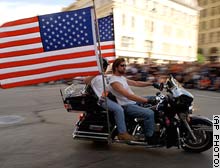
One of the 10,000 motorcycles
participating in the official
Harley-Davidson parade rides through
downtown Milwaukee on Saturday. |
Willie G. Davidson, a
grandson of Harley-Davidson's co-founder, and his
wife, Nancy, led the parade, followed by riders
on bikes toting large Harley flags representing
riders' clubs from all over the world.
"It just shows the
diversity of people, how they can get together
for a celebration like the Harley-Davidson
anniversary," said Bob Boyd, 67, who rode
his 2003 Dyna Wide Glide Harley from his farm in
London, Ontario.
"This Canadian feels part
of the American spirit. We're family."
Some of the motorcyclists were
picked to participate in the parade because they
had raised at least $5,300 for the Muscular
Dystrophy Association. Harley has a 23-year
history with the association and hoped to raise
more than $5 million for the group during the
Labor Day weekend.
The parade was one of the
highlights of Harley's four-day anniversary
celebration, which also includes motorcycle
exhibits, memorabilia sales and live
entertainment centered along Lake Michigan's
shoreline.
As spectators in T-shirts and
shorts mingled with those in denim and leather,
at least one neighbor worried about the noise
Saturday. The Milwaukee County Zoo took
precautions to protect its more than 2,000
animals from the roar in the parking lot just
outside, where the parade began, keeping many of
the animals inside until the riders were gone.
The celebration, expected to
draw 200,000 to 300,000 people, concludes Sunday
with a birthday party featuring music and
fireworks beside Lake Michigan.
|
|
| top 30
Aug 2003 - Ride on, Harley
30 Aug 2003 - Fans kick-start
Harley's 100th anniversary
30 Aug 2003 - Hogs on parade for
100th anniversary
29 Aug 2003 - Harley-Davidson Thinks
Young as It Turns 100
28 Aug 2003 - Harley fans kick-start
100th anniversary party
28 Aug 2003 - Collectors yearn for
old Harley bikes
28 Aug 2003 - Harley-Davidson Marks
100th Birthday
28 Aug 2003 - Harley Davidson stuff:
Serious business
28 Aug 2003 - Retro-bikes gain ground
27 Aug 2003 - Harley cruises into
second century
27 Aug 2003 - Harley-Davidson
motorbikes rev up in 100th yr
23
Aug 2003 - An American Icon turns 100
19 Aug 2003 - Takin' a tour of
Harleys and beer
16 Aug 2003 - Vintage Motorcycle
Jacket Values Zoom Ahead
|
|
Source URL: http://www.reuters.com/newsArticle.jhtml?type=topNews&storyID=3360460
 Harley-Davidson Thinks Young as It Turns
100
Fri August 29, 2003 04:25
PM ET
By Susan Kelly
MILWAUKEE (Reuters) -
Dennis Stamm, a lifelong Harley-Davidson rider,
remembers getting around town on the back of his
father's motorcycle when he was a boy and the
family of five had no car.
"I was born and raised
with Harleys," said the 61-year-old
machinist from Leesport, Pennsylvania, wearing a
black leather cap and T-shirt promoting his local
Harley Owners Group (H.O.G.) club.
After raising three children of
his own and working two jobs most of his life,
the open road beckons. Riding a custom Electra
Glide touring bike, he is among hundreds of
thousands of Harley faithful who have made the
cross-country pilgrimage to this blue-collar
Midwest city to mark the manufacturer's 100th
anniversary.
"To me, it's family. It's
tradition," he said. "You ride and
forget all your worries in the world. You just
think about getting out in the fresh air and
having a good time."
At times the roar of the
engines was deafening as Harley enthusiasts from
across the country converged in a blur of chrome,
wheels and leather to pay homage as much to the
Harley lifestyle as to the manufacturer's status
as a bona fide American legend.
The Milwaukee celebration,
capping a yearlong blitz of parties, rides and
record revenue boosted by sales of
special-edition bikes and Harley-Davidson Inc.
anniversary memorabilia, attracts the most
die-hard of Harley loyalists.
"It's a once-in-a-lifetime
opportunity," said a jittery Bob Rietzler,
56, just minutes before marrying his sweetheart
under the midday sun in a makeshift chapel in the
parking lot behind Harley-Davidson's red-brick
headquarters in downtown Milwaukee.
The bride, Lisa Dibrino,
wearing a red dress, arrived in a sidecar
attached to a Harley bike as the groom looked on,
his long, wavy gray hair flowing over the
shoulders of his silver-studded tuxedo.
RIDERS WELCOMED 'HOME'
Company-sponsored anniversary
events, from parades and concerts to drag-racing
demonstrations, began on Thursday and continue
through the Labor Day weekend. Activities were
spread out across several venues near the city's
lakefront, snarling traffic along the Lake
Michigan shoreline.
The experience only seemed to
energize local residents, who stood on highway
overpasses holding signs welcoming the riders
"home" to Milwaukee, and the mostly
middle-aged bikers who waved back.
"We learned a lot about
America during this trip. The villages are really
very small," said Herman Weltns, a
58-year-old German engineering executive at
Tenneco Automotive Inc. who got his first Harley
when he turned 40. Weltns traveled from Germany
to attend the celebration, taking the back roads
after arriving in Detroit.
Harley-Davidson, which survived
the Great Depression and rebounded after foreign
competition drove the company to near-bankruptcy
in 1985, today is revered as much by Wall Street
as by its loyal customers.
Its bikes can carry price tags
upward of $30,000 when outfitted with custom
colors and accessories.
Vern Berreth, 54, the owner of
an auto parts store in Denver said: "What I
like about Harley is the accessories. You can
make each bike your own."
To broaden its appeal beyond
the legions of affluent, but aging baby boomers,
Harley has revamped its line of entry-level
Sportster bikes and rolled out stylish new models
of its V-Rod "power" cruisers. The 2004
bikes were unveiled to the public during the
Milwaukee celebration.
Harley is hoping to attract
more of the younger riders like Chris Steinmetz
into the fold.
Steinmetz, a 28-year-old
Chicago firefighter, bought his first Harley, an
$11,000 Sportster model, last year. He chose a
Harley, he said, even though it was a stretch to
afford.
"It was the only one I
wanted to get," said Steinmetz, who admitted
to "peer pressure" from co-workers to
buy a Harley.
"There's something about a
Harley. They are just noisier and cooler,"
he said.
|
|
| top 30
Aug 2003 - Ride on, Harley
30 Aug 2003 - Fans kick-start
Harley's 100th anniversary
30 Aug 2003 - Hogs on parade for
100th anniversary
29 Aug 2003 - Harley-Davidson Thinks
Young as It Turns 100
28 Aug 2003 - Harley fans kick-start
100th anniversary party
28 Aug 2003 - Collectors yearn for
old Harley bikes
28 Aug 2003 - Harley-Davidson Marks
100th Birthday
28 Aug 2003 - Harley Davidson stuff:
Serious business
28 Aug 2003 - Retro-bikes gain ground
27 Aug 2003 - Harley cruises into
second century
27 Aug 2003 - Harley-Davidson
motorbikes rev up in 100th yr
23
Aug 2003 - An American Icon turns 100
19 Aug 2003 - Takin' a tour of
Harleys and beer
16 Aug 2003 - Vintage Motorcycle
Jacket Values Zoom Ahead
|
|
Source URL: http://edition.cnn.com/2003/US/Midwest/08/28/harley.anniversary.ap/index.html
Harley fans kick-start 100th anniversary
party
Thursday, August 28, 2003
Posted: 2000 GMT ( 4:00 AM HKT)
| MILWAUKEE,
Wisconsin (AP) -- Harley-Davidson
enthusiasts from around the nation and
the world were roaring into town as the
legendary motorcycle maker geared up for
its centennial celebration. Harley's four-day event starts
Thursday and was expected to draw 200,000
to 300,000 people. The festivities center
on Milwaukee's lakefront and include a
parade of 10,000 Harleys through the
city.
People waved from
freeway bridges Wednesday to welcome
riders streaming in from across the
nation. Several accidents involving
motorcycles snarled freeway traffic at
times.
|
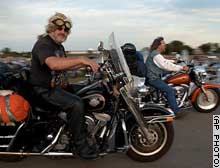
Harley-Davidson riders arrive Wednesday
in West Bend, Wisconsin, for anniversary
celebrations. |
"I'm loving it. I'm
here. I made it through Chicago," said
Rhonda Racklisse, who rode some 1,800 miles from
Minot, Maine.
She said she started riding her
own Harley a year ago after spending years on the
back of her husband's bike.
"I was bored riding in the
back," she said.
This time, Rhonda and Randy
Racklisse rode separate bikes, making the trip
with their 20-year-old son, Josh, "to visit
the best family in the world."
"We're all brothers and
sisters," she said.
Dave and Rita Chester from
Philadelphia stopped at a truck stop on their way
and encountered 11 people from England, also
riding Harleys to the celebration.
"It's just like a
fraternity, a massive club, where everyone has
one commonality, a Harley-Davidson
motorcycle," he said.
The grand finale Sunday will be
a 100th birthday party with music and fireworks
at the Lake Michigan shore.
Classic rock acts such as
Kansas, Peter Frampton and REO Speedwagon will
perform, and 80,000 square feet of exhibits will
showcase antique motorcycles, clothing, film
clips and bikes owned by Elvis Presley and Jon
Bon Jovi.
On Wednesday, Harley provided
an early start for many riders by marking the
first 20 years of HOG, or Harley Owners Group.
Up to 100,000 motorcyclists
were expected to cruise through the annual HOG
rally at the Washington County Fair Park at West
Bend, 30 miles north of Milwaukee, by the time it
ends Saturday night.
The company started the club in
1983 as a way to allow people to share the Harley
experience.
About 30,000 riders joined in
its first year, and the group now numbers about
750,000 in more than 1,300 chapters worldwide.
Members meet regularly for rides, parties,
fund-raisers, motorcycle seminars and other
events.
Frank Lamantia of New York City
said he rode a motorcycle as a young man but gave
up his bike in 1988 when he had a son. He got
another motorcycle in 2001, and hooked up with
HOG to find people to ride with.
"Now it's a form of
recreation for me," he said. "You can
ride around or you can ride with a group, but
you're also an individual so you make your bike
individual" through the selection of
accessories.
|
|
| top 30
Aug 2003 - Ride on, Harley
30 Aug 2003 - Fans kick-start
Harley's 100th anniversary
30 Aug 2003 - Hogs on parade for
100th anniversary
29 Aug 2003 - Harley-Davidson Thinks
Young as It Turns 100
28 Aug 2003 - Harley fans kick-start
100th anniversary party
28 Aug 2003 - Collectors yearn for
old Harley bikes
28 Aug 2003 - Harley-Davidson Marks
100th Birthday
28 Aug 2003 - Harley Davidson stuff:
Serious business
28 Aug 2003 - Retro-bikes gain ground
27 Aug 2003 - Harley cruises into
second century
27 Aug 2003 - Harley-Davidson
motorbikes rev up in 100th yr
23
Aug 2003 - An American Icon turns 100
19 Aug 2003 - Takin' a tour of
Harleys and beer
16 Aug 2003 - Vintage Motorcycle
Jacket Values Zoom Ahead
|
|
Source URL: http://money.cnn.com/2003/08/28/pf/autos/bc.usa.harley.reut/index.htm
 Collectors yearn for old Harley bikes
Classic Harley-Davidson
motorcycles more than hold their value.
August 28, 2003: 9:52 PM EDT
NEW YORK (Reuters) - As
Harley-Davidson Inc. motorcycles roll into their
100th anniversary this week, owners and
collectors are celebrating an American icon that
has come to represent coolness and badness
worldwide -- at a growing price tag.
This image costs buyers of a
new Harley-Davidson $8,000 to $25,000 -- far more
than other brands -- and as much as $150,000 for
rare, early models in Japan, a major market for
Americana.
"Many motorbikes look like
Harleys, but a Harley sounds so different,"
said Lin Todd, a former helicopter pilot who,
like other Harley fans, revels in the
"heavy-throated, muscular sound" that
other makers try unsuccessfully to imitate.
Even among newer models,
"Harleys hold their value better than any
other brand," added Mark Andrew, who works
for a trucking company. He estimated that his
fifth Harley, for which he paid $15,000 in 1998
and accessorized, could sell for up to $22,000 --
unless he trades it in at book value at a
dealership.
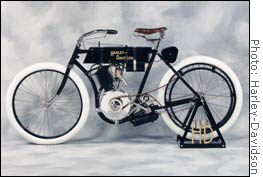
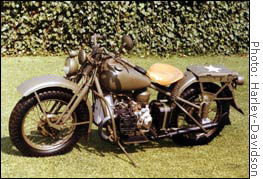
Harley-Davidson's first production
motorcycle |
The loud roar of the
engine -- which riders amplify by
adjusting or removing the mufflers -- is
just one aspect of the black leather,
bad-boy image that Harley-Davidson tried
to shake for most of its life. The
company -- founded in 1903 by William S.
Harley and Arthur Davidson, and joined
later by Davidson's brothers Walter and
William -- finally embraced that image in
recent decades as "bad" became
marketably "cool" and rock n'
roll became mainstream. |
"It's one of those
images associated with freedom,
individuality," said Bill Jack, senior
archivist at Harley-Davidson Motorcycle Co. in
Milwaukee, Wisconsin. "Riders talk about
motorcycling as a peaceful experience, a frontier
activity. There's a tribal nature to it.
Information and history are passed on
orally."
The aura of motorcycling has
been popularized by movies such as Marlon
Brando's "The Wild One" (1953), Steve
McQueen's "The Great Escape" (1963)
and, recently, "Bad Boys."
But this image goes back to the
1880s, when inventors such as Gottlieb Daimler in
Germany motorized a bicycle with a gas engine. By
the early 1900s, hundreds of companies were
making these new loud and fast machines with no
brakes or clutches.
Harleys were made especially
rugged and heavy for the clayey muck of Milwaukee
winters. The daredevil image stuck when in 1936,
Harley-Davidson focused on the sports market to
survive in competition with the cheap, plentiful
automobiles rolling off Henry Ford's assembly
line.
Collector value
Motorcycles from that period
and earlier are the most valuable, because most
were junked in a country that favored the new.
Models from 1905 to 1909 are
now worth $80,000 to $150,000, according to
Manabu Okada, owner of Semba,
Japan's largest dealership. Taxes, freight and other charges push
prices up in Japan, said the collector, whose
grandfather started the business by buying up 200
military Harleys from the U.S. Army after World
War Two. These models now sell for $13,000 to
$18,000 on both sides of the Pacific.
Today, a restored 1936
Knucklehead -- named after the shape of its
engine -- is worth $50,000 to $100,000, double
the price in the mid-1980s. One completely
restored model sold for $95,000 just six months
ago in the United States, Okada said.
The Knucklehead, also called
"the Blockhead" by Harley enthusiasts,
was a milestone in design, with styled square
blocks that housed the valves. It begat other
innovative engines such as the Panhead (1948),
Shovelhead (1966), Evolution (1983) and Twin Cam
88 (1999) for which collectors pay a premium
prices.
| In 1984
Harley-Davidson went public, and antique
motorcycles sold for record prices at a
auction after Steve McQueen's death,
setting the tone for the secondary Harley
market up till now. "What people want are
unrestored original motorcycles,
relatively unused," said Dale
Walksler, who in 2000 sold his
Harley-Davidson dealership and set up the
Wheels Through Time Museum in Maggie Valley, North
Carolina, with his personal collection.
|
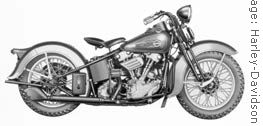
Harley-Davidson's "Knucklehead"
engine was introduced on this 1936 model. |
High prices have spawned
fakes. Last year, a totally fictitious "1908
Harley-Davidson racer" sold for $17,000 in
an Internet auction. Concerned members of the Antique Motorcycle Club of America notified the buyer, who managed to get
"most" of his money back, said Wagner,
author of "Harley-Davidson 1930-1941: Revolutionary
Motorcycles & Those Who Rode Them".
"He later sold it with a
disclaimer, for a 'mere' $4,000," he said.
"But it's still as phony as a $3 dollar
bill."
To celebrate its 100th
Anniversary, Harley-Davidson has released
"100 Years of Harley-Davidson"
(Bulfinch Press), by Willie G. Davidson, grandson
of company co-founder William A. Davidson.
|
|
| top 30
Aug 2003 - Ride on, Harley
30 Aug 2003 - Fans kick-start
Harley's 100th anniversary
30 Aug 2003 - Hogs on parade for
100th anniversary
29 Aug 2003 - Harley-Davidson Thinks
Young as It Turns 100
28 Aug 2003 - Harley fans kick-start
100th anniversary party
28 Aug 2003 - Collectors yearn for
old Harley bikes
28 Aug 2003 - Harley-Davidson Marks
100th Birthday
28 Aug 2003 - Harley Davidson stuff:
Serious business
28 Aug 2003 - Retro-bikes gain ground
27 Aug 2003 - Harley cruises into
second century
27 Aug 2003 - Harley-Davidson
motorbikes rev up in 100th yr
23
Aug 2003 - An American Icon turns 100
19 Aug 2003 - Takin' a tour of
Harleys and beer
16 Aug 2003 - Vintage Motorcycle
Jacket Values Zoom Ahead
|
|
Source URL: http://edition.cnn.com/TRANSCRIPTS/0308/28/lol.20.html
Transcripts
LIVE FROM...
Harley-Davidson Marks 100th
Birthday
Aired August 28, 2003 - 15:42
ET
KYRA PHILLIPS, CNN ANCHOR:
Bikers celebrating a milestone as their beloved
Harley turns 100 years old this weekend. True Hog
believers will be celebrating for four days in
Milwaukee.
One of those believers, our
CNN's Keith Oppenheim, who is getting a little
rebel side going.
I understand, Keith, you're
surrounded by some major babes. Is that true?
KEITH OPPENHEIM, CNN
CORRESPONDENT: Well, these are a couple women who
are into the Harley thing. And since this is our
live last shot of the day for you, Kyra, we
decided to make it the best one with the help of
Rose (ph) and Ginger (ph), both who bought new
bikes.
And first, I'm going to start
with Rose. Tell us about your bike, Rose, and why
you picked that one.
UNIDENTIFIED FEMALE: It's a
1200 Custom Sportster. It was shiny. I changed a
little bit. I changed the front fender. I changed
the rear fender. It was two-tone and I made it
all silver. And I haven't ridden since high
school, so I wanted to get something that's a
little bit smaller for me because pushing it
forward and backward, it's pretty heavy. It's
about 500 pounds. So that was about the right
size for me. I might upgrade in a couple years or
something.
OPPENHEIM: Right, and that's
what the idea is that you can always add to it.
And Ginger, on a similar idea,
you've got a very similar bike. It's the 100th
anniversary edition of the Fat Boy. Tell us a
little bit about why you came to the 100th
birthday event and what's in it for you guys.
UNIDENTIFIED FEMALE: Well, I
came to be a part of a, you know, a great legend.
Harley's been around for 100 years. It's an
awesome bike, it's been a dream of mine since I
was 19 to own my own bike. And I've been able to
do that and we're just down here to have good,
you know, safe fun.
OPPENHEIM: And you have your
own business, and Rose, you're a hairstylist,
both professional women who are getting into the
biker thing. Do you find that, you know, since
you're both very attractive young ladies, if I
may say, that people come to these events treat
you well, or is it different from that?
UNIDENTIFIED FEMALE: No,
everybody does treat us well and with respect,
you know? Nobody's really gone out of bounds or
anything. It's been really nice. Everybody's --
there's just a bond between bikers. I mean, you
wave, you see each other on the roads, you wave
hi. It's just like a connection.
OPPENHEIM: All right. We would
like both of you to get on your bikes right now,
start them up, and let's hear the roar.
Go ahead. You, too, Rose. These
are, again, the 100th anniversary edition of Fat
Boys. Two new ones. Let's hear them nice and
loud. And on that positive note, Kyra, I will
say, good day. I'm having a good time.
PHILLIPS: Now, I want to know,
Keith, are you going to get on the back of Rose's
bike or Ginger's bike?
OPPENHEIM: Say that one more
time.
PHILLIPS: Are you going to get
on the back of Rose's bike or Ginger's bike?
OPPENHEIM: You know, I think
that is really bad form here in Harley country.
You can put anybody on the back except a guy
behind a woman. You just don't see that around
here.
PHILLIPS: Oh, you know what? I
think the women would be more than happy. I think
you need to drop that microphone, hop on, and one
of these gals needs to take you out of that live
shot.
OPPENHEIM: OK. Can I sit on the
back of one of your bikes? There's a special
request. OK. Good day. Here I go.
PHILLIPS: Here we go. That's
right. Oh, that's what I'm talking about. Keith
and Ginger, rebels with a cause. All right.
|
|
| top 30
Aug 2003 - Ride on, Harley
30 Aug 2003 - Fans kick-start
Harley's 100th anniversary
30 Aug 2003 - Hogs on parade for
100th anniversary
29 Aug 2003 - Harley-Davidson Thinks
Young as It Turns 100
28 Aug 2003 - Harley fans kick-start
100th anniversary party
28 Aug 2003 - Collectors yearn for
old Harley bikes
28 Aug 2003 - Harley-Davidson Marks
100th Birthday
28 Aug 2003 - Harley Davidson stuff:
Serious business
28 Aug 2003 - Retro-bikes gain ground
27 Aug 2003 - Harley cruises into
second century
27 Aug 2003 - Harley-Davidson
motorbikes rev up in 100th yr
23
Aug 2003 - An American Icon turns 100
19 Aug 2003 - Takin' a tour of
Harleys and beer
16 Aug 2003 - Vintage Motorcycle
Jacket Values Zoom Ahead
|
|
Source URL: http://money.cnn.com/2003/08/25/pf/autos/harleymerchandise/index.htm
Harley Davidson stuff: Serious business
The famous motorcycle marque
spreads its image in some surprising ways
August 28, 2003: 5:34 PM EDT
By Les Christie, CNN/Money
Contributing Writer
NEW YORK (CNN/Money) - For the
motorcyclist, riding a Harley is a serious life
choice. True-blue fans of the American icon,
celebrating its 100th birthday this week, steep
themselves in the Harley mystique, including all
the trappings.
 It goes beyond
gloves, leather jackets, and helmets. Getting
married to your best biking partner? Accessorize
your wedding with cuff links, rings, ring pillow,
and motorcycle cake topper, all adorned with the
Harley logo. It goes beyond
gloves, leather jackets, and helmets. Getting
married to your best biking partner? Accessorize
your wedding with cuff links, rings, ring pillow,
and motorcycle cake topper, all adorned with the
Harley logo.
Want to add spice to that
Harley honeymoon? Pack your Harley saddlebags
with a Harley bustier, garter belt, and thong.
 And when that
little biker comes along, pour your pennies into
a Harley Davidson Hog Bank shaped like a fuel
tank with ears and snout. And when that
little biker comes along, pour your pennies into
a Harley Davidson Hog Bank shaped like a fuel
tank with ears and snout.
 Harley dealerships sell all these
products, more than 3,0000 items of clothing
alone -- plus 1,200 seasonal clothing items --
directly to the public. The stores have
transformed from greasy motorcycle shops into
upscale emporiums, complete with fitting rooms. Harley dealerships sell all these
products, more than 3,0000 items of clothing
alone -- plus 1,200 seasonal clothing items --
directly to the public. The stores have
transformed from greasy motorcycle shops into
upscale emporiums, complete with fitting rooms.
 Then there's
Harley licensed merchandise, often a far cry from
the company's well-known core competencies. Want
to be the bad boy of the country club? A
Harley-Davidson golf cart might do the trick. Has
that weekly game of Yahtzee lost some zing? Try
the Harley version. Got the Monday morning blues?
Perk up with a cup of Biker Brew coffee. Then there's
Harley licensed merchandise, often a far cry from
the company's well-known core competencies. Want
to be the bad boy of the country club? A
Harley-Davidson golf cart might do the trick. Has
that weekly game of Yahtzee lost some zing? Try
the Harley version. Got the Monday morning blues?
Perk up with a cup of Biker Brew coffee.
 You can get a
breakaway collar for your cat, a Barbie or Ken
doll for your child, and a Bobby, Little Biker
Baby porcelain collectible for your mom. You can get a
breakaway collar for your cat, a Barbie or Ken
doll for your child, and a Bobby, Little Biker
Baby porcelain collectible for your mom.
 Some of the
goods fit the company image of macho risk-taking:
shot glasses, cue balls, and Zippo cigarette
lighters. But some of the licensed merchandise
hardly conjures up a Harley connection; cologne,
dolls and cell phones don't scream
"motorcycle monomania." Some of the
goods fit the company image of macho risk-taking:
shot glasses, cue balls, and Zippo cigarette
lighters. But some of the licensed merchandise
hardly conjures up a Harley connection; cologne,
dolls and cell phones don't scream
"motorcycle monomania."
For Harley, there's real dollar
value in this merchandising effort. It sold $232
million worth of Harley-badged goodies in 2002,
41 percent more than just a year before. And
although $36 million in royalties from licensing,
up from $32 million in 2001, represents just a
small percentage of Harley's $4 billion in total
revenue, it carries extremely high profit
margins.
 More than
anything, however, the goods represent successful
brand marketing, something critical to Harley's
future. Harley's motorcycle sales have soared;
290,000 motorcycles this year, compared with
202,000 in 2000, but the median age of Harley
owners has reached 46, eight years older than the
rest of the industry. More than
anything, however, the goods represent successful
brand marketing, something critical to Harley's
future. Harley's motorcycle sales have soared;
290,000 motorcycles this year, compared with
202,000 in 2000, but the median age of Harley
owners has reached 46, eight years older than the
rest of the industry.
Associating its name with cool
clothes, toys, and games enables the company to
project and nurture its hard-won, youthful image,
which will power its future sales.
Customers can even use a Harley
Davidson Visa card to pay for purchases.
|
|
| top 30
Aug 2003 - Ride on, Harley
30 Aug 2003 - Fans kick-start
Harley's 100th anniversary
30 Aug 2003 - Hogs on parade for
100th anniversary
29 Aug 2003 - Harley-Davidson Thinks
Young as It Turns 100
28 Aug 2003 - Harley fans kick-start
100th anniversary party
28 Aug 2003 - Collectors yearn for
old Harley bikes
28 Aug 2003 - Harley-Davidson Marks
100th Birthday
28 Aug 2003 - Harley Davidson stuff:
Serious business
28 Aug 2003 - Retro-bikes gain ground
27 Aug 2003 - Harley cruises into
second century
27 Aug 2003 - Harley-Davidson
motorbikes rev up in 100th yr
23
Aug 2003 - An American Icon turns 100
19 Aug 2003 - Takin' a tour of
Harleys and beer
16 Aug 2003 - Vintage Motorcycle
Jacket Values Zoom Ahead
|
|
Source URL: http://money.cnn.com/2003/08/26/pf/autos/retrobikes/index.htm?cnn=yes
Retro-bikes gain ground
Names like Indian, Triumph and
Royal Enfield are taking a page from Harley's
classic playbook.
August 28, 2003: 5:37 PM EDT
By Les Christie, CNN/Money
Contributing Writer
 NEW YORK
(CNN/Money) - They're big, fast, and classically
beautiful. Taking a page from Harley-Davidson, as
well as their own predecessor's illustrious
histories, three motorcycle makers --Indian
Motorcycles, Triumph Motorcycles, and Vincent
Motors -- are resurrecting, or attempting to
resurrect, long-dead brand names with designs
that echo the glory days of motorcycling. NEW YORK
(CNN/Money) - They're big, fast, and classically
beautiful. Taking a page from Harley-Davidson, as
well as their own predecessor's illustrious
histories, three motorcycle makers --Indian
Motorcycles, Triumph Motorcycles, and Vincent
Motors -- are resurrecting, or attempting to
resurrect, long-dead brand names with designs
that echo the glory days of motorcycling.
A fourth entrant, Royal
Enfield, makes a smaller bike that has never gone
out of production overseas.
Part of the appeal of these
classic heritage-type motorcycles is "to
make a statement about one's individuality,"
said Eric Bass, who writes for the online
motorcycle magazine, Motorcycle.com. "Buyers
have a different mindset from someone buying a
major brand."
For one thing, riders have to
contend with bikes whose reliability tends to be
lower and parts not easily available. "If
you have a breakdown on the road," said
Bass, "you may have to take up residence for
a while." Many buyers of these classics, he
noted, "enjoy fixing their bikes."
Indian chiefs
 Indian was reborn in 1998 after a hiatus
of 45 years. In its the old days, the Indian
nameplate competed head to head with Harley in
the heavy cruiser class. The modern Indian's
designers looked directly to the past for
inspiration. Indian was reborn in 1998 after a hiatus
of 45 years. In its the old days, the Indian
nameplate competed head to head with Harley in
the heavy cruiser class. The modern Indian's
designers looked directly to the past for
inspiration.
"We use Indian DNA,"
said Lou Terhar, CEO of the new company. "We
went through an extensive design process, brought
in aficionados and dealers, to try to identify
the factors that made an Indian an Indian."
The company incorporates large cover fenders,
front and rear, an Indian head on the front
fender, and air covers replicating the original
design, along with big, round barrels on the
engine, to make the big (up to 1,633 cc) new
bikes look like a blast from the past.
Some modern-day Indian buyers
see the new bikes as a chance to realize an old
dream. Perhaps when they were kids riding in the
family car, they "caught a glimpse of that
big lit up Indian head on the front, [and] it's
been love ever since," Terhar theorized.
"We're building a major
American Cruiser, aimed at a buyer who likes the
retro look," said Terhar. "Customers
buy it as a want, not as a need." Indian
prices start at about $16,000 and go to $25,000.
Triumph
 Triumph
manufactures several contemporary looking
motorcycles, including the newly launched Rocket
III, which boasts a 2.3 liter motorcycle engine,
the largest in a production bike, they say, and
will be available starting in June 2004. But the
company's best selling model in the United
States, according to CEO of Triumph of America
Mike Vaughan, is the Bonneville America,
retro-designed from the 1969 Bonneville. Triumph
manufactures several contemporary looking
motorcycles, including the newly launched Rocket
III, which boasts a 2.3 liter motorcycle engine,
the largest in a production bike, they say, and
will be available starting in June 2004. But the
company's best selling model in the United
States, according to CEO of Triumph of America
Mike Vaughan, is the Bonneville America,
retro-designed from the 1969 Bonneville.
 Vaughan says
the new bike's "retro styling cues"
include its teardrop-shaped tank with Triumph
logo, instrument-array positioning, and faux
tool-box hanger. Vaughan says
the new bike's "retro styling cues"
include its teardrop-shaped tank with Triumph
logo, instrument-array positioning, and faux
tool-box hanger.
The Bonneville targets the baby
boomer market, but "we're picking up younger
and older customers as well," said Vaughan.
The bikes sell for between $6,999 and $8,400.
Vincent
 Vincent motorcycles never sold in the
same numbers as Indian or Triumph (a new Vincent
in the early 1950s cost about the same as a small
house). But fans admired the bikes for their
technologically advanced designs and powerful
engines. A Vincent set a speed record of more
than 150 miles per hour on the Bonneville Salt
Flats in 1948. Seven years later, however, the
company folded. Vincent motorcycles never sold in the
same numbers as Indian or Triumph (a new Vincent
in the early 1950s cost about the same as a small
house). But fans admired the bikes for their
technologically advanced designs and powerful
engines. A Vincent set a speed record of more
than 150 miles per hour on the Bonneville Salt
Flats in 1948. Seven years later, however, the
company folded.
In 1994 a San Diego
businessman, Bernard Li, began working to bring
the bike back. In October 2002 he unveiled five
prototypes including the Black Lightning S, based
on the 1955 Black Lightning.
Li said the Vincent will be
more of a "performance bike." At 400
pounds, it's lighter than any Harley and is
powered by a 130 horsepower engine. If all goes
well Li will begin filling orders in 2005. The
Black Lightning S, he said, will sell for about
$20,000.
Royal Enfield
 Royal Enfield
motorcycles are more than just
"retro-styled"; the company has never
made a more contemporary design. The company is
"basically recreating this prehistoric
Enfield bike and selling them new," said
Bass. Royal Enfield
motorcycles are more than just
"retro-styled"; the company has never
made a more contemporary design. The company is
"basically recreating this prehistoric
Enfield bike and selling them new," said
Bass.
Originally a British bike, its
manufacture was transferred to India in 1955. The
company has never updated the bike's look. The
two U.S. Classic models sold in the United
States, in 350 cc and 500 cc designs, are fully
compliant with federal safety standards and
emission requirements, however.
Larry Sahagian, the general
manager for Enfield Classic Motorworks, the
bike's importer, says the bike's mechanical
design is both simple and robust. "We've
been building the same bike for nearly 50
years," he said, "and consistently
improving. You can run the wheels off of them
cruising at 55 or 60 miles per hour. They won't
break down."
Royal Enfield began selling
bikes in the United States in 1996 and now
imports about 500 a year. Its customers are
mostly 40 plus-year-old hobbyists adding to their
collections of from one to 10 other motorcycles,
according to Sahagian. "It's a fun product
to use to relive the past," he said. Prices
range from about $3,500 to $4,400.
|
|
| top 30
Aug 2003 - Ride on, Harley
30 Aug 2003 - Fans kick-start
Harley's 100th anniversary
30 Aug 2003 - Hogs on parade for
100th anniversary
29 Aug 2003 - Harley-Davidson Thinks
Young as It Turns 100
28 Aug 2003 - Harley fans kick-start
100th anniversary party
28 Aug 2003 - Collectors yearn for
old Harley bikes
28 Aug 2003 - Harley-Davidson Marks
100th Birthday
28 Aug 2003 - Harley Davidson stuff:
Serious business
28 Aug 2003 - Retro-bikes gain ground
27 Aug 2003 - Harley cruises into
second century
27 Aug 2003 - Harley-Davidson
motorbikes rev up in 100th yr
23
Aug 2003 - An American Icon turns 100
19 Aug 2003 - Takin' a tour of
Harleys and beer
16 Aug 2003 - Vintage Motorcycle
Jacket Values Zoom Ahead
|
|
Source URL: http://edition.cnn.com/2003/BUSINESS/08/27/harley.ap/index.html
Harley cruises into second century
Wednesday, August 27, 2003
Posted: 1405 GMT (10:05 PM HKT)
| MILWAUKEE
(AP) -- Harley-Davidson, the iconic
motorcycle maker whose bikes call to mind
leather-clad easy riders cruising down
the open road, has reached its
centennial, surviving the Depression and
near-bankruptcy to become an American
success story. Along
the way, the company has collected
thousands of fans who love the
freedom-of-the-road lifestyle and the
bike's classic chrome-and-metal look,
dependability and a distinctive engine
rumble known to Harley riders as
"potato, potato, potato.''
|
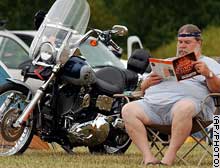
More than 100,000 enthusiests are
expected in the Milwaukee area for the
company's week-long 100th anniversary
celebration. |
Harley-Davidson is also
celebrating a 46 percent share of the North
American heavyweight motorcycle market, an
impressive showing for the company that William
Harley and Arthur Davidson started in a wooden
shed.
"When they're buying a
Harley, they're buying an image and a lifestyle
first, and a motorcycle second,'' Tim Conder, an
industry analyst with A.G. Edwards & Sons
brokerage firm, said of Harley buyers.
At least 250,000 visitors are
expected to make the pilgrimage to Milwaukee in
the next week for Harley-Davidson's 100th
anniversary blowout. The bash will feature
motorcycle stunts, music, bike exhibits,
merchandise sales and plenty of partying _ along
with the constant rumble from all the bikes.
"This place is not going
to be quiet,'' said promotions director Brett
Rushon.
Analysts say Harley has to do
more to ensure its next 100 years are a success.
Aging baby boomers form Harley-Davidson's
customer base, and the number of those buyers is
likely to decrease as they get older.
"Harley will rightly argue
they have plenty of boomers left. But in the long
term, the most critical issue of Harley is
whether buyers will start looking at Harley as
the old guy's bike,'' said Don Brown, an
independent motorcycle analyst in Irvine, Calif.
| Market
share figures point out the company's
potential weaknesses. Although Harley
dominates the North American heavyweight
market, it comes in second to Honda in
the overall U.S. market, according to the
Motorcycle Industry Council. Younger
riders and those overseas prefer the
faster Japanese sports bikes that cost
less than the $15,000-plus price tags
most Harleys carry. But for Harley fans, owning one
of the bikes -- known affectionately as
"hogs'' -- has been a transcendent
experience.
|
Bleustein and 12 executives bought Harley
in 1981, and began fixing its finances
and quality. |
"Getting your first
Harley is like having your first love, sometimes
more,'' said George Miller, a 46-year-old Harley
rider who works at a Houston refinery.
The company and its hefty
motorcycles have left indelible marks on American
culture -- giving rise to the rebellious
motorcycle culture immortalized in the movies
"The Wild One'' in 1953 and "Easy
Rider'' in 1969. That has helped feed a side
business of merchandise, including leather
jackets, that bear the famed black, white and
orange Harley-Davidson logo.
The company worked to clean up
its rough-and-tumble image in the 1980s, but CEO
Jeffrey Bleustein said it still has drawing
power.
"It certainly doesn't hurt
if there's a little bit of naughty in the
image,'' he said. ``We wouldn't want to be too
sterile.''
Harley's first century wasn't
always easy. The company overcame the advent of
the automobile, the Depression and two World Wars
to emerge in 1953 as America's only major
motorcycle maker. But then came a flood of
inexpensive imports mid-century and a merger with
American Machine and Foundry Co. in 1969.
Harley's quality soured, and AMF put the company
up for sale in 1980.
Bleustein and 12 executives
bought Harley in 1981, and began fixing its
finances and quality.
At the company's urging, the
government imposed five-year tariffs in 1983 on
imported heavyweight motorcycles. That helped,
but Harley squeaked by bankruptcy in 1985 after
it finessed new financing.
"You consider in 1981, we
were beg, borrowing and stealing every penny we
could get to invest in this company, not knowing
where our future might take us,'' said Willie G.
Davidson, chief styling officer and grandson of a
founder. "That's an amazing success story.''
To attract new customers,
Harley two years ago introduced the sleek V-Rod,
its first bike with a liquid-cooled engine, said
Bob Simonson, an industry analyst with William
Blair and Co.
Harley is now launching a
second bike into the V-Rod's family and is
redesigning its Sportster family of entry-level,
lower-priced bikes in an appeal to younger riders
and women.
The company also has a
subsidiary, Buell Motorcycle, that makes sports
bikes, but it only accounted for 4 percent of
Harley's bike shipments last year, according to
company figures.
"We are going to continue
to give attention to what is our classical
product line because it's classical,'' Bleustein
said. "But at the same time we'll see a lot
of other activities that are geared toward
reaching out to other new customers.''
|
|
| top 30
Aug 2003 - Ride on, Harley
30 Aug 2003 - Fans kick-start
Harley's 100th anniversary
30 Aug 2003 - Hogs on parade for
100th anniversary
29 Aug 2003 - Harley-Davidson Thinks
Young as It Turns 100
28 Aug 2003 - Harley fans kick-start
100th anniversary party
28 Aug 2003 - Collectors yearn for
old Harley bikes
28 Aug 2003 - Harley-Davidson Marks
100th Birthday
28 Aug 2003 - Harley Davidson stuff:
Serious business
28 Aug 2003 - Retro-bikes gain ground
27 Aug 2003 - Harley cruises into
second century
27 Aug 2003 - Harley-Davidson
motorbikes rev up in 100th yr
23
Aug 2003 - An American Icon turns 100
19 Aug 2003 - Takin' a tour of
Harleys and beer
16 Aug 2003 - Vintage Motorcycle
Jacket Values Zoom Ahead
|
|
Source URL: http://www.reuters.com/newsArticle.jhtml?type=topNews&storyID=3346011
Assets: Harley-Davidson motorbikes rev
up in 100th yr
Wed August 27, 2003 02:41
PM ET
By Richard Chang
 |
NEW YORK, Aug 27
(Reuters) - As Harley-Davidson Inc.
motorcycles roll into their 100th
anniversary this week, owners and
collectors are celebrating an American
icon that has come to represent coolness
and badness worldwide -- at a growing
price tag. This
image costs buyers of a new
Harley-Davidson $8,000 to $25,000 -- far
more than other brands -- and as much as
$150,000 for rare, early models in Japan,
a major market for Americana.
|
"Many motorbikes
look like Harleys, but a Harley sounds so
different," said Lin Todd, a former
helicopter pilot who, like other Harley fans,
revels in the "heavy-throated, muscular
sound" that other makers try unsuccessfully
to imitate.
Even among newer models,
"Harleys hold their value better than any
other brand," added Mark Andrew, who works
for a trucking company. He estimated that his
fifth Harley, for which he paid $15,000 in 1998
and accessorized, could sell for up to $22,000 --
unless he trades it in at book value at a
dealership.
The loud roar of the engine --
which riders amplify by adjusting or removing the
mufflers -- is just one aspect of the black
leather, bad-boy image that Harley-Davidson HDI.N tried to
shake for most of its life. The company --
founded in 1903 by William S. Harley and Arthur
Davidson, and joined later by Davidson's brothers
Walter and William -- finally embraced that image
in recent decades as "bad" became
marketably "cool" and rock n' roll
became mainstream.
"It's one of those images
associated with freedom, individuality,"
said Bill Jack, senior archivist at
Harley-Davidson Motorcycle Co. in Milwaukee,
Wisconsin. "Riders talk about motorcycling
as a peaceful experience, a frontier activity.
There's a tribal nature to it. Information and
history are passed on orally."
That motorcycling aura has been
popularized by movies such as Marlon Brando's
"The Wild One" (1953), Steve McQueen's
"The Great Escape" (1963), and
recently, "Bad Boys."
But this image goes back to the
1880s, when inventors such as Gottlieb Daimler in
Germany motorized a bicycle with a gas engine. By
the early 1900s, hundreds of companies were
making these new loud and fast machines with no
brakes or clutches that posed a danger to
pedestrians and horses on the road.
Harleys were made especially
rugged and heavy for the clayey muck in Milwaukee
in the winter. The daredevil image stuck when in
1936, Harley-Davidson focused on the sports
market to survive the plentiful cheap automobiles
rolling off Henry Ford's assembly line on to the
roads.
Motorcycles from that period
and earlier are the most valuable, because most
were junked in a country that favored the new.
Models from 1905 to 1909 are
now worth $80,000 to $150,000, according to
Manabu Okada, owner of Semba, Japan's largest
dealership (http:/www.semba.co.jp/). Taxes,
freight and other charges push prices up in
Japan, said the collector, whose grandfather
started the business by buying up 200 military
Harleys from the U.S. Army after World War Two.
These models now sell for $13,000 to $18,000 on
both sides of the Pacific.
In 1971, when cheap, reliable
Japanese motorcycles ruled the market,
broken-down Harleys from the 1930s and 1940s sold
for just $75 each, said Herbert Wagner, author of
"At the Creation: Myth, Reality, and the
Origin of the Harley-Davidson Motorcycle,
1901-1909" (http:/www.atthecreation.com).
"You could get a runner
for $300 to $400, he added.
Today, a restored 1936
Knucklehead -- named after the shape of its
engine -- is worth $50,000 to $100,000, double
the price in the mid-1980s. One completely
restored model sold for $95,000 just six months
ago in the United States, Okada said.
The Knucklehead, also called
"the Blockhead" by Harley enthusiasts,
was a milestone in design, with styled square
blocks that housed the valves. It begat other
innovative engines such as the Panhead (1948),
Shovelhead (1966), Evolution (1983) and Twin Cam
88 (1999) that collectors pay a premium for in
landmark models.
In 1984 Harley-Davidson went
public, and antique motorcycles sold for record
prices at a auction after Steve McQueen's death,
setting the tone for the secondary Harley market
up till now.
"What people want are
unrestored original motorcycles, relatively
unused," said Dale Walksler, who in 2000
sold his Harley-Davidson dealership and set up
the Wheels Through Time Museum
(http:/www.wheelsthroughtime.com) in Maggie
Valley, North Carolina, with his personal
collection.
High prices have spawned fakes.
Last year, a totally fictitious "1908
Harley-Davidson racer" sold for $17,000 in
an Internet auction. Concerned members of the
Antique Motorcycle Club of America
(http:/www.antiquemotorcycle.org) notified the
buyer, who managed to get "most" of his
money back, said Wagner, author of
"Harley-Davidson 1930-1941: Revolutionary
Motorcycles & Those Who Rode Them"
(Schiffer, http:/www.schifferbooks.com).
"He later sold it with a
disclaimer, for a 'mere' $4,000," he said.
"But it's still as phony as a $3 dollar
bill."
To celebrate its 100th
Anniversary, Harley-Davidson has released
"100 Years of Harley-Davidson"
(Bulfinch Press), by Willie G. Davidson, grandson
of company co-founder William A. Davidson.
|
|
| top 30
Aug 2003 - Ride on, Harley
30 Aug 2003 - Fans kick-start
Harley's 100th anniversary
30 Aug 2003 - Hogs on parade for
100th anniversary
29 Aug 2003 - Harley-Davidson Thinks
Young as It Turns 100
28 Aug 2003 - Harley fans kick-start
100th anniversary party
28 Aug 2003 - Collectors yearn for
old Harley bikes
28 Aug 2003 - Harley-Davidson Marks
100th Birthday
28 Aug 2003 - Harley Davidson stuff:
Serious business
28 Aug 2003 - Retro-bikes gain ground
27 Aug 2003 - Harley cruises into
second century
27 Aug 2003 - Harley-Davidson
motorbikes rev up in 100th yr
23
Aug 2003 - An American Icon turns 100
19 Aug 2003 - Takin' a tour of
Harleys and beer
16 Aug 2003 - Vintage Motorcycle
Jacket Values Zoom Ahead
|
|
Source
URL: http://business-times.asia1.com.sg/story/0,4567,91812,00.html
August
23, 2003
An American icon turns 100
 CHICAGO - In 1903, the same year
Henry Ford incorporated the Ford Motor Company
and the Wright brothers first flew, William
Harley and his friends Arthur and Walter Davidson
launched the Harley-Davidson Motor Company in
Milwaukee, Wisconsin. CHICAGO - In 1903, the same year
Henry Ford incorporated the Ford Motor Company
and the Wright brothers first flew, William
Harley and his friends Arthur and Walter Davidson
launched the Harley-Davidson Motor Company in
Milwaukee, Wisconsin.
From the beginning, one of the
bike's most distinguishing characteristics was
the distinct cadence of its engine in idle -- an
uneven, syncopated rhythm Harley describes as
'pop, pop, pause'.
Down the years, Harley
engineers added other design features: a 45
degree V-twin motor was introduced in 1909, the
'Bar and Shield' logo in 1910, and the
teardrop-shaped gas tank in the 1920s.
In the 1930's an 'eagle' design
was placed on those tanks and the famous
'Knucklehead' engine was introduced.
During World War I
Harley-Davidson manufactured nearly 20,000
motorcycles for the US government, and during
World War II virtually all of the Harleys
produced went towards the war effort.
By 1920, Harley-Davidson was
the largest motorcycle manufacturer in the world,
with bikes sold by more than 2,000 dealers in 67
countries worldwide.
Following WWII the Harley's
market share, as well as its myth, continued to
grow, helped along by appearances in movies such
as Easy Rider and as props for glamorous stars
including Jayne Mansfield, Elvis Presley, and
Peter Fonda.
But by 1981 the company had
fallen on hard times and was on the verge of
collapse because of waning quality and
competition from a raft of Japanese motorcycles.
In 1983, the administration of
then-president Ronald Reagan and the
International Trade Commission approved tariffs
up to 49 per cent on imported Japanese
motorcycles 700 cc and larger for five years,
giving the company much-needed breathing space.
The tariffs curbed sales of
Japanese models in the United States and gave
Harley time to upgrade its manufacturing
operations and improve quality, and in 1987 the
company said it no longer needed the tariff to be
profitable.
Last year, the American icon
shipped a record 263,000 motorcycles, capping a
17-year string of record growth.
|
|
| top 30
Aug 2003 - Ride on, Harley
30 Aug 2003 - Fans kick-start
Harley's 100th anniversary
30 Aug 2003 - Hogs on parade for
100th anniversary
29 Aug 2003 - Harley-Davidson Thinks
Young as It Turns 100
28 Aug 2003 - Harley fans kick-start
100th anniversary party
28 Aug 2003 - Collectors yearn for
old Harley bikes
28 Aug 2003 - Harley-Davidson Marks
100th Birthday
28 Aug 2003 - Harley Davidson stuff:
Serious business
28 Aug 2003 - Retro-bikes gain ground
27 Aug 2003 - Harley cruises into
second century
27 Aug 2003 - Harley-Davidson
motorbikes rev up in 100th yr
23
Aug 2003 - An American Icon turns 100
19 Aug 2003 - Takin' a tour of
Harleys and beer
16 Aug 2003 - Vintage Motorcycle
Jacket Values Zoom Ahead
|
|
Source URL: http://edition.cnn.com/2003/TRAVEL/DESTINATIONS/08/19/travel.madeinmissouri.ap/index.html
Takin' a tour of Harleys and beer
Missouri home to nifty
factory tours
Tuesday, August 19, 2003
Posted: 1944 GMT ( 3:44 AM HKT)
| KANSAS CITY, Missouri
(AP) -- It ain't Disneyland. There are no
water slides nearby. The ocean's white,
sandy beaches are a couple of time zones
away. Security is tight and safety
glasses are required. No alcohol is served.
And yet, for those
folks who treat their bike like a member
of the family, there's no roadside
attraction that's more of a vacation
must-see than a factory where metal and
motors go in one loading dock, and
ready-to-ride Harley-Davidson motorcycles
come out another.
|
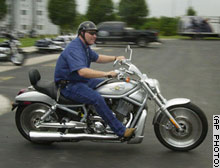
A man rides a Harley-Davidson near the
company's Kansas City plant. |
"We had to
come," said New Jersey resident Tom Mann, an
owner -- you could tell by his leather vest and
Harley Owner's Group patches -- of his visit to
Harley-Davidson's Kansas City plant. "I had
to see where the bikes were made.
"My bike came from this
place."
Like most Harley-Davidson
riders -- or so says the company that's among the
latest to make Milwaukee famous -- Mann is the
ultimate brand loyalist. He even brought pictures
of his heavily customized Super Glide Sport
along, and his tour guide and other plant
employees couldn't wait to see them.
Phil Swope, the Kansas City
plant's security chief, helped developed the tour
after the factory opened in 1998. He calls it a
"cult." (He's a member, with a Road
King on order.) That's probably a little strong
-- passionate might be a better way to describe
it.
"For some it's a companion
on the road. For some it's family, even,"
said Lara Lee, director of Harley-Davidson Inc.'s
museum and archives, who rides an Ultra Classic
with sidecar. "So, to be able to see the
birthplace of something with such great meaning
to you is very compelling, very moving for a lot
of people."
Many tours, companies
available
For people like Mann -- who
have a passion for product -- the Harley plant is
one of several spots in the state where factory
doors are open to visitors. For everyone else,
they're not a bad way to kill a lazy summer
afternoon when family and friends come calling.
Hallmark Cards Inc. in Kansas
City has its Crown Center mall and visitors
center, and more than 200,000 people visit Nestle
Purina PetCare Co.'s Purina Farms outside St.
Louis each year. And for those who think every
good tourist stop does, in fact, require a beer,
Anheuser-Busch Cos. in St. Louis has got you
covered.
For both Harley-Davidson and
Anheuser-Busch, offering tours isn't the latest
idea from the marketing department. It's not even
an old idea -- it's historic. The first inside
look at Budweiser's famed beechwood aging process
came in 1865, not long after the company was
founded in 1852, said Sue O'Leary, manager of the
company's tours and gift shops.
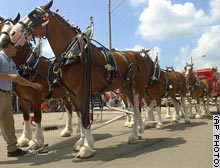
Clydesdales have been associated with
Anheuser-Busch for decades. |
Lee said documents
found in Harley-Davidson's archives
suggest tours of the company's original
Milwaukee factory -- now home of the
100-year-old company's headquarters --
began as early as 1929. A brochure from 1937 lures
prospective visitors --
"Harley-Davidson motorcycles lead
adventurous lives from the very beginning
of their existence," it reads. It
promises a look at the "thump-thump
of giant presses" and "glowing
red-hot furnaces" that are part of
the "magic transformation of raw
steel into Harley-Davidson
motorcycles."
|
There's no thump-thumping
inside the company's Vehicle and Powertrain
Operations plant in north Kansas City: the press
that now stamps out fenders and gas tanks from
sheets of steel does so with the loud hiss of
hydraulics. There are no furnaces glowing, but
there is a laser booth where a robot trims scrap
from those pressed steel parts.
The press and the laser booth
are stops on the plant tour, which begins with a
short video about Harley-Davidson. The Kansas
City facility, which Swope said receives between
25,000 and 30,000 visitors a year, is one of
three the company opens to the public; the others
are in York, Pa., and Milwaukee.
"We don't do anything
special by way of activity -- it's people making
motorcycles," Lee said. "I imagine
that's what you would have seen in 1929 or 1937
or 1954: people making motorcycles."
'A real sense of what
goes on'
The Kansas City plant assembles
Harley-Davidson's Sportster and Dyna models, and
builds Harley's newest bike and its engine, the
V-Rod and liquid-cooled Revolution, from the
frame up. While staying in-between the yellow
lines and dodging the occasional fork truck,
visitors to the plant see these processes up
close, often close enough to chat with employees
working the line.
"What we try to do is give
people a real sense of what goes on inside the
factory," Lee said. "Who are these
people that make these machines? How much are
people involved? How much is done by machinery.
How does it all come together?"
The company's hometown is
Milwaukee, and it will celebrate its 100th
birthday with a four-day bash there August 28-31.
Tens of thousands of motorcyclists are expected
there to help the company mark its centennial.
The St. Louis brewery anchors
the south end of the historic Soulard
neighborhood. Visitors can get a look inside at
bottling operations, sample free beer, stroll the
landscaped grounds and see the horses at the
Clydesdale stable.
"Other tours seem like
they are all production. This had other things:
the videos, the horses," said Jennifer
Weinhandl, who was visiting the St. Louis brewery
from Minnesota with her husband and six children.
But at Harley-Davidson, it's
all about the bikes and their riders. Dozens
stand watch like sentinels out front, and only
after a closer look will a visitor see the sign
admonishing "No touching." Those bikes
all belong to proud employees.
IF YOU GO ...
- HARLEY-DAVIDSON: 11401 N.
Congress, Kansas City, (877) 883-1450,
www.harley-davidson.com
- ANHEUSER-BUSCH: 12th and
Lynch streets, St. Louis, (314) 577-2626,
www.anheuser-busch.com
- HALLMARK: 2450 Grand
Blvd., Kansas City, (816) 274-3613,
hallmarkvisitorscenter.com
- PURINA: 200 Checkerboard
Drive, Gray Summit, (314) 982-3232,
www.purina.com
|
|
| top 30
Aug 2003 - Ride on, Harley
30 Aug 2003 - Fans kick-start
Harley's 100th anniversary
30 Aug 2003 - Hogs on parade for
100th anniversary
29 Aug 2003 - Harley-Davidson Thinks
Young as It Turns 100
28 Aug 2003 - Harley fans kick-start
100th anniversary party
28 Aug 2003 - Collectors yearn for
old Harley bikes
28 Aug 2003 - Harley-Davidson Marks
100th Birthday
28 Aug 2003 - Harley Davidson stuff:
Serious business
28 Aug 2003 - Retro-bikes gain ground
27 Aug 2003 - Harley cruises into
second century
27 Aug 2003 - Harley-Davidson
motorbikes rev up in 100th yr
23
Aug 2003 - An American Icon turns 100
19 Aug 2003 - Takin' a tour of
Harleys and beer
16 Aug 2003 - Vintage Motorcycle
Jacket Values Zoom Ahead
|
|
Source URL: http://www.reuters.com/newsArticle.jhtml?type=topNews&storyID=3288438
Assets: Vintage Motorcycle Jacket Values
Zoom Ahead
Sat August 16, 2003 09:06 AM ET
By Richard Chang
NEW YORK (Reuters) - Vintage
motorcycle jackets, available 10 years ago for
$200 or less, now sell for thousands of dollars,
as leather has become a fashion statement and
cheap imports highlight the quality of garments
made in the mid-20th century.
Driven largely by movies that
glamorize motorbike culture and a Japanese
craving for American culture, prices of desirable
brand-name jackets have easily increased tenfold
in as many years. In Europe, the painstaking
attention to detail by specialist makers has won
over customers.
"In Japan, it's an
idealization of U.S. motorbike culture. In
Europe, it's obvious that our clothes are
first-class, so people ask where they come
from," said Dave Hanson, manager of Langlitz
Leathers Inc. ( http://langlitz.com ).
Langlitz makes what has been
called the "Rolls-Royce of motorcycle
jackets" -- a feat it has accomplished since
1947 by keeping operations to a store that makes
only six garments a day. This is despite demand
that has led to more than 50 authorized dealers
in Japan alone, and with no advertising at all.
While Langlitz makes stock for
its inventory, many garments are customized for
consumers who order online or travel halfway
around the globe to its store in Portland,
Oregon. Langlitz jackets usually cost $800 to
$1,200, with no wholesale discount. But prices
can double in Japan and Europe with import taxes
and retail markups.
That's just for new jackets.
Used jackets in good condition
once sold for about two-thirds of their original
price. But two years ago Hanson paid $2,000 for
an old Langlitz racing suit that in the 1950s
would have cost $50 to $60.
The highest price quoted is
probably $30,000, for a long horsehide jacket
with a green cloth label Langlitz used to put on
its garments from 1950-1956. Named "Red
Dog" by Joe Kim, who helps coordinate
Langlitz sales to Japan, the reddish-brown jacket
has an obsolete Crown brand zipper and chain-pull
zippers that the company has since stopped using.
"There are people who are
willing to pay $20,000 or trade a vintage Harley
motorcycle for (the jacket), but I say
'No,"' said Kim. The jacket is on display in
a store in Japan, where it's insured.
Horsehide comes at a premium
because the leather, common in the early half of
the 20th century, has been replaced by cowhide,
which is not as tough. Deer hide, though softer
to the touch, is even tougher, as well as more
rare and expensive. After all, motorcycle jackets
were created as a second skin to protect riders
in accidents.
Vintage prices are now so high
that paramedics rushing to the scene of a
motorcycle crash sometimes find victims who are
more concerned about their jackets than
themselves, Kim said.
With fashionistas accounting
for a growing market, the few premium U.S. makers
-- including Schott Brothers of New York and
Vanson, with a factory in Fall River,
Massachusetts -- are seeking ways to tap into the
demand without sacrificing quality.
Schott ( http://www.schottnyc.com ) is selling limited edition replicas,
in cowhide, of its 1928 Perfecto jacket, designed
by company founder Irving Schott. He was the
first to put a zipper in a jacket.
The pricetag is $450, versus
thousands of dollars for a vintage version -- if
you can find one.
"The classic motorcycle
jacket is part of the soul and heritage of
America. It represents everything that is
freedom, bad boy James Dean, Marlon Brando. It
has an American icon flavor," said Don King,
vice president of sales at Schott.
Over the last few years,
motorcycle jackets have won a young following,
especially among blacks and Hispanics, and should
become even more popular, King said, pointing to
the influence of movies about big, fast bikes,
such as "Fast and Furious" and
"Bad Boyz."
Even as vintage prices have
soared, buyers can find bargains in second-hand
stores. New Langlitz jackets, on the other hand,
can sell for a lot more on eBay than directly
from the store.
Fringes reduce the resale value
because most men, especially bikers -- who
account for 90 percent of sales at Langlitz and
other premium brands -- don't want them.
Color and size also count.
"For every brown jacket, 100 guys want
black," Hanson said. "The closer you
are to normal (size), the more valuable."
And while some wearers think a
badge-covered jacket may look cool, each pinhole
can cost them $50 in resale value.
For a colorful history on the
subject, check out Rin Tanaka's "Motorcycle
Jackets: A Century of Leather Design" and
"Motorcycle Jackets: Ultimate Biker's
Fashions," (Schiffer, http://www.schifferbooks.com ).
|
|
| top |
|
|
| |
|
|
| |
|
|
| |
|
|
| |
|
|
| |
|
|
| |
|
|