| DAVID
GOH'S HOME PAGE Last updated: 31 Dec 2002 This page is located on:
|
Kawasaki
AR-125 Page first created 20 Jul 1999; Last updated 31 Dec 2002
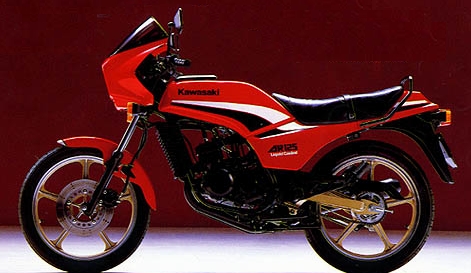
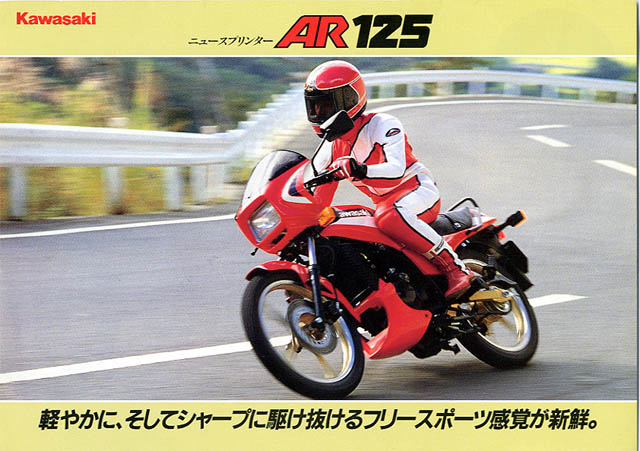
The AR 125 was very sporty and trendy for its time, and ideal of those aspiring to own its bigger (obviously more expensive) brothers, the GPZ and GPX series:
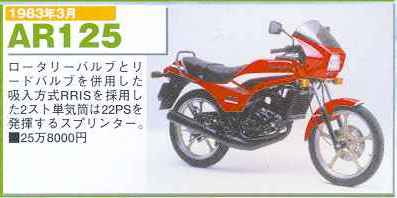
Over the four years I had it, it became increasingly difficult to keep the vehicle in good repair. There were problems with fuel-oil mix control, such that the engine seized twice and at other time, practically let the oil mix uncontrolled such that the bike emitted a dense cloud of fumes wherever it went and holes had to be drilled into the expansion chamber on the exhaust pipe so that the accumulated engine oil can be drained out.. Then the frame corroded such that its worst, it became impossible to take a pillion/passenger... the frame was very much near breaking point. Then the Unitrak seized and replacing the suspension cost more than to get another bike. I had many good miles with the bike, but it was no longer economically viable to keep it going, and the bike was junked away in 1992. The Kawasaki AR125 was manufactured from 1982 to 1989. At its time, it was priced at ¥258,000.
Depending on the year of production, model numbers may be A1, A1A, B1, B2, B3, B4, B5, A1B, A2, A3, A4, A5, A6.
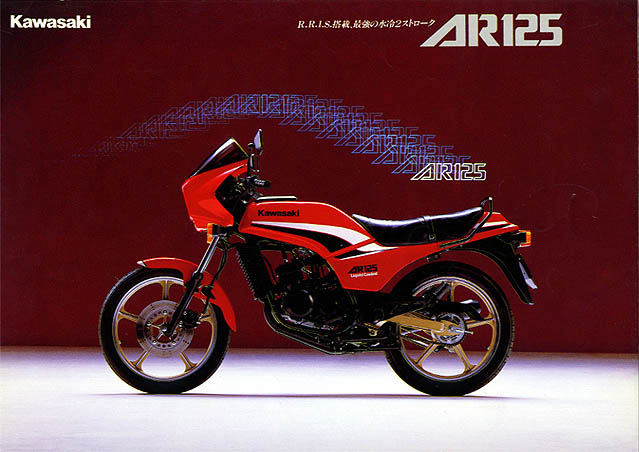
It will will show how to remove, dismantle, inspect, repair and replace the following: engine, clutch, primary and secondary transmission, carburation and lubrication systems, ignition system, frame and suspension, wheels, brakes and tyres, and electrical system. Also included is routine maintenance, fault finding instructions, recommended lubricants and specifications. Some archive advertisements of the AR-125
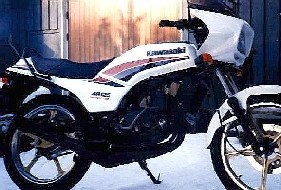
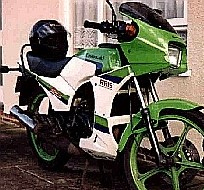
The last version produced in the late '80s featured a distinct end-can on the exhaust pipe, and more notably, a square headlamp fairing with "underhang" i.e. where the lower part jutted out manta-like (see below right); compare against earlier version which is typically overhang (left). It also has the signal lamp assembly on the handle bars instead of on the forks, and the front fairing and headlamp fairing combined appears bigger, covering the radiator, like the airscoop shape which typifies the emerging GPZ series.
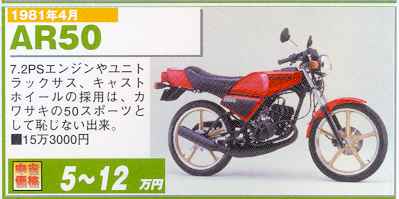
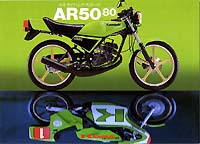
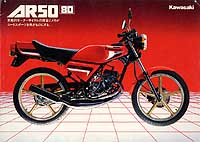
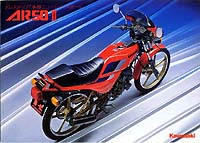
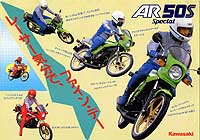
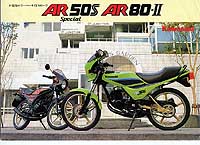
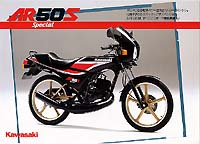
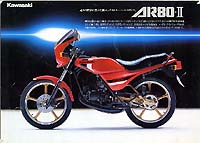
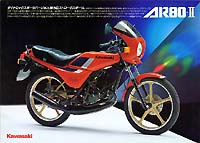
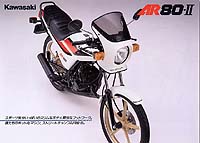
Besides the AR-125, this bike also had smaller variants, the AR-50 and the AR-80. Besides red, it also featured in green, white and black. By the way, this particular shade of green is the colour for Kawasaki's official racing team.
The pain of owning a Kawasaki: Singapore sole distributor In Malaysia and Thailand, the Thai-made Kawasaki KR 150 is a huge hit. However in Singapore, the Kawasaki name never ever made a significant impact. In my opinion, it is all the fault of the Singapore sole distributor, Evershine. Evershine offered poor support, made maintenance a nightmare with exorbitant cost for parts and long lead times for replacement parts (i.e. they didn't stock spares). After putting up all the problems of getting parts and service for my AR 125, I swore never to buy another Kawasaki again. No wonder Kawasaki is a very very very distant 4th in the Singapore motorcycle industry, compared to the other big 3 Japanese brands Honda, Suzuki and Yamaha.
In the late 1990s, there were rumours that that the Japanese principal Kawasaki Heavy Industries (KHI) might set up its own distribution and support centre in Singapore to handle sales and support problems, though these apparently never materialised. However what is more likely is a parallel importer is stocking some key items. Judging from the recent growth in the number of ZX racers that I've been seeing around, it would seem that there have been some in-roads made into improving the situation somewhat, or enough people have been deluded into buying a Kawa. But the damage has been done and despite the growth, the numbers continue to be relatively poor and it is a long way from being able to challenge the Singapore market leaders (Honda, Yamaha). Personally I remain unconvinced. To buy a Kawasaki bike, I'd think one would really have to be a hard-core Kawasaki lover, or be brainwashed into buying a Kawa. The headaches of 2-stroke engines Powered by a 2-stroke engine, this street bike was plagued by the usual problems associated with 2-stroke engines, i.e. smoky engine exhaust, the need for 2T engine oil to be mixed with the fuel, sometimes clogged exhaust pipes. Since the exhaust pipes frequently got clogged and the bike kept losing power, to restore the power, the exhaust pipe had to be regularly cut opened to remove the accumulated particles that were clogging it up. Rewelding it back was a bummer because my pipe got shorter and shorter till it could not be mounted back on the frame properly. This made me swear off 2-stroke bikes for good... In my opinion, always get a 4-stroke engine: it is so much easier to maintain....
Anyway in recent years, the smoke emissions standard has been raised. That makes it very much harder for 2-stroke bikes to meet the environmental requirement... so there are fewer and fewer 2-stroke bikes, both new and old, on Singapore roads. Just a tip to riders owning a 2-stroke bike: rev harder! drag your engine! Sounds strange? No... you need because the exhaust from a 2-stroke engine usually contains plenty of particles, you really need to rev higher in order to force the particles out of your exhaust pipe! For those with a tachometer, as a guideline, try to change your gears at a higher RPM, at least 5000 rpm or more, if you can bear it. Like my brother, you might actually begin to see improved fuel economy... what a paradox! To learn more about 2-stroke engines, visit the excellent and highly educational website called "How Stuff Works".
The following is an extract from "How Stuff Works" : How Two-stroke Engines
Work The
Two-stroke Cycle
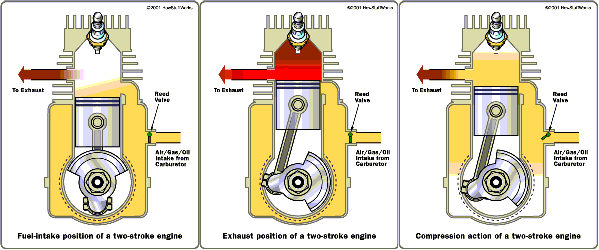
This figure shows a typical cross flow design. You can see that two-stroke engines are ingenious little devices that overlap operations in order to reduce the part count. You can understand a two-stroke engine by watching each part of the cycle. Start with the point where the spark plug fires. Fuel and air in the cylinder have been compressed, and when the spark plug fires the mixture ignites. The resulting explosion drives the piston downward. Note that as the piston moves downward, it is compressing the air/fuel mixture in the crankcase. As the piston approaches the bottom of its stroke, the exhaust port is uncovered. The pressure in the cylinder drives most of the exhaust gases out of cylinder. As the piston finally bottoms out, the intake port is uncovered. The piston's movement has pressurized the mixture in the crankcase, so it rushes into the cylinder, displacing the remaining exhaust gases and filling the cylinder with a fresh charge of fuel. Note that in many two-stroke engines that use a cross-flow design, the piston is shaped so that the incoming fuel mixture doesn't simply flow right over the top of the piston and out the exhaust port. Now the momentum in the crankshaft starts driving the piston back toward the spark plug for the compression stroke. As the air/fuel mixture in the piston is compressed, a vacuum is created in the crankcase. This vacuum opens the reed valve and sucks air/fuel/oil in from the carburetor. Once the piston makes it to the end of the compression stroke, the spark plug fires again to repeat the cycle. It's called a two-stoke engine because there is a compression stroke and then a combustion stroke. In a four-stroke engine, there are separate intake, compression, combustion and exhaust strokes. You can see that the piston is really doing three different things in a two-stroke engine:
It's really pretty neat to see the piston doing so many different things! That's what makes two-stroke engines so simple and lightweight. If you have ever used a two-stroke engine, you know that you have to mix special two-stroke oil in with the gasoline. Now that you understand the two-stroke cycle you can see why. In a four-stroke engine, the crankcase is completely separate from the combustion chamber, so you can fill the crankcase with heavy oil to lubricate the crankshaft bearings, the bearings on either end of the piston's connecting rod and the cylinder wall. In a two-stroke engine, on the other hand, the crankcase is serving as a pressurization chamber to force air/fuel into the cylinder, so it can't hold a thick oil. Instead, you mix oil in with the gas to lubricate the crankshaft, connecting rod and cylinder walls. If you forget to mix in the oil, the engine isn't going to last very long! |


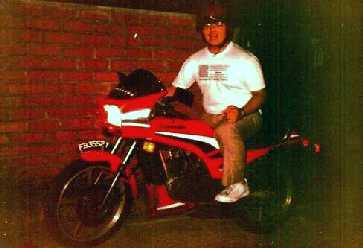
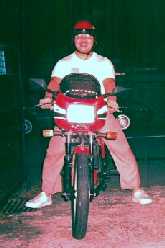
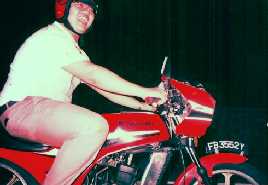 My first bike was a fairly ancient Kawasaki
AR-125. I owned this bike from 1988 to 1992.
Mind you, I'd didn't buy it...
it was handed down like from an uncle who gave up
riding. By the time I got it, the bike was already
pretty old.
My first bike was a fairly ancient Kawasaki
AR-125. I owned this bike from 1988 to 1992.
Mind you, I'd didn't buy it...
it was handed down like from an uncle who gave up
riding. By the time I got it, the bike was already
pretty old.