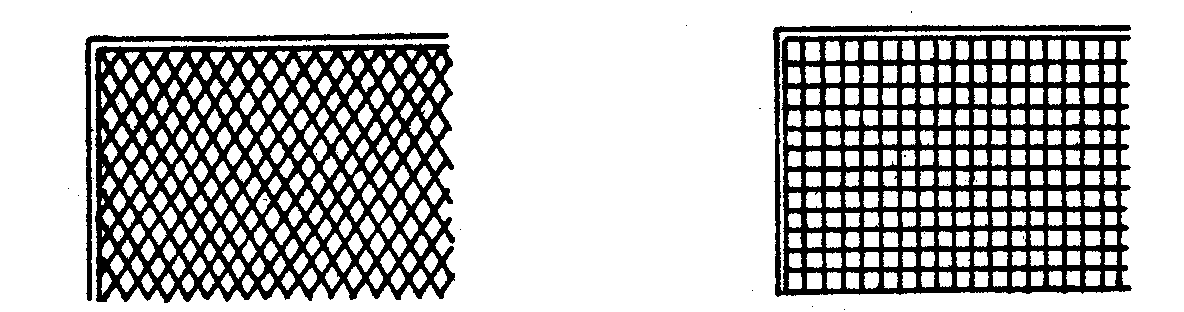
However from some photographs it would appear that grilles got interchanged between makes and on the Number 12 "Alligator" bonnetted cab, even the two halves can be different.
The Canadian Army Engineering Design Branch played a major role in the development and pre-production testing and approval of the Canadian Military Pattern (C.M.P.) range of vehicles.
Canadian Military pattern vehicles were manufactured by General Motors (Chevrolet) and Ford using many common standardised components, subassemblies and assemblies which fitted trucks whether they were small or large. For example, there were three basic vehicle cabs which could be fitted to either 8-cwt, 15-cwt, 30-cwt or 3-ton chassis.
The chassis themselves
had similar wheelbase dimensions: 101-inch for both Chevrolet and Ford
8-cwt and 15-cwt trucks; 134-inch
for 30-cwt and short wheelbase 3-tonners,
158-inch long wheelbase 4x2 and 4x4 3-tonners; and 160-inch for Ford
6x4 and Chevrolet 6x6 3-tonners.
With such an
enormous number of vehicles to deal with, so as a starting point the lightest
of the range the C.M.P. 8-cwt series will be taken.
However before going into detailed descriptions various points to
assist in vehicle identification and to clarify the various types of cab
have to be set out.
In addition to
these specially designed trucks, termed Canadian Military Pattern, General
Motors, Ford and the Chrysler Corporation (Dodge) also produced countless
numbers of 'conventional-modified' vehicles. These utilised various pre-war
civilian chassis with minor modifications to meet Service needs.
How to distinguish CHEVROLET or FORD trucks ?
As Canadian Military
Pattern vehicles were produced to a common design, though by two different
motor manufacturers it Is perhaps surprising that it can be somewhat difficult
to identify the make of-a particular C.M.P. truck. Many lost their maker's
nameplates but there are other external clues.
In some respects
the difference in the pattern of radiator grille mesh, Chevrolet being
in the form of a diamond and Ford square, should be the easiest guide.
However from
some photographs it would appear that grilles got interchanged between
makes and on the Number 12 "Alligator" bonnetted cab, even the two halves
can be different.
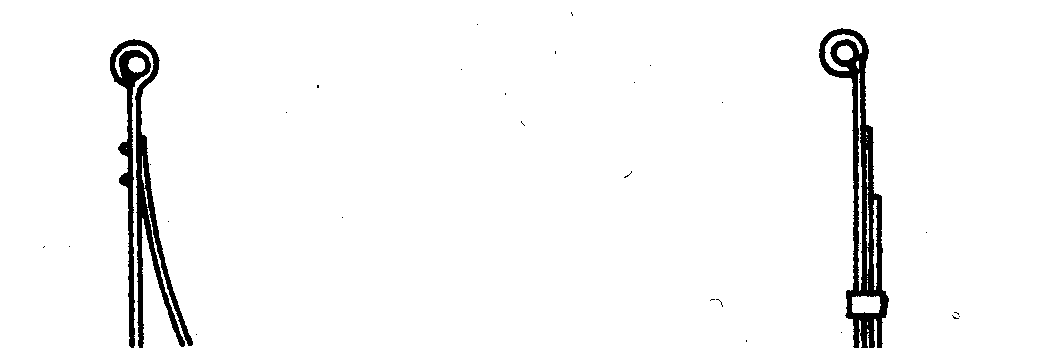
Perhaps then
the most reliable external difference is in the appearance of the radiator
brush guard which was fitted tc the front bumper bar, being in the form
of a double leaf on a Chevrolet but laminated on Ford trucks.
The position
of the vehicle's horn provides a further indication. On the Chevrolet it
was hidden being mounted on the inlet manifold. On the Ford it was exposed
and located opposite the steering box.
Finally, a high proportion of Chevrolet trucks had a cylindrical radiator overflow tank mounted above the front nearside wing. This was repositioned in vehicles built from 1943 onwards and sited under the floor board.
The position
of the vehicle's horn provides a further indication. On the Chevrolet it
was hidden being mounted on the inlet manifold. On the Ford it was exposed
and located opposite the steering box.
Finally, a high
proportion of Chevrolet trucks had a cylindrical radiator overflow tank
mounted above the front nearside wing. This was repositioned in vehicles
built from 1943 onwards and sited under the floor board.
Designed and composed by Eric Delcommenne © Copyright canadiantruck.com 1999