 |
|
 |
|
 |
|
 |
|
 |
|
 |
|
 |
|
 |
|
Right: the 2CV is unveiled before an enthusiastic public at the Paris Salon in 1948
...2CV History...
|
Over the war years, Boulanger, whilst not obstructing the Germans at every turn, was able to re-think the TPV. The chassis, engine and suspension were radically revamped; the bodyshell was designed by Bertoni, who went on to design the DS. The whole caboodle was renamed the "2CV", or "Deux Chevaux". Following the war, the Traction Avant reappeared in 1946, followed by the H-Van the next year. The stage was set.
Production started at Citroen's Levallois factory in Spring 1949, with 924 being built. The 1949 2CV, known as the "Type A", was powered by a 375cc, 9bhp air-cooled engine. It had a full length canvas roof, which continued below the rear window to form the bootlid. There was no ignition key (a turn switch activated the ignition, and a pull-start fired the engine), and no way of locking the doors. There were no indicators so the lower part of the front windows hinged up to allow hand-signals, and the only colour option was dark grey. None the less, it was the cheapest car available anywhere, and there was soon a six-year waiting list. The 2CV has changed -- sometimes radically, sometimes only in detail -- for almost every year of its 42 year production run and it would be deeply tedious to list these modifications in too much detail, but here are some highlights... |
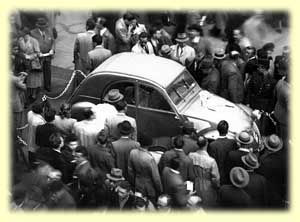 On
the evening of 10th October 1948, three heavily-shrouded cars were
smuggled on to the stand at the Paris Salon amid tight security.
The next day Pierre Boulanger stepped on to the Citroen podium,
shook hands with the French President, Vincent Auriol, and proudly
removed the shrouds. The President gaped; flashbulbs popped; motoring
journalists howled with laughter; the public reached for their cheque-books.
The 2CV was born.
On
the evening of 10th October 1948, three heavily-shrouded cars were
smuggled on to the stand at the Paris Salon amid tight security.
The next day Pierre Boulanger stepped on to the Citroen podium,
shook hands with the French President, Vincent Auriol, and proudly
removed the shrouds. The President gaped; flashbulbs popped; motoring
journalists howled with laughter; the public reached for their cheque-books.
The 2CV was born.| < BACK |