Limited Slip / Locker Options for 200 and 700
Series Volvos
By Stu Spencer
Differential Options:
So you want to spin both tires, huh? Tired of that open differential
letting one tire spin itself into a slick? If your car was not lucky enough
to come from the factory with an "anti-spin" differential, you have 2 basic
differential options to allow you to better distribute power to both tires (short
of welding the spider gears); limited slip or locking. All 200 turbos
and most 700 turbos (with a live axle, sorry no multilink) came with a Dana
30 differential in either the 1030 or the 1031 rear end. This is the same
differential that came in many late model Jeeps. Because of this 'commonality',
any competent 4X4 or differential shop should be able to install a traction
aiding device for about 2-3 hours of labor depending if you have all bearings
and seals replaced too (recommended). MVP
now sells and installs LSDs. Give them a call and they can hook you up too.
I personally have a NOS (new old stock) Volvo LSD in my 81' 245GLTi
that I got for a very good price. I think it was some of the best
money I have spent on the car. Now I can take a corner without lighting
up the right rear. It does take a bit of getting used to when you
are in a fast corner, under full power, and both tires start to break loose.
Overall, it has increased the smile factor when driving my car.
According to the SAM catalog for the LSDs they sell, the differentials break
down as listed below. The cars listed in the same column use the same
differential part number from SAM. It looks like the only real difference
is in the ABS tone ring In the early late 80s and 90s, Volvo went to a
locking rear that locked the rear at about 25 MPH. There is no LSD listed
for cars with multilink rear suspensions (88-90 764 and some 900s).
I got some mail from "C. Gravatt" about ABS:
"Regarding the difference between ABS & non-ABS locking diffs.....
When Volvo was testing locking differentials (prior to introduction in their
production cars) the "prototype locking diffs" for "test vehicles" were delivered
with two different slotted rings. Fewer and larger slots (or teeth) for the
electronic speedometer pick-up on non-ABS equipped cars and much more numerous
(about 4 times as many) smaller teeth on the ABS equipped cars. I seem to
remember that the ABS modified the signal (reduced the number of pulses) that
was eventually "read" by the speedometer. The Installation of the wrong ring
would result in an extremely high reading or non-functioning speedometer on
the non-ABS equipped car and inoperative (the ABS would detect a rear wheel
speed signal fault and shut down) ABS on the ABS equipped cars. Don't know
if this is the reason for the differences in your catalogue, but those differences
might simply be an indication of which ring type of ring is fitted to the
diff. Hope this helps, C. Gravatt"
|
Without ABS
|
With ABS
|
With Volvo 'locking' rear
|
|
240 -1991
|
240 -1991
|
240 1992+
|
|
740 -1988
|
740 -1988
|
740 1989+
|
|
764 -1987
|
764 -1987
|
765 1988+
|
|
765 -1988
|
765 -1988
|
|
There are pros and cons to every style of traction aiding devices. For a
very good summary of each style, please read the Traction
Aiding Devices FAQ. Remember, this site is based on 4X4s, so not all the devices
mentioned are available or practical for our cars.
1. Limited Slip Differential (LSD):
The 'positraction' or LSD is recommended for road driving and for moderate racing
applications. They are the most driver friendly. There are two basic styles
of LSD that can be put into the Volvo Dana 30; friction based and torque sensing.
- Friction based units such as a Dana "Powr-Lok" and OEM 'anti-spin'. These
units use clutches to allow some speed differences, like while turning, but
will 'bind' the wheels together starting with a specified amount of torque.
Typically you might get a 70/30 power split between wheels or a 60/40 with
a really tight LSD. One major drawback is that eventually the clutches
wear out and require replacement. The harder you use the LSD (more burnouts,
etc.) the shorter the life of the clutches. Usually a friction modifier
is added to the differential oil to extend the clutch life and reduce chattering.
This style of LSD is the most commonly used in Turbobricks member's cars.
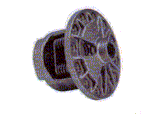
- Torque sensing units such as a Tractech "TrueTrac". These units use
worm gears to 'bind' the wheels together before slip occurs but allow some
speed differences like while turning. They apply more torque to the
wheel that has the best grip. One drawback is that because the Dana
30 is a 'small' differential, these units must be very compact and therefore
small gears must be used. Some 4X4 shops I talked to said that under
high torque these smaller gears may fail. An advantage of these units
is that there are no clutches to wear out. Talk to your 4X4 shop for
their opinion.
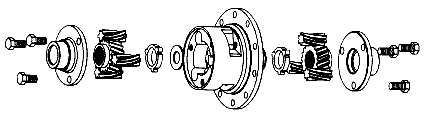
Here is a letter I recieved about a TrueTrac:
"I am writing to tell you that I have just had a Tractech 'TruTrac'
torque sensing rear diff installed in my 82 242ti. It was installed on Monday
and yesterday with a 6 inch snowfall happening on the way home it got the
acid test. I have to agree with you about this being some of the best money
I have ever spent. The car was fantastic, with traction to just take off
and drive. I also use real winter tires which have been very good but the
addition of the diff really made it happen. I know that some people expressed
concerns about handling the torque of a high output turbo. But, a turbo
does apply the torque of the engine more progressively than a N/A engine
and this diff is designed to handle more torque than my volvo is going to
put to it. So, I went for it and am very happy with the result. It was a
more labor intensive installation than other vehicles because of the emergency
brake setup. If you are going to be a long term owner and are modifying
your car it really is adding another level of traction to the car. So, now
you can tell others that you do know someone that has tried the torque sensing
diff with good results. Hope all is well with you and your enjoying the
ride. Best regards, Dave 82 242ti 247k mi."
2. Locking Differential:
Most 'locker' differentials basically have mechanical teeth which are
meshed together to lock the axles together. An advantage of a locker
is that they are tough as hell and don't 'wear out'. The locking
differential is recommended for heavy duty racing. There are two
basic styles of locking differentials; automatic and manual. Some
lockers replace the entire carrier and others only replace the spider gears.
If only the spider gears are replaced, the ring and pinion does not have
to be reset.
-
Automatic 'locker' differentials are controlled by where the torque is
being applied, not necessarily by whether or not you are turning a corner
(although this is a good example). If the torque applied by the engine
to the differential via the driveshaft is greater than the torque applied
by the ground via the wheels, then the locker will lock and force both
axle shafts (and both tires) to rotate at the same speed. If the
torque applied by the ground to one of the wheels to the differential is
greater than the engine torque, that shaft will unlock and allow that wheel
to rotate free. Not all corners will elicit this unlocking action.
If the road surface is slippery and you are applying engine torque, the
tires may very well spin instead of unlock ('tires' because you can never
spin just one tire with a locker, it's both or none). An automatic
locking differential may bang, clunk, or hitch when going around corners
and may cause some slippage when turning in icy or slippery conditions.
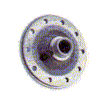
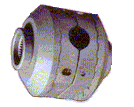
Automatic lockers such as the Tractech "Detroit EZ-Locker" or a PowerTrax
"Lock Right" are available. There is a new "Detroit Geroter" from
Tractech that is advertise to have eliminated the noise and jerks associated
with the standard locking differentials. The Tractech are more expensive
but are reported to be more durable than the PowerTrax.
Turbobrick member Philip Bradley commented: "I just took the 242T
on a 500 mile road trip. The EZ Locker works fine, just as it is
supposed to. It is not, however, just like a limited slip but with
no clutches to wear out, as it is sometimes advertised. The noise is heard
only at very low speeds, usually between 0 and 10 mph, when turning.
Sometimes when coasting on a very slow turn, the rear will snatch and grab,
causing the car to buck. There is not really anything to adjust to
get rid of this. In fact, the brochure and instructions warn to use
light throttle rather than coasting in slow turns. So one has to
remember to use a little gas rather than back off completely (or push in
the clutch) and then you cannot really tell the EZ Locker is there.
In a straight line, there is a solid, 50/50 lock that sends equal power
to each wheel. I have tested it so far only on dirt roads.
The car moves forward under power, however. When I had the open differential,
I could just spin a wheel on a dirt road without increasing speed much.
I should have the car at the drag strip soon for a proper pavement test.
I will obviously keep the EZ Locker, but it is less streetable than a limited
slip, although perhaps more durable. To anyone who lets others regularly
drive the car, or does not want any odd sounds from the rear, or does not
want to alter very low speed driving techniques on turns, I would not recommend
this style of rear. The 50/50 lock is better than a limited slip,
however, as those are often 25% TO 40% lock."
-
Manual lockers lock by engaging a sleeve that connects both axles together
via an air valve (ARB "Air Locker") or an solenoid (PowerTrax "C-Locker").
This is the only type of differential that allows full control. You can
choose the predictability and handling of an open diff, or the ultimate
lock of a spool. Installation requires some extra wiring; either
airlines and an compressor (Air Locker), or electrical wires (C-Locker).
To my knowledge, no Turbobrick member has installed a manual locking differential.
Purchasing and Installing a LSD/Locker:
Before shelling out your hard earned money, talk to a local 4X4 or differential
shop about your install. Unless you have lots of specialty tools,
setting up a rear end is not for the amateur. The average shop may
look at you weird when you ask about a Volvo but once you inform them that
it is 'just a Dana 30', they should calm down. If they want to charge
you extra because it is a Volvo or has disk brakes, go somewhere else.
The disk brakes are easier to remove than the locking hubs on the front
of a Jeep! Most shops can set up the differential with it still installed
in the car, although the rear sway bar will need to be removed. You
can purchase the differential from your local shop or try Reider
Racing or West
Coast Differentials on the web. Check to see if the unit comes
assembled or if you get a box of 'guts' and a 'carrier'. You can
sometimes get a pretty good price if you play one company against another;
"So and so has that differential for x$, can you beat that?"
You will need to specify the gear ratio when purchasing to insure that
the LSD/Locker is correct for your ring and pinion set. Differentials
will have different carriers for ranges of ratios. I have been
told that gears from the factory on a 240 Turbo are 3.73 with a manual
and 3.91 with an auto. 740 Turbos had fuel economy gears of 3.54
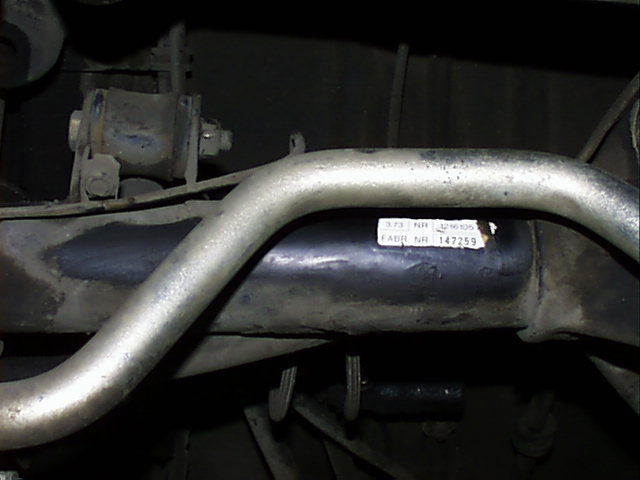
for a manual and 3.73 for an auto. To verify the ratio, there is
a label on the axle (picture below). When viewed from the rear, it
is on the driver's side just to the right of the spring. If you can't
find the label, "jack up one tire if you have an open diff, or both tires
if you have a working posi or locking differential. Rotate the tire one
full revolution for posis and lockers and 2 full revolutions for open diffs.
Carefully count the number of full revolutions the driveshaft makes. This
is your gear ratio. In other words, if the drive shaft turns 3 ¾
turns, you probably have a 3.73 gear ratio. Turning the tire for
twice the number of full revolutions and dividing the drive shaft revolutions
by two will give you a more accurate reading." (quoted from West Coast
Differentials)
If you have a car with an electronic speedometer, and your LSD replaces your
current carrier, you will need to replace the sensor wheel that signals the
speedometer impulse sender with the Volvo PN that corresponds with a stock Volvo
LSD for your year of car. Early model 700s use PN 1220844.
If you are installing a Dana "Powr-Lok", the new sensor wheel should fit correctly
because Dana made the OEM LSD too. If you are using a locker that only
replaces the spider gears, like a PowerTrax "Lock Right", your current
sensor wheel will stay as is. Any other style of LSD will require some
creative problem solving to attach the sensor wheel to the LSD carrier.
If you come up with a method that works (or does not) for a particular LSD,
please let me know.
Although you don't have to, it is recommended to replace the outer bearings,
outer seals, inner seals, and the carrier bearings. Replacing all of these
components will add about $200 to your install. At a minimum you should
replace the inner seals to keep the new differential fluid from washing the
grease out of your outer bearings. Check with wherever you buy/install
your differential to see if they can get the bearings and seals cheaper than
from Volvo. After the initial break in period (~500 miles) change the
differential oil. Red
Line has a 75W90 synthetic gear oil which already has a LSD friction modifier
in it. You can also use Amsoil 75W-90 or 75W-140 that work in LSD's (or
any type of differential). Check with your differential manufacturer to see
if a friction modifier is recommended.
Good luck and in the words of Turbobrick member Dave Barton, enjoy your
"tire glue".
If you have any questions, comments, testimonials, or found a good supplier,
please e-mail
me.
Thanks to Paul Schuh, Dave Barton, Jarrod Pilone,
Peter Linssen, and Philip Bradley for input on this article.