San Francisco Streetcars
| |
|
San Francisco is place where dot.com hustlers run computer banks out of Victorian mansions, fresh-faced kids from Stanford and MIT rub shoulders with the Hmong people, our allies in a lost war, who now scavenge for aluminum cans. Japanese tourists, some wearing face masks, plod the narrow sidewalks, retirees stroll about in manicured city parks, where – no one is sure of the number – perhaps ten thousand of the homeless sleep in conditions more primitive than experienced by our stone-age ancestors. New viruses, the latest a kissing virus, sweep through the community of mostly young men whose sexual practices would be familiar to ancient Greeks. Sacred Heart church, built on vast scale in 1897, now is home to a handful of aging parishioners. A net strung under the ceiling protects the faithful from falling plaster. Their African pastor, has face shining like a black sun, speaks of brotherhood between "all peoples, all tribes." While on the street, Porche Boxers and crouch-rocket motorcycles dispute passage with some of the earliest artifacts of mass transit. The cable cars are familiar to every tourist. But most people do not realize that the city has experienced a rebirth of the street car. During the good years, San Francisco Municipal Railway, or Muni, operated 900 cars on 50 lines. By 1982, the last five lines (J, K, L, M, N) were closed, replaced by light-rail surface transport and a subway under Market Street. The renaissance began in 1995 when L-line, running along Market from Castro to downtown, was reopened. Five years later, Muni extended the line to the Embarcadero. Plans are underway to reopen E-line, which runs from the Wharf to Pacific Bell Park and could ultimately reach the Presidio and Mission Bay. Passengers who want speed can ride the state-of-the-art subway; Muni’s surface transport consists more than 60 vintage street cars, lovingly restored and painted in their original liveries. A few of the cars had been purchased new by Muni and remained in inventory after operations ceased in 1982. Others were donated , traded for or purchased for nominal sums from cities that were phasing out streetcars. Volunteers, led by veteran trolley mechanics like Eddie Hansen, handle
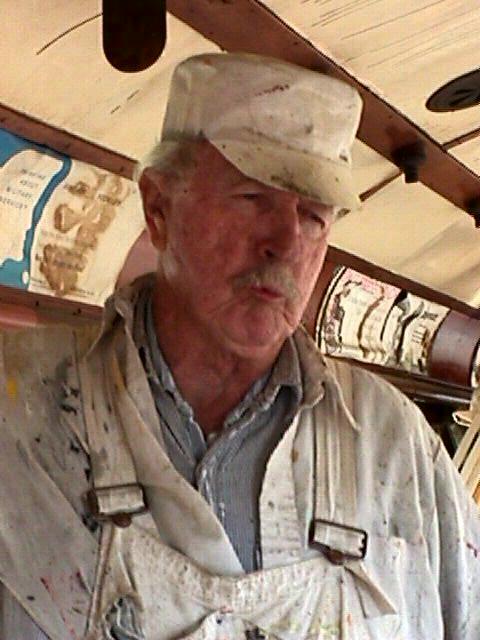
the restoration work. Most of the effort involves the wood and fabric
interiors and external paint. According to The cars pictured were undergoing restoration at the beginning of this year. Muni classes these cars as "Historic," which means that the design follows the traditional 19th century pattern. Unfortunately, none of the more modern Witt and PCC cars were in the yard at the time of our visit.
Car #578-S, built in 1896 for San Francisco on the open-side cable car
pattern, is the oldest in the collection. Because of the car’s age and mechanical brakes,
appearances are limited to ceremonial events. Car #1, another Muni veteran,
was built in 1912 and sees regular service on the F-line. Sometime this
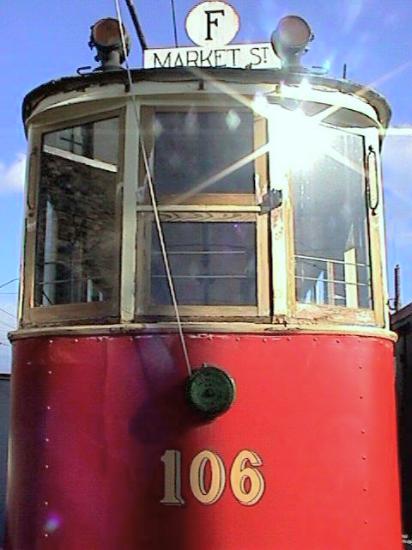
summer, it will be joined by #106, presented to the city some years ago
by the Soviet government. The Soviets claimed that #106 was built after the
revolution, but a careful examination suggests a build date of around 1912.
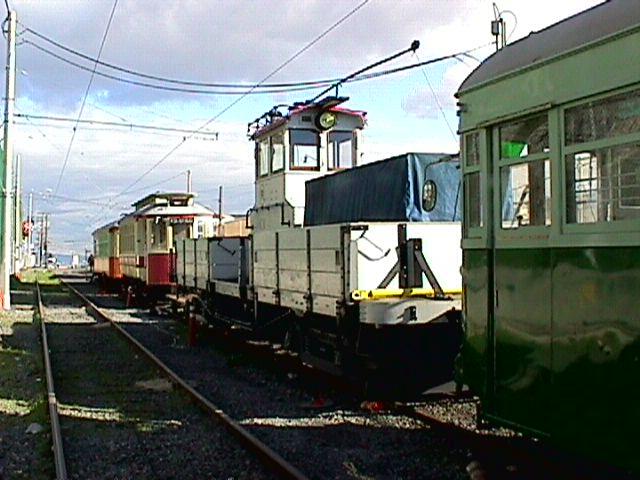
The freight car goes back to
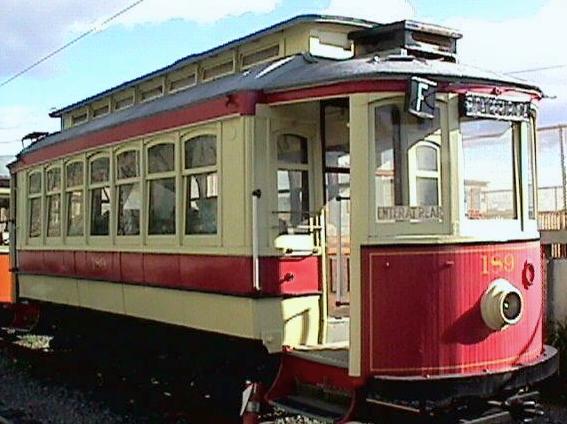
the same era. Although we think of streetcars as people movers, the same technology was used for freight. Other historic cars include #189 from Oporto, Portugal, and #578J, a beautifully
| |