
CHAPTER TWO
I had what I felt was a pretty classic ride, in fair shape and with great potential. I had looked at other GL 1000's with full Vetter or Windjammer packages and had recognized that I would probably strip all this stuff off anyway, so why buy it in the first place. People who were not used to seeing GL standards often reacted by saying "awesome bike". I was happy with the basic bare bones machine, but began to realize some of the elements that could have been better executed. The first time I removed the rear wheel, I found that the exhaust system was in the way and when I first removed the exhaust system, I found that it weighed a ton. This needed attention. I built some simple slip-on mufflers using rectangular aluminum extrusions and glass packing. (seen in the "early version" photo). These worked OK, but were a temporary measure, though they did amount to huge weight savings. I also found the dual point distributor to be a pain in the ass to work on, so began researching options. I eventually ended up with the Dyna S, which has been great. The first problem I encountered with the carbs, was a cracked slider in two of the carbs. I replaced them, but started to wonder if there was another setup that was; (a) easier to work on, (b) lighter, (c) more responsive. I found out about a two barrel conversion manifold that used to be made for these bikes, but learned that it had even longer intake runners than the stock sidedrafts. I felt the engine had been built for downdraft carbs and compromised for the sake of packaging. I decided to see if I could design my own intake system using Delorto, or Webber or Mikuni carbs. It turned out that a pair of Webber IDF 40 carbs sort of appeared in my path at a good price and I just bought them. I'd had some experience in the past with these on a Porsche and on a VW baja bug I'd built, so I knew they were relatively straight forward and "MUCH" lighter than the cement block that the stock carbs represented. This however was put on the back burner for the time being. I had tires to buy and to be on the safe side, I replaced the Dunlops that were on the bike with new Elites. They were an improvement over the worn ones, but never made much of an impression on me cause they seemed to wear into a triangular shape and then cup to the point of being unrideable. They still had lots of tread depth, but handled poorly after only about 7000 miles. I also got a pair of rear flats in a one week period and wondered if I had room in my life for wire wheels at all. Tubeless tires seemed to be a logical next step.
One of the easiest changes to make that effects the handling of a bike is to change the size of the front wheel. The early GL's used 19" front wheels which are actually best suited for dual purpose or off road styles of riding, or cruisers. They make for slower more stable responses to steering input. I learned that there was an 18" front wheel used on the '82 model, that was a comstar mag type that accepted tubeless tires, and made a note of that as a possible improvement for the front end feel. I had checked into Lester wheels but learned that they were available in 16" rear and 19" front only and I had my sites set on something that might lend itself more to lower profile tires, so went with a '78 rear 17" and the '82, 18" front comstars. I had to shim my brake calipers to center them on the '82 rotors, and adapt the speedo cable from the '82 as well, but everything worked fine and I noticed a big improvement in front end feel.
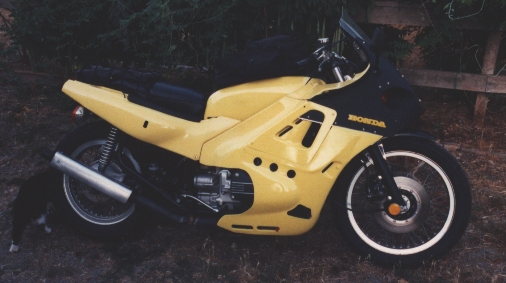
During this series of changes to the mechanicals, I was also thinking of aerodynamics and what might work for body parts. One day while visiting a friend in San Francisco, I had to walk my dog to the park down the street and came upon a pile of body parts. They turned out to be CBR 600 Hurricane pieces that had come off a wreck and had been left by the curb when the bike was hauled away. They had some cracks but no actual destroyed panels. I loaded them in my truck and went about trying to see if I might use them on the bike. As you can see by the photos of the early versions, they fit pretty well. The fact is that except for the width of the lowers, the contours of the Hurricane panels overlay the Wing engine almost perfectly. These panels worked really well on the road and produced a much more stable high speed feel. The only problems with them were related to heat and access to the engine and related components. I wanted to change over to the Webber carbs and had to modify the bodywork for this. Also I'd built a simple upper fairing from fiberglass and acrylic and was starting to think about improving on this area. The red half faired version shown at the top of this site was put together in '97 and is another fiberglass effort that I laid up using an acrylic skylite as a mold.
The Webber induction system was designed by me and built by a local fabricator of exhaust systems. "Major Muffler" in Santa Rosa, Ca. The owner of this business, Ken, built the system from drawings I provided as well as a spare head and one of the carbs to use for a jig. He also built the 4-2-1 exhaust system from the stock head pipes and a Suzuki GSXR muffler I found in the salvage store. Things were beginning to improve in leaps and bounds and I found that somehow I had lucked out at lots of turns in the road. The bike ran great with the new exhaust but now I had to make the leap to the new carb settup and hope to make more power, without getting lost in jetting and tuning.
Here's an early version.