
CHAPTER ONE
When I decided to get back into motorcycling after a few years without a bike, I made a decision to look for something I could live with on a few different levels. My previous motorcycling experiences centered mostly around British bikes in the 450 to 650 cc range. I had owned one Japanese bike, a Kawasaki 500 triple 2 stroke, but that was not one of my favorite rides and I knew I wanted to get a big bike. I'm 6'1" and 190 lb, and have always felt too out of place on my small bikes. I also knew I wanted something that was road oriented rather than another dual purpose bike. I had gotten some opportunities to ride the bikes of some of my friends and knew what a BMW and Ducati felt like compared to a BSA or Triumph. I also considered Harleys, as I'm a Milwaukee native and have kind of a soft spot for them. But even the used Harleys are relatively expensive and since I had set a fairly low $ limit for myself, I had to look at bikes that were'nt in great condition and even a cosmetically nice Harley's reliability is always a question mark. I also have discovered that my lower back is not in favor of the cruiser riding position, as you can't use your legs to ease the hard bumps, when your feet are way out in front. I pretty much had talked myself into a slightly forward upper body riding posture, and narrowed the search to bikes that leaned in this direction, or could be set up to encourage that posture.
I had some riding experience on a BMW boxer and always liked the concept of the bikes. They always had a fine reputation for reliability and longevity. The original Goldwing, I felt, had been designed to emulate the same riding experience as the BMW, and had been intended to compete for the same market. The aftermarket success of Goldwing related accessories from makers like Vetter and Windjammer, took the bikes in the direction of the full dress tourer, and Honda was smart to follow their lead, but I feel they could have had similar success with a line of sportier outfitted models and maintained the original direction of the early standard. It seems that rather than take that approach, they opted to focus on the ST 1100 for that share of the market. Never the less, the early Wings had, to my mind, the potential to shine as performance oriented touring bikes. The 4 cylinder boxer engine in the Wing is smoother as well as more powerful than the BMW twin, and when put in the proper context to be ridden with a bit more gusto, has proven itself to be a truly remarkable motor. This sweet personality comes shining through time after time, and has made me such a fan, that I have taken my plans for exploring it's potential in the direction of a totally new chassis. More on this later.
I also want to maintain my bikes myself, without having to rely on dealer or shop mechanics for routine procedures. I've always felt more secure with a vehicle that I understand on some basic mechanical level. When you're far from home, it's reasurring to feel you can bail yourself out of any difficulty that might arise. I bought lots of magazines and read used bike recommendations, and talked to some guys who work on bikes every day to see what they felt was the easiest and most straight forward model to work on. Without exception they all said the early GL 1000 and 1100 Goldwings are the easiest to work on as well as really reliable over the long run. I'd seen some standard early GL's that I thought were really handsome bikes and figured I'd start watching the papers for prospects.
I found my '76 in the paper and discovered that the owner was a bike mechanic who had just bought a Harley and owned an older Norton that kept him busy. He needed to get rid of one bike and said he hated to see it go, but something had to give. I bought it for $950.00 in 1991. I found that it shifted a lot worse than I'd expected a Goldwing to shift, but I babied it along for awhile till I learned this was a sign of a bad driveshaft. $135 and a few hours later and I was on my way to gaining some experience with working on GL's.
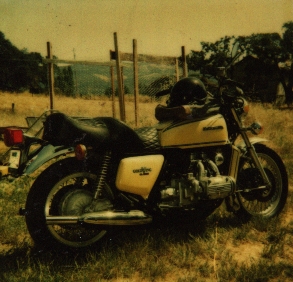
Being a graduate industrial designer and dyed in the wool hotrodder, I could'nt help looking at the bike as a potential project. I've always liked the "beauty of function" and "elegance of simpicity" doctrines that were taught in design school, and am a firm believer in letting the mechanical elements rule the priorities and appearance of a machine. I also learned that the early GL's were not as slow as I had thought. A bit of research uncovered the facts. The '75 original wing weighed in at 585 lbs., made 80 hp and turned the quarter mile in under 12.5 sec. I was beginning to see even more potential for fun in my daily ride. And I planned to ride as close to daily as possible. I commute 30 miles each way, six days a week and felt that a bike was a good solution to making that time spent in a healthy escape from the stresses of self employment. Little did I know that the Wing would prove to be incredibly realiable as a high mileage vehicle. Mine had 41,000 showing on the odometer, but I later decided that it may have been around once before. The photo under "here's where I started" shows the bike within a few days after I bought it.
One of the first things I wanted to change on the bike, was the handle bar. The long horn style bar made me feel out of touch with the front wheel and so I changed to a straighter, shorter bar. I also started thinking about a fairing, and eventually built myself a fork mounted bikini style fairing that served the purpose of breaking up the chest area and making the California freeway pace more enjoyable. My commute is not just limited to freeway and offers 5 possible routes, 4 of which are back roads over mountainous terrain, so I began to think about ways to make the bike more at home on these kinds of roads.
Here's where I started.