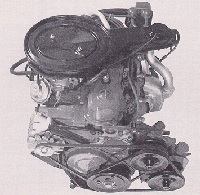
All X-cars were offered with the 2.5 liter (151 cid) 4 cylinder or the 2.8 liter (173 cid) V6.
This engine, Built by Pontiac Motor Division, displaces 151 cubic inches. It is commonly known as the "Iron Duke Four" because of its durability and economy. It was produced 1977-1993, and was the base engine in the vast majority of GM cars of many sizes in the 1980s. In 1980 it was first used as a front wheel drive engine in the X bodies, and for that first time had a crossflow cylinder head design (i.e. intake and exhaust manifolds are on opposite sides so the air flows through the engine in one direction).
In 1980-81, then engine was carbureted. From 1982 on, it had throttle body fuel injection (TBI) and later became known as the "Tech Four". Most 4 cylinder designs from GM were later derived from this engine.
This engine produced 90 hp - even for a small car such as the Skylark this isn't much power. Choked with emissions equipment, and tuned for maximum economy, the Iron Duke is a bit slow. However, if you can deal with that, you'll find this engine is quite capable in all other areas, particularly in durability. Most of these engines quite easily achieve over 150,000 miles.
Incidentally, Pontiac offered (and still does, I believe) performance rebuild kits for the 2.5. Likely included would be a performance cam though I'm not sure what else. I'd love to hear if anyone's done this.
One design element that contributes to the engine's longevity is the fact that no timing chain (or timing belt) is used- instead the crankshaft and camshaft are directly connected through a timing gear. This prevents a costly engine repair due to damage caused by the chain breaking at high mileages on other engines. I've seen it happen. The crank gear is steel; the cam gear is either a bakelite fabric composition or aluminum. The teeth on the cam gear can strip out on high mileage engines, but this setup lasts longer than a timing chain. Mine is still just fine at 182,000 miles.
Both the block and head are of cast iron construction, which is better than some of these aluminum head/cast iron block engines which suffer head warping after overheating. The only aluminum used in this engine that I know of are the pistons themselves. Some of these engines even had roller valve lifters- very unusual for such a low cost, high production engine. Not all did though. The 2.5 doesn't really seem to have a "weak point" in it like other engines- except they tend to leak oil a lot from the valve cover and other gaskets. However, if you keep the level topped up and change the oil regularly, you'll be fine for many years. The early (80-81) carbureted version of this engine is pleasantly smooth and quiet. Even the starter sounds cool. The 82 and later fuel injected version is somewhat noisier- mainly noise from the TBI unit I believe. Also, the timing gear setup makes these engines somewhat noisier. As a matter of fact, during the 1990 model year, GM switched to a timnig chain design on the 2.5 to reduce noise. Still it is much better than those annoying buzzy/whiny 4s on many foreign cars. The late 80s/early 90s version of this engine used in the A body cars is much smoother/quieter.
The 2.5 is easily GM's best four cylinder engine, not just because of its timing gear setup, but also because of its overhead valve design. Most of GM's other 4 cylinder engines were of overhead cam design. For instance, the 2.0 used in 80s Cavaliers, the 2.2 in Corsicas, and the 2.3 Quad 4 used in Grand Ams, just don't seem to have the durability of the venerable 2.5. There was a 2.0 overhead valve engine used in Cavaliers also, but I don't know much about it.
The only problems I've ever heard of with the 2.5 (besides oil leaks) was that during the 1980 model year, one of the head bolts was placed too close to the exhaust manifold. The excess heat would cause the bolt to crack down inside the block, causing a compression loss. You had to get a bolt extractor to get the thing out, and replace the bolt. That was ALL you needed to do- however a lot of people paid to have head gaskets replaced when that wasn't what was needed!
I've also heard in the Fiero there were problems with the 2.5 where the water jacket would crack in the block, but this was unique to that car because the engines were hard to keep cool in a mid-engine car like that. Also the Fiero oil pan was reduced in size to only 2.5 quarts (!) to fit the thing in the car, so if you ran a quart low on oil you were likely to burn the engine up! These problems never occurred in the X or A bodies.
Type............................................L-4
Piston Displacement(cu. in.)....................151 (2.5 L)
VIN code........................................5(80-81); R(82-85)
Built by........................................Pontiac Motor Division
Sales code......................................LW9
Valve arrangement...............................in-line
Bore and Stroke (in)............................4.00 x 3.00
Cylinder Head and Block Material................Cast Iron
Compression Ratio...............................8.2:1
Net/Installed Horsepower @ Engine rpm...........90 @ 4000
Net/Installed Torque (lb.-ft.) @ Engine rpm.....135 @ 2400
Recommended Fuel................................No-lead
Carburetor Type.................................2-barrel, 2 stage
downdraft
Carburetor version..............................Rochester Varajet E2SE*
Idle Speed (rpm) Automatic (Drive)..............650 A/C off
Idle Speed (rpm) Manual (Neutral)...............1000 A/C off
*1980 models used 2SE Carburetor; 1982 and later had TBI
Courtesy 1981 Buick sales literature

This engine was produced by Chevrolet Motor Division. It displaced 173 cubic inches, and it is known for its unique 60 degree design- that is, the cylinder banks are 60 degrees apart as opposed to the traditional 90 degree V6- this design was used to save space, and to save fuel. It was designed specifically for the X cars and was produced 1979-1989.
This engine produces 115 hp, and is quite capable a performer as well as being economical. With a 3 speed automatic transmission, this engine could move a Skylark from 0-60 in about 8.5 seconds. That may not seem like much, but it was better than many performance cars of the period with much larger and heavier engines. It is definitely quick.
The 2.8 V6, other than its 60 degree design, shares many of its design elements with the highly respected Chevrolet small block 305 V8. It is made of light weight cast iron and aluminum components- and thus weighs in at a mere 800 pounds (approximately).
The 2.8 is a much better engine for performance and smoothness. These things are amazingly quiet at highway speeds too. They are quite economical on fuel and are quite durable. They don't seem to last as long as the 2.5 but are quite capable of doing so with the proper care (i.e. oil changes). At high mileages (over 120K) the rod and main bearings in these engines tend to wear. You'll hear this as a ticking just after cold starting the engine, or sometimes at idle speed too. If you have a high mileage 2.8 and weren't good about changing the oil, your bearings may have worn to the point that the oil light will dimly glow at idle or deceleration, and then go out on acceleration. This is because the bearings have worn so much that oil pressure at idle is too low. It's time to think about a rebuild if this is occuring. Otherwise other parts of the engine may soon be damaged by the low oil pressure situation.
The 2.8 went out of production after the 1989 model year. It has been superceded by the 3.1 and 3.4 V6's, designs of which have been based completely on the 2.8. So, it is still alive in a sense.
The 2.8 was carbureted throughout X-body production, though a multi-port fuel injected version was offered as an option (and rarely ordered) on 85 Skylarks and Citations. Most still got the carbureted V6 or the TBI 4 cylinder.
Type............................................60 degree V-6
Piston Displacement(cu. in.)....................173 (2.8 L)
VIN Code........................................7(80); X(81-85)
Built by........................................Chevrolet Motor Division
Sales code......................................LE2
Valve arrangement...............................In-head
Bore and Stroke (in.)...........................3.50 x 3.00
Cylinder Head and Block Material................Cast iron
Compression Ratio...............................8.5:1
Net/Installed Horsepower @ Engine rpm...........115 @ 4800
Net/Installed Torque (lb.-ft.) @ Engine rpm.....150 @ 2000
Recommended fuel................................No-lead
Carburetor Type.................................2 barrel, 2 stage
downdraft
Carburetor version..............................Rochester Varajet E2SE*
Idle Speed (rpm) Automatic (Drive)..............700 A/C off
Idle Speed (rpm) Manual (Neutral)...............750 A/C off
*1980 models used 2SE carburetor Courtesy 1981 Buick sales literature
Some lucky folks have the rare High Output version of the 2.8 V6. It was first offered as an option in 1982, mainly on the sport versions of the X cars. This engine had a higher compression ratio, giving it 135 hp! It was offered in the sporty Chevy Citation X-11 package, the Pontiac Phoenix SJ, the Olds Omega ES 2800, and the Buick Skylark Sport Sedan and Coupe (82) and the Skylark T Type (83-84). The sport versions of these cars were a rare sight then, and are even more rare today. Besides the more powerful engine, these cars had a Rallye sport suspension, smoked taillight lenses and blackout trim (as opposed to the chrome used on other versions of these cars).
The 2.8 V6 HO was optional, but rarely ordered, on all X car models.
Compression ratio..............................................8.94:1
Valves....................................1.72" intake, 1.42" exhaust
Camshaft specs:
Lift.................................... .394" intake, .410" exhaust
Duration........................................... @.050" : 196/203
Lobe Centerline.......................................... 109 Degrees
I've heard of people stuffing 3.8's into X cars and racing them. I'm sure a 3.0 would fit in there quite well also. If anyone has ever done this and has been successful, please let me know- I'd like to hear about it.
As mentioned previously, the 2.5 was carbureted until 1982 when it was changed to throttle body fuel injection. 1977-79 models had a 2 barrel cabruretor, but I don't know which model it was. In 1980, when it was switched to crossflow head design, the Rochester Varajet II carburetor was added- 1980 and 81 only. However, some X cars, A cars, and F cars (Firebird/Camaro) sold in Canada with the 2.5 DID get the Varajet carburetor in 1982 and 1983. The engine used distributor (HEI) ignition up until 1986, after which it was converted to distributorless ignition.
American Motors also used the 2.5 Iron Duke in many of its cars from 1980-1983. Such cars were always equipped with the Varajet carburetor. This engine found its way into the AMC Concord, Spirit, and Eagle of ths period. It also can be found in Jeep CJ's and the small Wagoneer (the little one that later became the Cherokee) up until 1984. In 1985 AMC built it's own 2.5 4 cyl (150 cu in instead of Pontiac's 151 cu. in.) which was based on the design of the AMC 258 cu in straight 6- the roots of which go back to sometime in the 60s.
The 2.8 V6 was available with only the Varajet carburetor until 1984 (VIN codes X or Z- the latter was the high performance version). In 1985 and 86, both the carbureted (code X) and an electronic fuel injected version (code W) was offered. In 1987 and later, only the EFI version was available. Also, 1987 was the first year distributorless ignition was used on the 2.8 V6.
Like the 2.5, many 2.8 V6 engines were also sold to AMC for use in its cars. I'm not sure that any of it's actual cars got it, but I know Jeeps got the 2.8- I don't think CJ's got it, but the Wagoneer/Cherokee had the 2.8 in the 1985-87 or so period, until Chrysler bought out AMC in 1987. AMC cars and Jeeps also used the GM ignition switch, by the way. However, AMC used Chrysler Torqueflite automatic transmissions. AMC cars often had many different parts from the Big 3 domestic automakers, and also some of it's own parts. The 258 straight 6 was still used in Jeeps until Chrysler cut down the displacement to 243 cubic inches sometime in the late 80s.