
|
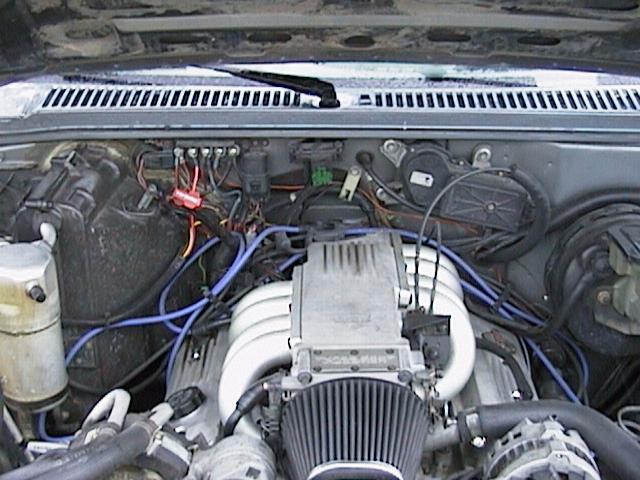
I drive an '86 Chevy S10 pickup with a V8 stuffed under the hood. This is a picture of my engine compartment- as you can see, it certainly isn't pretty but it's functional. Functional to get driven every day, anyway. It isn't terribly fast (probably good for about a 15 flat at about 90 mph), but for an S10, it is certainly quicker than most (Syclones excepted, of course). It's great for surprising people- no one ever really expects an S10 to run like this. I know several other people with V8 S trucks (pickups and Blazers)- one of them is a black '83 extended cab truck with a cowl hood and a 6 speed. His motor is stock, from an '89 Corvette, which means it has aluminum heads. He also has DFI fuel management. My motor is out of a 90-92 F-body, so it is speed density and has iron heads. It is stock, and was rebuilt @22,000 miles ago. So far, I haven't had any problems with the motor other than the oil consumption problem (when the motor needs a bore/hone and you don't do it then put it back together with chrome rings, that'll happen), but I have engine cooling issues like you wouldn't believe. The guys down at Centennial Radiator love me. I have to go in there about every third month or so to get something in that damn radiator brazed up. What a pain in the ass. I am getting pretty good at taking it out of the truck, though. I know exactly what tools I will need, and what order things need to come out in. Also, I know exactly where to put my catch basin for my coolant. Once again, practice makes perfect. I am pretty close to being one perfect motherfucker when it comes to taking out my radiator. I do have to admit, though- my truck is rolling proof that if you put enough time and work into it, you can put any motor in any car. There are kits to put V8s in S10s, but that's not the way this one was done. No, I didn't just want a challenge- I didn't do the original conversion. The guy who did built his own motor mounts, which are both good and bad. Good in that I have plenty of distributor to firewall clearance (when compared to many V8 S trucks), but bad in that the motor is placed so far forward that the bolts for the water pump pulley are only about 1/2" from my damn radiator. Which, obviously, means that I have no room behind my radiator for fans. So I have to have them in front of my radiator, which also necessitates them being in front of my A/C condenser. When fans are in a "pusher" configuration as opposed to a "puller" configuration, it is said that they loose @15-20% of their air flow capacity due to air "backing up" between the A/C condenser and the fan blades. |
Don't get me wrong- I LOVE the idea of engine swap vehicles. If I didn't, I'd have gotten fed up with my truck long ago and burned it to the ground so I could collect insurance money on it. I love the idea of putting a bigger motor in a vehicle than it came from the factory with. While there are problems that arise when doing an engine swap (suspension, cooling, brakes), they can be overcome with some planning, a Jeg's catalog, and some mechanical know how. Oh yeah, don't forget money. Sometimes lots of it- how much you are willing/able to do yourself will dictate how much money you will have to spend to complete an engine swap. For instance, a V8 S10 could be assembled hardly spending any money at all on swap-specific parts. Of course, you would need a welder to build your own motor mounts and headers; but other than that, it would pretty much drop right in. You'd have to get the drive shaft professionally shortened (usually about $80 or so- unless you just happen to have access to a driveshaft balancer, which I happen not to. Dammit.), but other than that, a shadetree mechanic with some experience and some know-how would be able to do a V8 S10 conversion. On the other hand, the motor mounts can be bought pre-made from JTR for about $80, and the time I would spend setting up my own motor mounts is worth that, so that's what I would do if I was going to build another V8 S10. Which I will someday- I am thinking about a blown/aftercooled 383 inch LT1 hooked to a 4WD 4L60E followed by an Oldsmobile Bravada AWD transfer case (before they started using that "smart track" system that uses the ABS sensors to sense wheel slippage and determine which wheels to transfer power to/from). Alas, all it takes is money and time- two things I am chronically short of.
As for cooling issues, I am a big believer in big aluminum radiators and engine driven fans (which obviously need to be "pullers"). Perhaps an electric fan could keep up in a motor swap situation, but until I can afford to try some $200 19" super duper bad ass motherfucker, I will recommend engine driven fans to everyone that will listen to me when doing an engine swap. The reason is simply that with a good fan shroud and an engine driven fan, airflow across the radiator is just not an issue.
As for suspension issues, damn near anything you're going to swap a motor into will have aftermarket higher rate springs available for it. Obviously, higher rate springs are a necessity to help keep the front of the car/truck off the ground once you've added the weight of a bigger motor. I should note here: the necessity for stiffening up the suspension is largely dependant on where you mount the motor- the further back you can get it, the better; this allows the rear suspension to help carry the additional weight of the bigger motor. Depending on how far back you can mount the motor, stiffening up the front suspension may not be a necessity at all. Just add some good shocks/struts to control jounce (with more weight in the nose, it will tend to want to bounce around more), and it will ride and handle like stock- or, in some cases, better.