The E3 Buyer's
Guide (updated June 8, 1998).
Other good reading: E3
Guide From Road&Track's Used Car Classics, 1985 (370K)
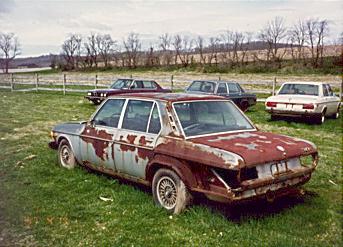
Sometimes blemishes are easy to find...
Rust - Engine - Driveline
- Interior - Modifications
Suspension & Brake - Pricing
- Conclusion
1. Rust
The "rust-free" E3 is a myth. With enough probing, you can find some
on any car. First, you need to know where to look, then the trick is to
know what rust is important, and what isn't. All of this rust is at least
kind of repairable, but if the car is rusted through in more than three
or four of the BAD areas, and you're not a hobbyist welder, go find another.
A poke with a srewdriver can reveal a very rusty piece that looked fine
from the outside. If the seller is a big guy with tattoos, perform this
test discreetly.
BAD Rust Places:
Front shock towers. Inspect from the engine bay, and under the fenders.
Rear Shock towers. Remove the covers (if fitted) from the wheel
humps in the trunk. Usually, a horizontal line of spot welds rusts through
here.
Firewall. There is a rust trap at the back of the strut tower horizontal
brace, where it meets the firewall. From in the fender well, inspect the
firewall where it meets the rear-upper edge of the plate that surrounds
the strut/spring assembly. From inside the car: Open the glovebox, remove
the plastic shield at the back, and look for rust. If you see clean spot
welds, good. On the driver's side, see what you can past the fuse box.
Floor pans. Mainly the front ones go at the outside corners, above
the jacking points. This is relatively easy to repair.
Chassis legs. Especially on the driver's side, the box section rusts
out, possibly from battery acid and/or brake fluid. Mine rusted from the
back of the driver's floor pan to about 6 inches before the first suspension
mounting. Patchable.
Rocker panels. You can only really check these from outside. Inspect
the whole length.
C-Pillars. Cars with sun roofs are especially prone to rust around
the vents on the outside of the C-pillars if the sunroof drain tubes are
blocked. Nasty.
Around gas tank. BMW used a spongy water-retaining gasket to seal
the gas tank to the body. Inspect from the trunk: remove the right-hand
trunk-floor panel.
Not-So-Bad Rust Places:
Front fenders. In a vertical line parallel to the front door edge.
Also around the turn signals. Fenders are a bolt-on fix. Not too tricky.
Rear quarter panels. Behind the rear wheels. Can usually be patched
OK.
Spare tire well. If the drain holes have been blocked, this might
even have standing water in it. Unless it has big rust holes!
Door bottoms. Rear corners of the door skins are a rust-friendly
design.
Front-edge of hood. Clogged drain holes will quickly cause rust
here too. Inspect from the engine bay.
Like other BMWs of the early 70s, E3s can develop rust on just about
any spot, so the above list is by no means exhaustive, but points out the
"classic" rusty bits.
2. Engine
Cylinder Head. Newer is better. The year is stamped on the left
side of the head, near the front. Cylinder
Head FAQ.
The engine should be checked for excessive smoking due to oil burning,
excessive valvetrain noise, and sludge buildup when looking under the oil
filler cap. The aluminum bits inside should be clean and shiny, or maybe
light brown. Beware of black or gummy parts inside.
This is obscure. If the engine has sat for a long time (years),
oil pump pickups have been known to disolve in the acidic soup of oil and
condensation. Not likely, but brake hard a couple of times and see if the
oil light comes on.
Large amounts of sweet-smelling steam coming from the tailpipe upon initial
start-up usually indicates a cracked cylinder head, or sometimes a leaking
head gasket.
A common older BMW problem is blue oil smoke coming from the tailpipe while
coasting down off the throttle from high speeds or on startup. This is
an indication of bad valve seals and worn valve guides. This problem is
liveable, just as long as the oil level is checked regularly.
Lots of crankcase blowby is an indication of loose rings, and is often
accompanied by oil smoke from the exhaust while idling and accelerating.
The lower end of these engines is tough, and it is usually the head that
needs the most work during rebuild time.
Overheating is common unless cooling system modifications have been performed.
Common improvements include: later (viscous) fan clutch, 3-core radiator,
9-or-more-blade fan, cooler thermostat.
3.
Driveline
Manual transmissions are reasonably tough, as is the clutch. A little
bearing noise is acceptable, but excessive noise is usually a sign of impending
failure. All stock gearboxes are 4-speed. If the car has a 5-speed, it's
a retro-fit.
Differentials are usually reliable. Seal leakage problems are almost
universally common, and should be left alone. The Limited Slip Diff was
available as an option, and is highly sought-after. To check whether the
car has an LSD: jack up the back, turn one rear wheel. If the other wheel
rotates in the opposite direction, then the diff is NOT LSD. LSD's also
have an "S" stamped on the lower RH side, under the fill plug (the ratio
is stamped here also).
Automatic transmissions are notoriously weak. Figure on about $1100
for a rebuilt exchange unit from BMW. Conversions to a manual transmission
are also a common and relatively straight-forward procedure, provided a
complete parts car is available.
Driveshafts can cause vibration from a broken front flex disk (guibo)
or a bad center support bearing. Each of these is only about a $30 part.
If close inspection of them reveals no flaws, the U-joints may be bad.
This is expensive to fix, as the entire driveshaft must be rebuilt (about
$300+).
4.
Interior
Clock. If you find a working one, you've beaten some pretty big
odds. They can be repaired, especially the earlier mechanical ones which
have a soft-solder fuse that is often their only problem.
Dash cracks are very common. An uncracked one is a rare find. '72
and later dashes are one piece. Older ones are 3-pieces, and much easier
to recover with leather or similar.
Gauge problems are usually a bad ground wire somewhere. Overall,
the gauges are very reliable.
Seat padding tends to fall out after 20+ years, leaving horshair
on the floor and a bony seat. I repadded the rear seat in my Bavaria with
carpet underlay foam. Works well.
Skai Vinyl used on these seats is excellent and remains flexible
long past the life of other period vinyls.
5. Identifying
Modifications
Weber Carbs are a popular replacement for the original Zenith units,
can be a performance improvement, as well as being easier to tune. Most
popular is the smaller downdraft 32/26DGAV models. These are found with
both small on-carb air cleaners, and the original large black air cleaner
(usually a kit made by JAM). Most sought after are the triple double-sidedraft
setups. Single 4-barrel carbs and larger 38/38 downdraft carbs have also
been used.
Thermal Reactors are big ugly boxes fitted to the exhaust manifolds.
They were fitted only to '75 and '76 U.S.-spec cars. These decrease fuel
efficiency and are are a poor attempt at emissions control. Often they
are replaced by exhaust manifolds from earlier E3s or a real header from
Stahl.
Wheels. All E3s came with 14x6 wheels, either  steel
(here with stock hubcaps and trim ring) or alloy.
steel
(here with stock hubcaps and trim ring) or alloy.
Stock alloys are the  20-spoke
"turbine" design, and the
20-spoke
"turbine" design, and the
 5-spoke "coupe" style.
Shock absorbers. Boge was stock. No doubt they've been replaced
by now, so check to see if it has Bilsteins or something similarly valuable.
Sway Bars. These were available for both front and rear from BMW.
I think the stock sizes are 19mm front, 16mm rear.
6.
Suspension & Brakes
Nirvomat is a self-levelling suspension system installed on a small
minority of E3s. It's a bad idea. If the rear end of the car is very low,
the Nirvomat system may have failed. Nirvomat
FAQ.
Brakes Pull? Frequently, rubber hoses swell internally as they age,
causing blockages. No biggie to replace. Sometimes calipers will get stuck.
Not too expensive -- rebuild kit is abot $25. See Caliper
Rebuild FAQ.
Brakes Spongy? The fluid is probably ancient. Check the color. No
biggie here.
Brakes Shimmy? Rotor warpage is common on these cars, especially
with the original solid front disks. Rotors and pads are readily available,
and well priced. Four-wheel disk brakes are standard on all E3s, by the
way.
7.
Pricing
This is a very subjective area. Driveable E3s have been found for well
under $1000. A basically sound model might fetch $2-3K. Very good would
be up to $5K. Even the best E3 is not likely to fetch much over $10K, but
that figure is rising as the collectibility of the model increases, and
people realize what a bad deal an expensive coupe can be. In any case,
the E3 is the bargain of the BMW world.
Conclusion
In 25 words or less: If you find a low-rust E3 with a perfect dash,
buy it as you can fix everything else relatively easily.
All mechanical parts are readily available. Many trim parts are no longer
available new, but there's a lot of old stock out there, and a lot of good
parts cars. Many items, especially mechanical, can also be gleaned from
newer models, particularly the 5-series to 1981 (E12).
Credits: Thanks to Filippo Morelli
for allowing me to use some wording from the 2002 Buyer's Guide on his
excellent 2002 Page.
E3 Buyers Guide compiled by Gerald
Stanley.
BMW Links:
Gerald's
personal car page -The
index of the B-FILES - Senior
Six Home - FAQ
Index - Kelly Holsten's
Bavaria Page.