Sandblasting or glass bead blasting is a must to have or have access to if you are going to do a restoration. The first bike I did a complete frame up restoration on was a basket case Harley Davidson, I know, what was I thinking. Well anyway, I stripped the bike down to the frame and then tryed the old paint remover, without much success so I started sanding, and sanding ect. This is when the sandblasting comes in real handy. If you are planning on doing several restorations it might pay to build your own blasting cabinet.
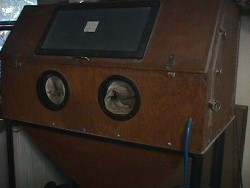
My homemade blasting cabinet
I ordered a kit from Tip Tools and Equipment and built my own blasting cabinet. The kit came with plans but I enlarged mine so I could get a complete cycle frame inside. I use a fine grade of blasting sand for the frame or steel parts that need blasting. When I'm cleaning aluminum parts or engine cases I use glass beads, they are much easier on the softer metals. Some people say glass beads are too ruff for the engine cases. Most of these people use Walnut shells or is it Pecan shells and some even use baking soda. My personal opinion is that is extreme or their stuff must be in a lot better shape than the stuff I find to restore.
Beadblasting Engine Case
As I mentioned above, I use glass beads to beadblast the engine cases. I get a number of questions from people regarding if it is possible to beadblast a complete engine or should it be disassembled totally down to the engine cases. Naturally, the best way to do this is a complete stripdown of the complete engine. However, sometimes (Due to time or money) this is not possible. You can beadblast an totally assembled engine if the proper care is taken to completely seal the engine. The key words are "properly sealed", anything less and you just get to take it down and do it again, this time the hard way.
How can you properly seal and engine from the pressures of beadblasting? First, be sure to use the proper pressure on the air gun. I have found most hobbist take the "give her all she got" approach and that is not correct. Check the suggested blasting pressure for the medium you are using. Most times it is about half the pressure that is available, I think I use from 45 to 60 lbs of pressure in most cases. This reduces the dust and allows you to see exactly what you are blasting and most importantly it reduces the pressures against the seals.
How can I seal my engine from damage from the blasting pressure? I have found that corks push tightly into the intakes and exhaust holes followed by about a 1/4 inch of melted wax over the cork works great. I generally tape over the wax to provided extra protection. Keep in mind the intake and the exhaust are not the only areas that will need attention. Never blast directly at a seal such as at the countersprocket of shift lever. I Usually cut a piece of cardboard to go over the seal. I then seal the cardboard with wax and again, protect the wax with tape. Don't forget to plug all breather holes in the crankcase. Cover and protect all areas that you are not going to blast. This is very important unless you like extra work.
Be sure to throughly clean and srub the engine before removing any of the protected coverings you have installed. This is very important as you don't want to go this far and mess it up at this stage.

 Tip Tools and Equipment and built my own blasting cabinet. The kit came with plans but I enlarged mine so I could get a complete cycle frame inside. I use a fine grade of blasting sand for the frame or steel parts that need blasting. When I'm cleaning aluminum parts or engine cases I use glass beads, they are much easier on the softer metals. Some people say glass beads are too ruff for the engine cases. Most of these people use Walnut shells or is it Pecan shells and some even use baking soda. My personal opinion is that is extreme or their stuff must be in a lot better shape than the stuff I find to restore.