Quite often when installing late model braking systems in street rods, we have to manufacture our own brake pedals-particularly when installing the Master cylinder under the floor.
Unfortunately, if you don't pay enough attention to the design of the pedal, the effectiveness of the braking system can be reduced. Some basic principles can be gleaned from examining the pedal that the original donor car used to activate the master cylinder.
As an example, let's assume that you are going to use a master cylinder from a late model Ford-say XY to XB Falcon. If we look at the pedal, it has the following dimensions and properties:
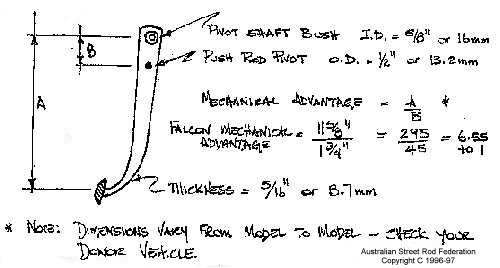
If you duplicate these dimensions and properties in your own custom pedal, then you can be reasonably assured that the pedal travel won't be excessive, the pedal pressure needed will be similar to production vehicles, and the system will work to your expectations.
Here are some layouts that can be used:
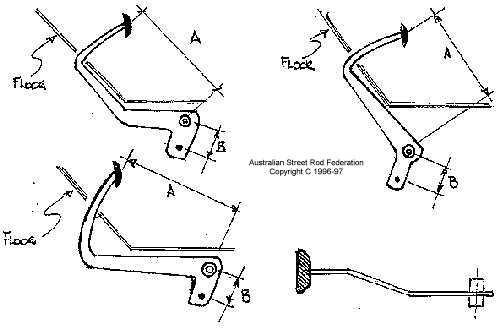
When setting up the pedal, the connection to the push rod should be perpendicular to the push rod when the pedal is depressed for normal operation. This ensures that the maximum effectiveness is made of pedal pressure, with minimum displacement or travel of the pedal.
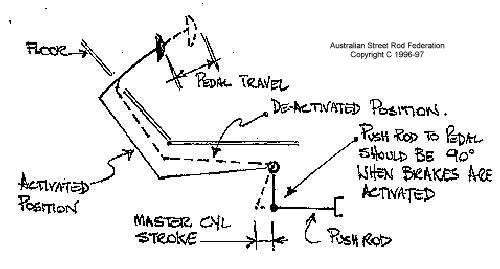
If you need to put a bend in the pedal for clearance reasons, as shown in (2), then you need to increase the material thickness of the pedal so that the pedal won't distort-particularly under emergency braking conditions when "panic" induced foot pressures are much higher than normal "slow down" pressures.
For this reason you should also ensure that the clevis pins or bolts used on the push rod connections, and the push rod itself is large enough in size to prevent buckling under 'emergency braking' conditions. Remember that longer push rods need to be larger in diameter to prevent buckling under load. (The standard input shaft to an XB Falcon Mastervac is 1/2" diameter).
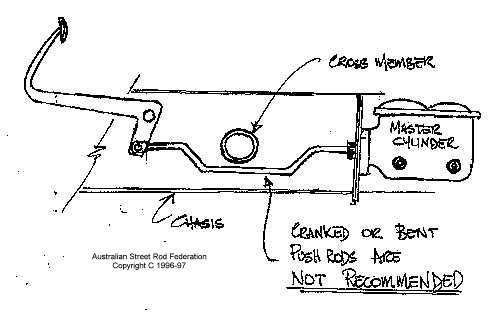
Bent or "cranked" push rods should be avoided, as they weaken the push rod, and are susceptible to bending under emergency loads. If you find yourself in the position where you are considering a bent push rod, reconsider your design-perhaps use a remotely boosted system, if the space requirement for the Mastervac unit is the problem, or relocate the master cylinder if need be.
One other consideration is the shape of the pedal. Modern pedals generally have a rounded face to the pedal, as opposed to a flat surface.
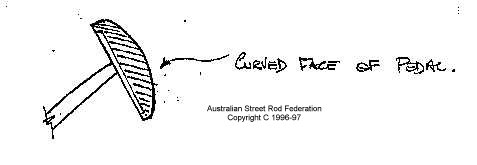
This provides a more comfortable "feel" when using the pedal, allowing the ball of your foot to "roll" around the pedal face as the pedal is depressed. Using a "standard" pedal face on your custom pedal is recommended.
The same basic principles apply to clutch pedals. So, when you salvage the master cylinder from the donor car, consider getting the pedal as well. It gives you correct dimensions to match pedal travel to master cylinder stroke, maintaining the correct mechanical advantage and pedal pressures, and is a source of parts.
Since the brake pedal is an integral part of your vehicle's safety, you should ensure that any welding is properly prepared and executed, using a qualified tradesman if need be. Material sizes are also important, so, err on the conservative side. Non slip pedal surfaces should also be used. If in doubt, look at the original pedal, and contact your T.A.C. Rep.
Alan Evans
(copyright)