Street Rodder News Issue No. 11 - October 1997
Street Rodder News Issue No. 11 - October 1997
Panhard bars are probably the simplest and most widely used form of controlling lateral movement of the body/chassis of a street rod relative to beam axle suspension systems (front and rear). By following a few simple rules in manufacturing and mounting a panhard bar, you can be assured of an effective means of lateral movement control.
the bar
The bar can be of either hollow tube, or solid bar construction, with either spherical rod ends (heim joints) or rubber bushed pivots at each end. If you put a bend in the bar to provide clearance around some steering or suspension component, you may need to increase the diameter of the bar to reduce the probability of the bar buckling under load. As a general rule, it is best to keep the bar straight. It is preferable to have as long a bar as possible. Short bars scribe sharper arcs during suspension travel, and contribute to bump steer problems. For this reason panhard bars mounted to the centre section of the differential, and dead perch mounts on transverse springs, do not give optimum results.
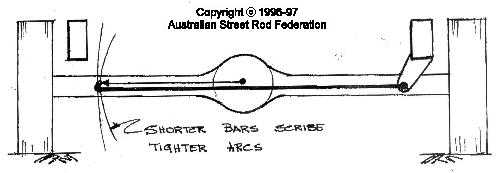
bar mounts
It is important that the mounts are strong enough to resist the very high loads imposed under combinations of acceleration and cornering. Double shear mounts are preferable, and gusseted or triangulated mounts may be necessary to achieve a suitable mounting position.
mounting the bar
Correct mounting of the bar is extremely important, to ensure efficient operation. It should be mounted parallel to the ground, and to the axle. If it is mounted at an angle, it would move in an arc contrary to the natural bump arc of the axle, and thereby contribute to bump steer. The chassis connection should be on the driver's side of the vehicle so that the panhard bar arc and the drag link are complimentary to each other.
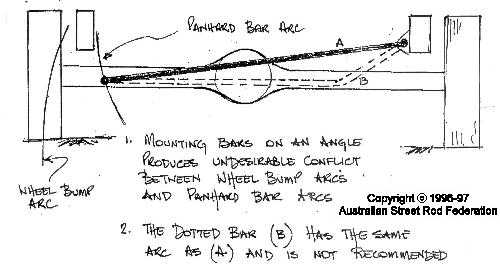
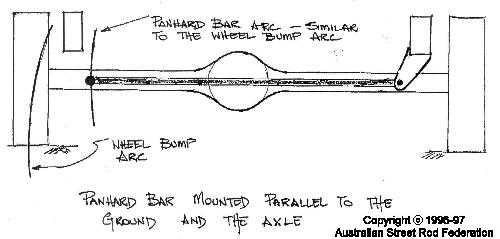
When suspension systems experience larger amounts of travel, say more than 2.5 inches, or 60 to 65mm of travel into bump, the traditional panhard bar starts to contribute to bump steer, due to the increased arc of travel. When this is encountered you may wish to consider the Watt's linkage system.
watt's linkage system
The Watt's linkage system is the only lateral control system that gives zero bump and roll steer, by using a bellcrank attached to the centre of the axle with a pivot, and to the opposite sides of the chassis by pivoted arms of equal length; one at each end of the bellcrank. This keeps the axle correctly aligned to the chassis through both bump and rebound movements.

It should be remembered that the position of the panhard bar could affect the handling characteristics of your vehicle. For example, the roll centre of a coil sprung rear axle is the point at which the panhard rod crosses the car's centreline. The height of the bar therefore determines the height of the roll centre, and affects the weight transfer to the outer wheels during cornering.
For this reason, it is important to carefully consider the panhard bar installation.
Copyright © A. Evans 1997