Reprinted from i Saluti, May 1998
from www.chicago-rawhide.com
Wheel Bearing Replacement
Bearing/seal Removal — Front Wheel
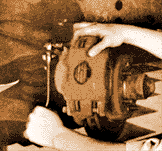
- Raise the front end of the car on a hoist or safely support it on jack stands and remove the wheel. Never work on a car supported only by a jack.
- On disc brake cars loosen and remove the brake caliper mounting bolts. The brake line does not need to be disconnected, but CAUTION: the caliper must be supported while disconnected to avoid brakeline damage. The caliper can usually be suspended by a wire loop.
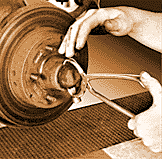
- Using pliers or a screwdriver, remove the dust cover and cotter pin.
- Loosen the adjusting nut. Jerk the rotor assembly to loosen the washer and outer wheel bearing (brakes may have to be backed off). Push the assembly back on the spindle.
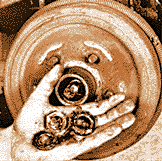
- Remove the adjusting nut, washer and outer wheel bearing.
- Pull the rotor assembly straight off the spindle. Do not let the inner bearing or seal drag on the spindle threads.
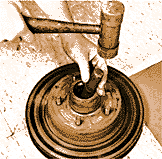
- With seal side down, lay the rotor on the floor. Place a drift or broom handle against the inner face of the bearing cone. Carefully tap out the old seal and inner bearing.
- Before discarding the seal, record its part number to aid in selecting the correct CR replacement. Never reuse old seals. Contamination entering past an old seal will ruin a bearing.
- Clean and inspect the old bearing thoroughly before reusing it (see Inspection and Cleaning below). CAUTION: If either the cup or cone is damaged, discard the entire bearing and replace it with a new one. Never install a new bearing cone with a used bearing cup, or vise versa. Remember to drive the used bearing cup out of the hub.
- Match the part number of the old bearing to select the correct CR replacement.
Cleaning and Inspection
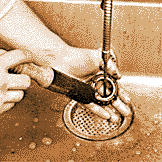
- Using a clean solvent and clean dry cloth, remove oil, grease and dirt from the hub cavity, dust cover and spindle.
- Use a clean brush to remove dust from brake parts. CAUTION: To avoid inhaling asbestos brake dust, never blow off brake parts with compressed air.
- Place the bearing in a metal basket and suspend it in a clean container or tank of solvent. If a basket is not available, suspend the bearing with a wire or place it on a metal plate at the bottom of the container or tank.
- Rinse the bearing in clean solvent as shown. Dry it thoroughly. Natural air drying is the safest method to use. Compressed air may be used with care, as long as it is free of all condensed moisture and all dirt has been removed from the bearing. CAUTION: Never spin a bearing with compressed air. Personal injury may result. Also, never use water or steam to clean or rinse a bearing. Moisture causes corrosion, which results in premature bearing failure.
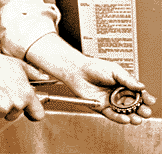
- Inspect the cleaned bearing thoroughly for nicks, pitted areas, and damage. If any of these are present, discard the entire bearing and replace it with a new one.
- If it will not be re-used immediately, dip the cleaned bearing in a protectant or coat the surface with a light grease. Rotate the bearing to work the grease thoroughly in and around the rollers and on the races. Wrap the lubricated bearing in waterproof paper and place it in a clean box.
- Inspect the spindle for burrs, nicks or embedded particles. Carefully smooth out any roughness with an emery cloth. Note: Deep scores or grooves on the shaft surface where the seal makes contact must be repaired before reassembling the wheel.
Bearing/seal Installation
- Be sure the new seal is the correct one for the application. If you are replacing the bearing, the new part number must match the old one. To select part numbers for either bearings or seals, consult the CR Passenger Car and Light Truck Seals and Bearings Catalog (CR#457205).
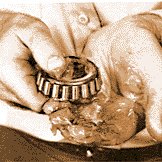
- By hand or with a bearing repacker, force grease through the cage and rollers or balls and on all surfaces of the bearing.
[If you don’t want to get your hands all greasy, you can put the bearing into a plastic bag with a good quantity of the grease. However you do it, make sure the grease is worked well into the bearings and use a good quality grease. RHH.]
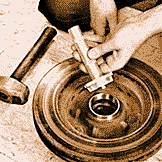
- Place the inner side of the rotor face up. If you are replacing the bearing cup, use the proper tool to drive the new cup into the hub.
- Coat the hub cavity with the wheel bearing grease to the depth of the bearing cup’s smallest diameter. Also apply a light coat of grease to the spindle.
[Alfa actually specifies the quantity of grease to pack into the hub when repacking wheel bearings: 65g (2.29oz) for the Spider and 50g (1.76oz) for the Milano/GTV6. RHH.]
- Place the inner bearing in the hub. Lightly coat the lip of the new CR seal with the same wheel bearing grease.
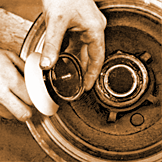
- Slide the seal onto the proper CR installation tool. The seal should fit over the tool’s adapter, and the sealing lip should point toward the bearing.
- Position the seal so it starts squarely in the hub without cocking. Tap the tool until the seal bottoms out. When the sound of the striking mallet changes, the seal will be fully seated in the hub.
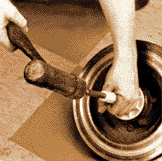
- If an installation tool is unavailable, use a wood block and hammer to drive in the seal. Never hammer directly on the seal. Be careful not to cock the seal.
Reassembly and Bearing Adjustment
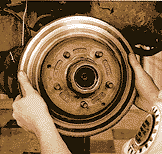
- Carefully lift and push the drum or rotor assembly onto the spindle. Keep the drum or rotor centered, so the seal is not touched or damaged by the spindle threads. Push the drum or rotor back until the seal is seated on the spindle’s surface.
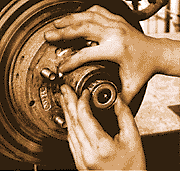
- Install the outer bearing cone, washer and adjusting nut, in that order.
- Reinstall the brake caliper.
- Rotate the wheel to be sure the brakes are not dragging. Dragging brakes will cause a false adjustment.
- Adjust the bearing to manufacturer’s recommended setting. [See below for Alfa Spider and Milano/GTV6, RHH.]
- If this information is not available, follow these guidelines.
- While rotating the wheel, tighten the adjusting nut until there is a slight bind and all bearing surfaces are in contact.
- Back off the adjusting nut 1/16 to 1/8 turn, or to the nearest locking hole, or enough so that the wheel rotates freely with 0.001 inch to 0.010 inch end play.
- Insert and bend the cotter pin. Replace the dust cover. Replace wheel and torque lug nuts to manufacturer’s recommended specifications [generally 72 ft-lbs. RHH.]
Special Instructions for Bearing Adjustment for Alfa Spider/Milano/GTV6
- Tighten adjusting nut to 14.8 thru 17.7 ft-lb, turning the hub at the same time. Then loosen the nut and tighten it again to 3.7 thru 7.4 ft-lb.
- Loosen the nut by 90 degrees and insert the cotter pin. If a notch on the nut and a hole on the steering knuckle fail to align, tighten the nut as necessary to allow inserting the cotter pin.
- Settle the bearings, by tapping the end of the steering knuckle end with a mallet and check that the washer is not too tight—ensure that the washer can be moved by applying slight pressure with a screwdriver between the washer and hub.
- If washer is locked, remove the cotter pin, loose the nut a little, and insert the cotter pin in a hole perpendicular to the hole just used.
[Conversely, if the washer seems too loose, remove the cotter pin, tighten the nut, and insert the cotter pin in a hole perpendicular to the hole just used. In my experience loosening the adjusting nut 90 degrees and inserting the cotter pin at this position leaves the bearing too loose. RHH]
- Tap the end of the steering knuckle with a mallet, rotate the wheel, and recheck washer movement.
- For vehicles equipped with ABS, check front hub bearing to wheel sensor clearance.
This page hosted by  Get your own Free Home Page