|
|
| Tim's "San Francisco" Duetto |
1n 1975, one year out of college, I bought a mint 1967 E-Type Jaguar here in St. Louis. I was one of the lucky ones, no Lucas gauge problems, no oil leaks, and a quantum step up from the 1947 Chevy Panel I had been driving, or as my friends described it-�herding�, throughout college. I still remember the long row of toggle switches on the dash, the long bonnet that opened to reveal the entire front end of the car, the Ansa exhaust and those covered headlights. I had the pleasure of that wonderful car for a couple of years before I opened a veterinary practice in St. Louis and sold the Jag to purchase an X-ray machine from the old Beaumont Medical Building that was about to be demolished. I hated to part with the car, but at the same time I felt a sense of relief, I lived in fear of repairs since I hadn�t really budgeted for that when buying the car. The second time I ripped off the exhaust while visiting my parents on their gravel road, the repair costs exceeded my budget.
Of course I also managed to receive three speeding tickets in the first 8 months. I couldn�t go anywhere without attracting the attention of police. I thought my �sports car� days were over then and certainly thought so in the early 80�s, when I was married and had adopted a three story 100-year-old house in Lafayette Square.
|
through the wiring . . . the headlights came on, the horn blared, the tires blew. |
And then one day, as I was struggling to carry out one of the 8 ancient refrigerators that came with the purchase of my house, I noticed a new tenant moving into an old commercial building down the alley. I watched with interest as various tool boxes and other odd things were unloaded and was fascinated with the small, sleek vehicles.
As I was to learn, these were mostly Alfas, one beautiful old Lancia and the new tenant was Carter Hendricks. I got to know Carter easily (in our neighborhood he was one of the more traditional types) and enjoyed walking down the alley to see what new project he was working on. Carter would wax poetic about cams and intakes which I knew nothing about and I would brag about the new plaster cornices I was creating in the parlors of the house.
I spent a lot of time in that alley. After the eight refrigerators, I had ten beds with mattresses and 20 tons of plaster to haul out. Then the radiators, the steam pipes and a mountain of wood lath. I found Carter�s shop to be a refuge. Classical music, pictures of Italian race cars and Carter�s enthusiasm for Alfas was infectious. I managed to endure the Jag comments-�they wallow in a corner like a pig, underpowered, greatly overrated.� Carter converted me to Alfas in no time.
It wasn�t long before I located a 1965 Giulia in Michigan using Hemmings. Carter spoke with the owner and helped evaluate the car and negotiate the price. My wife and I flew to Michigan and intended to make a leisurely drive home in the new car but ended up driving all day and night back to St. Louis. We simply did not want to get out of that car. It was our first convertible and after all those many hours at highway speed with the top down, we didn�t hear well for a week. I was feeling sophisticated with my new Italian beauty and Carter gained another customer and was one step closer to his goal of working on Alfas only.
Carter added a performance cam, upgraded the tires, did a complete tune-up and it ran fabulously. I personally thought the E-type was as fast but was not as well balanced. The thing that struck me the most about the Giulia was how well balanced the power, handling and braking were. I felt a lot more secure pushing the car hard than I had with the E-type. I still have family members who tell stories of the infamous rides I gave them from Lafayette Square onto I-44 west to the Kingshighway exit just so I could double back on I-44 eastbound and hit the 18th street exit at speed. This exit is from the left side of the highway which is unusual in itself and usually requires a higher than normal exit speed as you are in the passing lane. The exit is a sharp 180 to the left between two rows of concrete dividers with an immediate 90 back to the right and an abrupt stop at a stop sign. The added sound of the exhaust caught between the concrete barriers was impressive especially when I could pull off a couple of good downshifts with a throttle blip between the double clutches. (My friends called them �Steve McQueen downshifts� from the famous car chase in �Bullet.�) The sound of squealing tires added an accent as did all the deep scars and marks along the wall of those who didn�t get it right. I never told the family but Carter was the first one to show me the exit and he pushed it even harder than I ever did or so it seemed when I was in the passenger seat . . .
I had this marvelous car about two years also. One day on the way to my aunt�s house on West Watson Road it developed an engine fire that consumed the car in a matter of minutes. A leaky fuel pump was the diagnosis made by the attending firemen, but I am still not sure how anyone looks at the charred remains of a burned car and can say anything with confidence. I stood with my mouth open as I watched the fire burn through the wiring and the headlights came on, the horn blared and finally the tires blew. The firemen could only contain it enough to keep it from burning the overhead power lines that it was parked under.
My first son was born that year and once again I thought I was finished with �sports cars.� Spencer, our new baby, kept me busy and I found my trips down to Carter�s rapidly diminishing. Carter bargained with the insurance company for some time and eventually purchased the remains of the Guilia-I'm not sure what was salvaged but have often wondered if that engine is still alive somewhere in town.
Fifteen years later during the summer of 1999, my second son, John, and I bought his dream car, a 1964 Impala convertible. I found it in the Antique and Classic Car section of the Post-Dispatch; isn�t it funny how you never quit looking at the ads and how you can spot a car in the weeds with only the taillight showing while driving down the highway?
Prior to getting the Impala, I thought I had matured and had finally given up my various cyclical obsessions. I�m not sure I fooled anyone else but I surprised myself when a few weeks later the parts of the Impala were spread out in the driveway and yard looking a lot like the autopsy we did in vet school on one of the St Louis Zoo elephants. We soon were elbow deep in diesel fuel, de-greasing 35 years of grime from engine parts I couldn�t even name. That didn�t bring us to our senses either. Soon I had the hood and trunk lid wrapped in plastic like a large piece of dry cleaning leaving a small opening in which to pour 5 gallons of phosphoric acid. Trying to unwrap it and funnel the acid back into the drywall bucket was entertainment for our neighbors, as it wanted to come out in a gush. Our paint and rust removal method was wet/dry sandpaper and a drill with a 1/2 inch wide paint-removal pad on it. John, bless his heart hung in there, with visions of a low-rider pushing him forward.
Together we could de-grease, sand and strip a fender in about two days. Then it would take a couple days to get our hands looking presentable again and to let the scabs cover the wounds on our knuckles. The pile of Ziplock bags with various small parts grew and we got more creative with the names we gave the things they belonged to. We gradually gained confidence and I found myself looking at the ads thinking of a car for myself. That�s when I spotted an ad for a Duetto located in Washington, Mo., and began to inquire about Alfas again. I talked with Carter Hendricks again, learned about the St. Louis Chapter of the AROC and met Rich Hirsch by telephone. With his help I narrowed my search to a 1967 Duetto. Between Rich and Carter I narrowly missed snapping up the first few cars with �Dupont overhauls.� Rich suggested that we come to the annual summer meeting held at Walt and Marian Hatcher�s and I met many of the St. Louis club members. Seeing all those cars gave me the fever something terrible.
I joined the club without owning an Alfa, ordered a Duetto hat from Janet Hirsch and was the only one to drive home in a Suburban. Unfortunately for Jay Mackro, whom I met at the picnic, I began to consume all of his time with my questions, but this was a relief to Rich I�m sure. With Jay and Rich absorbing the bulk of my questions I found a 1967 Duetto in San Francisco which I decided to buy. A maternity leave for one of my partners prevented me from going to get the car for several months so I did the next best thing--I bought another.
I managed to find another 67 Duetto at the �Alfa Farm� in Kentucky and was able to drive down and bring it back in one day. Instead of the �driver� it was advertized to be, it turned out to be a complete project car, but I am having a lot of fun learning mechanics. Showing my usual restraint we have progressed through the usual stages--more craftsman tools, lots of new friends at Sears, a MIG welder, a large air compressor and more garage lights. I'm about 2/3 finished with stripping the outside of the car with primer in place and now the rusted areas are cut away and ready for sheetmetal. Now that it's ready for sheetmetal, I'm trying to get myself ready for sheetmetal. (My clean, shiny trunk that I lived in, doubled up, for several days is my pride and joy.)
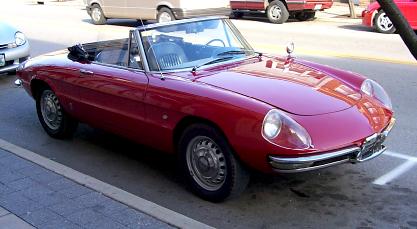
The Duetto shown in the photos, my pretty San Francisco Duetto, is home now. It also is not everything it was described to be, but that�s another story and I�m thrilled to own an Alfa again.
 Get your own Free Home Page