Reprinted from i Saluti, October 1994
Replacing the Power Steering Rack in the Milano
(or How Much Do I Really Love this Car?)
by Rich Hirsch and John Reilly
This article describes the difficulties in replacing the power steering rack on an '87 2.5L Milano (RH) and an '87 3.0L Milano (JR). Replacement of the rack was necessary because of excessive power steering fluid leakage.
Preliminary
Work is a lot less unpleasant if the rack environs are cleaned up using something like Gunk to clean the grease and muck from around the rack a day or so before beginning. Disconnect the battery's negative terminal. Support the front of the car securely on jackstands. Put the transmission in neutral. Jackstands should be reasonably high since most work will be accomplished through an access port in the wheel well. Remove both front tires. Siphon as much power steering fluid from the reservoir as possible. Place an oil catch-pan on the floor under the rack's valve. Check the perimeter of the access port for sharp edges. File down or tape any sharp edges. RH did not do this and consequently the backs of his hands looked like he had been attacked by a frenzied cat.
Rack Removal
- Through the access port, disconnect the rack's larger fitting. Catch any oil leaking from this fitting and dispose of it properly. Next disconnect the smaller fitting.
- Turn the steering wheel until the castellated nut securing the rack to the steering column's universal fitting is visible through the access hole. Remove the cotter pin and then the nut and bolt. Carefully pry the steering column's universal fitting off the rack's splined shaft. It may help to pull up on the lowest part of the steering column from inside the car to facilitate this (first remove the bottom steering column cover).
- Remove the four bolts securing the rack to the car body. Four bolts secure the rack to the chassis, two on the driver's side and two on the passenger's side. Of these bolts, three are very difficult to remove and one is extremely difficult to remove. On the passenger's side also remove the metal bracket and the rubber support block. Remove the rubber block first (it is split), then the bracket.
- Carefully pull the rack towards the driver's side while rotating it 90 degrees clockwise to conform to the access hole. It can be removed, but not without difficulty. To remove the unit we had to twist, cajole, and finally, rearrange the sheet metal slightly to accommodate the rack's splined shaft. To make more room, RH disconnected the lower pipe from the exhaust mainifold on the driver's side. For the 2.5L Milano, this may not be necessary. On his 3.0L Milano, JR had to disconnect the lower pipes on the driver's and passenger's side.
Once all of the exhaust parts are pushed out of the way, the rack can be rotated so it almost clears the access hole sheet metal (sheet metal in this case means 1/4 to 3/8 inch of the inner fender/forward body structure which is spot welded forming the upper edge of the access hole). Minor bending of the sheet metal with a pair of ViseGrips provides the final clearance and the rack can be removed. One of the authors who was keeping track of the time noted that it took eight hours to get to this point!
Rack Inspection
Compare the new and old racks and if necessary, reroute and secure with cable clamps any flexible piping on the new unit to match that on the old unit. RH purchased a ZF-remanufactured rack in '93 that was virtually identical to the old rack, except for the routing of the flexible piping on the rack. JR purchased a Pirelli-remanufactured rack in September '94 that was similar to the old rack, but lacked the flexible piping and contained two grooves in the splined shaft, rather than the one groove on the old rack.
- Add power steering fluid to the new rack and then replace the plastic plugs which closed the fitting holes during shipment (not much fluid is accepted).
- Set up the rack as shown in the figure below before installing. The distance from the end of the shaft to the center of mounting bracket should be 15.73 inches. This distance can be set by acting on the rack's splined shaft (above the spline) with pliers. Be careful not to damage the splines! The distance from the end of each shaft to each securing nut should be 1.02 inches.
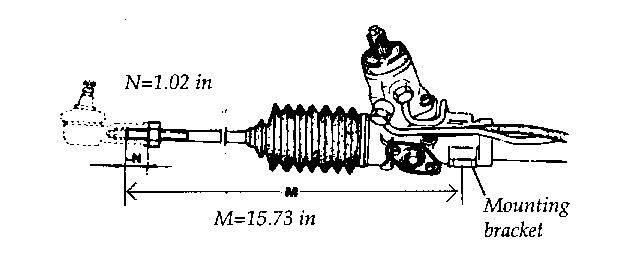
New Rack Installation
- Thoroughly clean the chassis support for the rack, especially the four bolt holes (lots of WD40, compressed air). Also clean up the four bolts, preferably with a die to remove any dirt and corrosion. Make sure each bolt tightens easily in its hole.
- Insert the new rack into the cavity through the access hole. Carefully guide it into position. Don't push on the shaft ends or you may disturb the centering alignment. You may once again have to coax the sheet metal into allowing the rack's passage, but the new rack should be much easier to install than the old rack was to remove. Once in place, attach the rack to the chassis with four bolts.
- Replace all of the exhaust pieces that you previously removed either to improve access or simply out of frustration.
- Attach the steering column universal fitting to the rack's spline shaft. Rotate the steering wheel until the universal fitting's bolt position lines up with the groove in the rack's splined shaft. Then carefully press them together working through the access hole and from inside the car, if necessary. It helped to apply gentle pressure on the universal fitting with a pry bar. Pressure was applied to the fitting while the steering wheel was rotated. After the fitting slides on, use a centering punch to position the fitting vertically along the spline shaft, so it will accept the bolt. Insert the bolt and screw on the castellated nut. Insert a new cotter pin and bend it around the nut.
The differences in JR's rack made assembly much more involved. There were two grooves on the splined shaft for the aligning bolt of the universal fitting. One of the grooves would align with the universal if the steering wheel were rotated 90 degrees, but the splines would not line up (part of the splined shaft is "unsplined" forcing the universal fitting to go on in only one position). The other groove would match if the steering wheel were rotated 180 degrees. Ergo, the steering wheel would be upside down!
JR then called the remanufacturer of the rack. "This has never happened before," he said. "It may be, that when remanufactured, the spilned shaft was put in 180 degrees out" (WHOOPEE!). The choices were to get another rack (another eight hours?) or to remove, rotate 180 degrees, and remount the steering wheel.
Since remanufactured racks are all ZF (with or without flexible piping) and are interchangeable (HAH!) between the Model 75 and Model 90, and the remanufacturer had no easy way of telling if the next rack would have the same problem, JR called Alex at West County Motors about rotating the steering wheel. Alex consulted with "the mechanics" and said that on a Milano the steering wheel could be rotated 180 degrees. Therefore, JR reattached the steering column universal and temporarily had an upside down steering wheel.
- Attach the two fluid fittings to the rack. Make sure the nuts on the rack shaft ends are still each 1.02 inches from the end. Attach the steering tie rod ends to the rack on both sides. This is done by rotating the rack shafts coming out of the rubber boots using a l3mm wrench. (Remove the clamp and lubricate the rubber boots at their ends with power steering fluid before turning the shafts.) Turn the shafts until the lock nuts contact the faces of the tie rod ends. Tighten to 50 ft-lbs.
- Fill reservoir and loosen the large fitting at the rack valve until fluid flows out it. Run engine, fill reservoir to "MAX" level. Do a few lock-to-lock turns, and make sure fluid level remains at "MAX."
- If necessary, remove the steering wheel and rotate it 180 degrees. Carefully pry the horn "ring" off with your fingers. Disconnect the horn wires. Remove the nut and washer. Fiddle for two hours with the wheel puller until you can find some combination of the parts of the tool which will fit inside the center of the steering wheel. Simply pop the wheel off. Rotate the wheel 180 degrees and reinstall it. Fortuitously, the plastic "dogs" which are part of the turn signal on/off apparatus are so installed that the only possible reinstallation is the 180 degree rotation.
- Take the car somewhere close to have the toe-in adjusted. In JR's case in spite of repeatedly checking the nut settings, the toe-in was sufficiently out of spec that the tires squealed all the way.
The following related notes appeared after this article was written:
NOTE 1: From Alfa Ricambi Performance Quarterly, Spring 1995, in the article "AR Ricambi Project Car, Milano 2nd Installment"
- "Remember not to twist the rack end boots or to tear them open when adjusting the toe or else dirt may enter, thereby wearing out the seals prematurely. Also, if the rack develops a slow leak, be sure not to let the reservoir run dry or you will ruin the power steering pump as well!"
- "When removing the rack assembly, it helps to loosen the driver's side motor mount and jack up on the underside of the engine carefully to gain extra clearance. It may also be easier to remove the exhaust manifold on that side to improve access to the hydraulic lines. Disconnect the battery as there are some hot lead junctions in that area which can cause some interesting fireworks. The rack easily slides out the driver's side wheel well (with wheel removed, of course)."
NOTE 2: From Alfa Digest, 23 November 1995, Vol 01, Number 210, by Jay T Hinton, [email protected]
- "Being just back from a trip in France, I thought I would let out a couple of things. First, I had been trying to buy just the seals to rebuild a steering rack on a Milano, was told no way could I buy them in the US. So, my first day in France, I went to a local Alfa dealer and he said no problem, ordered me two sets and I paid 60 bucks total."
NOTE 3: From Alfa Digest, 10 July 1996, Vol 02, Number 302, by Colin Verrilli, [email protected]
- "A couple footnotes on replacing the PS rack in my Milano (75). My car is an '87 Gold. I did not have a lot of problem with the 4 bolts. I used a variety of wrenches though. Offset and "bended" wrenches help."
- "To make clearance to remove the rack, I had to remove the driver side exhaust manifold and loosen the passenger side one at the Y-pipe. I also loosened the driver side motor mount (single bolt) and raised that side of the engine slightly. I pried the Y-pipe down slightly and inserted a block of wood. With this done, I could remove the rack as stated in the article. Believe me, I tried first without doing this - not possible. (Note, I did not have to bend sheet metal!)"
- "The rack I took out was the kind without the flexible tube and with the two notches in the splined section. The one I put in had the flexible tube and only one notch. It was remanufactured by ZF. I re-routed the flexible tube to make mounting the U-bracket easier."
- "I replaced the outer tie-rod ends while at it (about $22 each). I followed the setup measurements in the article, but ended up with a steering wheel way off center. The alignment shop couldn't get enough adjustment out of the tie-rod ends. I ended up having to pull the steering wheel and recenter. The steering column must have been put on the notch that's 45 degrees off of the standard one. I replaced the exhaust gaskets when I reassembled (3 at manifold, 1 at Y-pipe)."
- "If you do this, plan on some serious time...10 to 20 hours. A lot of this time is spent cleaning the grease and gunk off all the parts."
NOTE 4: From Alfa Digest, 08 Nov 1998, Vol 07, Number 237, by Scott Swanberg, [email protected]
- "...plan on many hours, 10+. Only comments are that removing the driver's side exhaust manifold, and loosing the driver's side engine mount to jack up the drivers side of the engine are mandatory. Also, be sure to have a supply of right angle, open end wrenches, very handy."
This page hosted by  Get your own Free Home Page