by Rich Hirsch
Since I have to do this on the ’66 GTV, I was interested in a demonstration at Alfa Amici given by Brian Haupt on replacing the rocker panels on a Spider. Brian is owner of Carriage & Motor Works (913) 384-4515 and does this professionally, so he knows what he’s talking about.
Here’s my interpretation of his recommendations:
1) Get Alfa Romeo factory panels. Brian said most other patch panels are much thinner than factory. One audience member recommended Wolf Steel patch panels as an alternative.
2) Attach the rockers to sound metal via plug welds. That is, punch 5mm holes in the rocker patch panels near the edge. Weld the circumference of holes to sound metal on the body of the car. Make plug weld spacing duplicate original spot welding spacing. That is, if original spot welds were 1 1/2 in. apart, make plug welds 1 1/2 in. apart.
3) The only way to tell if the middle rocker is rusty is to remove the outter rocker.
4) Weld with the car on the ground or on wheel supports. If the car gets welded supported on jack stands, the panels may not fit well when the car is supported more naturally on wheels on the ground.
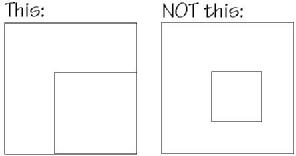
5) Is is very difficult to put a square patch in the middle of a panel because of heat distortion. It is far better to replace a larger section:
6) On attaching a rear or front wing panel, Brain uses seam welding on a lapped joint. To make the joint less noticeable, he uses an air-driven “panel flanger” tool. This tool depresses a part of a panel so another panel can be attached to the first and pretty much end up with a flush fit:
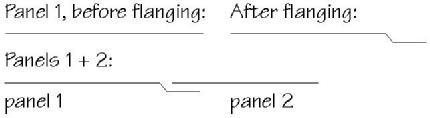
Weld is then done at the seam between the two panels. For this, try to put the flange in the top panel so moisture does NOT get trapped between the panels:
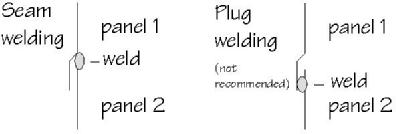
You could do a series of plug welds here, rather than seam weld the panels together, but Brian said there would be more flex with plug welding so the body putty would be more likely to crack. Therefore, seam welding is better. Butt welding could also be done, but it’s harder to do well, takes longer ($$) and will probably give a more distorted result. Apparently there is less local heating and distortion with lap welding. Another tip is: Don’t just start at one end and continue across. Do lots of short runs at many spots around the panel to minimize heat distortion, eventually filling in the entire seam.
Also, use a weld-thru primer to protect bare metal that can't be painted from rusting.
Typically it costs about $2000 - $2500 to have this done to a Spider.
One reason the rocker panel rusts is that there is a drain hose from the soft top that terminates directly behind the rocker. Over time the drain hose rots and the water ends up inside the rocker panel, rather than moving through it. One thing Brian does to prevent future rotting is to renew and extend the drain hose when he replaces a rocker panel.
 Get your own Free Home Page