Reprinted from i Saluti, June 1999
from the Alfa Digest via the Internet

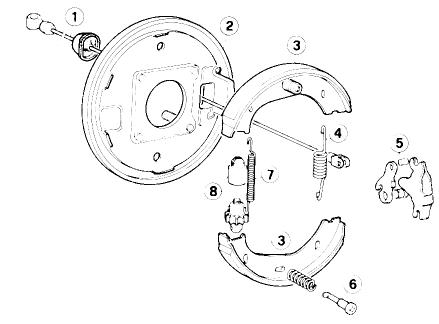
Spider/GTV Parking Brake Assembly

by Bob Abhalter

1 Control cable
2 Backing plate (shoe holder)
3 Shoe
4 Shoe extension spring
5 Shoe expansion actuator
6 Bayonet pin
7 Return spring
8 Toothed adjuster

I recently replaced the brake shoes in the parking brake on my spider. Here's how I did it:

  1. I had the choice of bench assembly or doing it with the axle in the car. I found it easier to reassemble the unit while on the car.
  2. Remember/note that the two control cables (1 in Figure) are of different lengths. The longer one fits on the left.
  3. Screw in the toothed adjuster (8) until fully collapsed (short as possible.) The wheel part installs on the side of the brake shoe that has the �U� cutout - but you knew this.
  4. On the bench or floor, fit the toothed adjuster assembly (8) (wheel down - longer part of the adjuster pointing up when installed) and the brake shoes together as a partial assembly using the skinny, longer spring (7) on the adjuster side.
  5. Fit the two shoes behind the axle flange up against the backing plate. Anchor the shoes to the backing plate with the spring-loaded attaching bayonet pins. Once you find the slot and press in, a quarter-turn with the Allen wrench will do it.
  6. Insert the shoe expansion actuator (5) through the cut-out from the front and jockey it around the axle into position between the two brake shoes. Engage the notches in the actuator with the notches in the shoes. I can�t say for sure that the orientation of the actuator matters, but I noticed some interference the first time I did it, so I checked my parts book. It�s hard to explain, but the U-strap on the outside arm of the actuator should point down and the longer part of the fork should stick up (see the Figure).
  7. You should now be able to install the stubby, fat spring (4). It helps to have a pair of brake spring pliers to do this. In fact, it would be tough to do this job without a pair.
  8. At this point everything should be together. Make sure the bayonet pins are still properly seated before you fit the disk and caliper. If the disk hangs up, make sure the shoes are centered on the backing plate and that the actuator (5) and adjuster assembly (8) is properly seated between the shoes.
  9. Connect the control cables to the cable levers on the differential. If you have changed brake shoes, you will probably have to release the cable adjuster on the handle end of the cable. Watch out for rust/binding of any sort. It is easy to break the threaded adjuster.
  10. Adjust the clearance by working the adjuster wheel (8) with a screwdriver through one of the access holes in the disk. Bring the shoes into contact with the drum, then back off three or four notches. It helps to work the control cable a few times to make sure the shoes are centered.
  11. Adjust the parking brake cable length so there is just a slight amount of slack in the cable when the parking brake is off. Test to make sure the brake is engaged after three or four clicks of the brake lever.
  12. Degrease hands and dress wounds.

    This page hosted by Get your own Free Home Page
    Hosted by www.Geocities.ws

    1