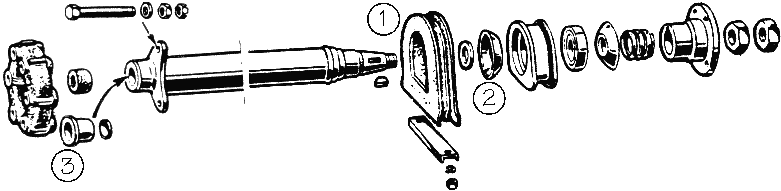
Fig. 1. Pre ‘69 105 style driveshaft support bearing. The metal ring that surrounds this piece must be air-chiseled out for this upgrade.
What’s that? Your 105 car is experiencing terrible drive line vibration problems, even after you’ve had the drive shaft balanced? This article may be of great interest to you.
BlueBelle, Stephen Habener’s vintage racing ’65 GTV has had a drive line vibration problem for some time now. Past 60 mph the entire floorpan starts vibrating like a bed in your favorite cheap motel, once you’ve deposited the quarter. The vibration level increases with speed.
Although this problem may develop on all 105/115 cars, the pre’69 cars may be more susceptible because of the center drive shaft bearing support methods. The earlier cars had their center bearing suspended in a large rubber enclosure, which was held to the floorpan of the car with a single piece of metal. Straight from the factory this allowed the bearing to have plenty of movement within that rubber enclosure (see #1, Fig. 1).
|
Fig. 1. Pre ‘69 105 style driveshaft support bearing. The metal ring that surrounds this piece must be air-chiseled out for this upgrade. |
After 30 years or so, you may have much more play than desired which can have am effect on the pilot bushing that fits over the output shaft of the transmission. On BlueBelle, this pilot bushing (No. 3 in Fig. 1) was in very bad condition, allowing lots of free play between it and the transmission’s tailshaft--a certain recipe for drive line vibration. In fact, there are documented cases of generators, starters, and bell housings breaking due to the added vibration of excessive play in this pilot bushing Without a snug fit between the drive shaft and the transmission tailshaft, severe vibrations and stresses are induced.
The later bearing was also suspended in a rubber enclosure, but that rubber enclosure was encased in a metal ring, which was affixed to the bottom of the floorpan (see #1, Fig.2) The metal enclosure made for a much sturdier mount for the center bearing.
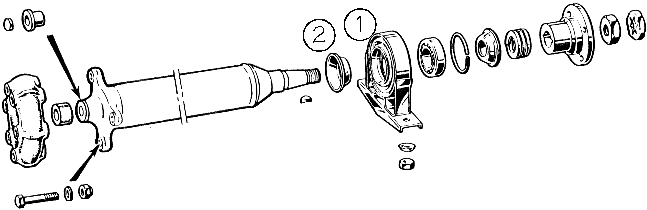
Fig. 2. The stouter later drive shaft support bearing. |
The downside? Some modification of the mounting area is necessary. There is a metal horseshoe-shaped retainer for the early style rubber mount that must be air-chiseled out of the drive shaft tunnel. Then, two studs that hold the bearing retainer must be welded back on to the drive line tunnel. Any well-equipped shop will have the necessary tools.
Two saucer-shaped metal dust shields surround the center support bearing on either side (#2 in Fig 1 and Fig. 2). The ones off of the earlier drive shaft will not fit so the shields off of the later drive shaft must be used in short, it’s easier to purchase a 1750 or 2000 Alfa drive shaft and simply install it, as all the necessary equipment will be present.
This replacement and upgrade completely cured BlueBelle’s drive line ills.
 Get your own Free Home Page