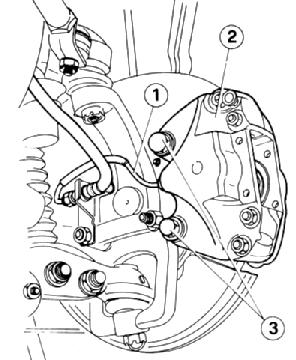
2 Caliper
3 Securing bolts
|
|
|
1 Brake pipe
2 Caliper 3 Securing bolts |
I recently rebuild the front right caliper on my �73 GTV since one of the pistons was sticking. The rebuild kit was obtained from the local Alfa ex-dealer and was for an ATE caliper. It contained two rubber dust covers, two rubber piston seals, and two metal retaining rings. In rebuilding a caliper, Do not separate the caliper since your rebuild kit doesn�t include the O-rings for those hydraulic connections between the caliper halves.
1) Use a turkey baster to remove as much brake fluid as possible from the master cylinder (MC) reservoir.
2) Remove the caliper from the car (this essentially drains the brake line, so get a can to catch the drippings). Use some brake cleaner to clean off the caliper; you don�t want to get dirt and grime inside the caliper. Remove the ratty old dust shields and the metal retainer rings that hold them in place.
3) Record the position of the pistons in the caliper, since you want to reinstall the pistons at the same angle.
4) To remove the pistons, use a C-clamp to hold one piston in place and apply compressed air where the hydraulic brake line attaches to the caliper. The unclamped piston should pop out; sometimes you have to reposition the C-clamp so that it doesn�t interfere with the piston when it comes out. To remove the remaining piston, you need to seal off the hole where the first piston used to reside. I used a flat metal plate I had lying around to cover the hole and held it in place with the C-clamp. A bit higher air pressure was required to pop it out since there was some leakage.
5) Remove the rubber piston seals from inside the cylinders.
6) Use brake cleaner (don�t use anything else but brake cleaner) to thoroughly clean out the caliper drillings, piston cylinder, and the pistons. I had to scrape out some hardened spooge. Check the pistons for pitting on the sealing surface; not sure if you can get replacement pistons. Make sure all the gunk is removed especially in the groove that holds the piston seal. Check out the hydraulic drillings to see that they are not partially clogged. Clean out the groove on the top of the piston cylinder where the rubber dust boot will be placed - usually just rust is present in there. Remove the bleeder valve and coat the threads with anti-seize so that you won�t have trouble with it later on (like it shearing off!).
|
|
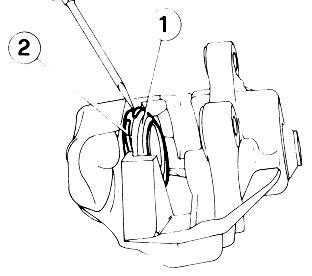
1 Rubber dust cover
2 Retaining ring |
7) Coat the piston seal groove with either brake grease or brake fluid. Insert the piston seal, making sure that it hasn�t twisted on you. Coat the outside of the piston and piston seal with brake grease/fluid, orient the piston to its proper (original) angle, and then insert the piston into the cylinder - I was able to push one in by hand, but the other required I used the C-clamp to push it all the way in.
8) Put on the rubber dust boot and the metal retainer ring. Repeat for the other piston.
9) Loosely bolt the caliper back onto the wheel, attach the hydraulic line, torque down the caliper bolts, insert brake pads, and anti-rattle clip.
10) Check brake flex hoses for cracks, renew if necessary. When installing new flex hoses, make sure they are not twisted.
11) Start bleeding at the caliper furthest away from the MC. If it has been awhile between brake fluid renewal, consider flushing/bleeding the entire brake system.
12) Once you have bleed the system, check for leaks -check where the hydraulic hard-line is attached to the caliber and the lower part of the caliper if the piston seals were leaking. Drive around for a bit and check again.
 Get your own Free Home Page