The Single-Plane Force Streamliner
By Waldo E. Stakes
In this article Waldo talks us through the basics of land speed vehicle design, ending with his concept of the perfect wheeled land speed record vehicle, which he calls the "Single-Plane Force Streamliner."
In my quest to build a logical, functional land speed record vehicle I have spent twenty years researching nearly every streamlined vehicle ever built including many paper projects that were not built. All of these countless designs had obvious aerodynamic, dynamic, or safety flaws. Some of these vehicles are inherently unstable or the forces generated by them worked directly against their chances for success.
A thrust-powered vehicle needs to be stable, maintain ground contact and have sufficient power to exceed the existing record. A wheel-driven record is harder to achieve because of the added element of traction. A motorcycle record is harder still because the bike has to balance on it's tire's contact patches. These facts are reflected in the current speed records 763mph (jet), 409mph (wheel driven), and 322mph (motorcycle).
I believe in K.I.S.S. (keep it simple stupid) design concepts. This has led me to the "Plane Force Design." In the average streamliner common at Bonneville, the design lends itself to unnecessary rolling moments that will lead to yaw and pitch. These forces lead to reduced traction and stability. Imagine a vehicle that would track straight as an arrow throughout a run, and be so light and easy to maintain only a small crew is needed to campaign the vehicle. It would be able to exceed the unlimited motorcycle record and then take the wheel-driven record in any or all streamliner classes.
The current streamliner designs tend to have the engine mounted at the rear of the vehicle for safety reasons and add to ballast on the rear drive wheels for traction. A major flaw with this idea is that it puts the center of gravity far behind the aerodynamic center of pressure so if the vehicle yaws or pitches it will eventually end up going backwards.
Quite simply you can't throw dart fins first. The weight will swing forward as the drag pulls the rear around behind. The average streamliner and most of the lakesters are darts moving backwards. The only thing keeping them straight is the adhesion of the tires. If you could pick these vehicles up and throw them they would end up tail first.
To correct this you can add drag to the rear of the vehicle to pull up the center of pressure behind the center of gravity. This can work but now you will need more power and greater traction because you have to moave all that extra drag you added for stability. If you used fins and mounted them to the top of the vehicle they will want to pull the nose of the vehicle up. If you put these fins on the side of the vehicle they will add yaw because they will pull on either side of the vehicle. The best place to put the fin would be underneath the vehicle as it would pull the nose down but there is no room under the vehicle. If there was it would not work well because the air under the vehicle will be turbulent or disrupted. You would have to build the vehicle high off of the ground and that would put its center of gravity too high and lead to any number of problems.
Enter the "Plane Force Streamliner". This vehicle uses its own dynamic and aerodynamic forces to eliminate the yaw and roll moments. What you have left is thrust, drag and lift (both positive and negative). Since there are less forces acting on the vehicle there will be fewer things to go wrong. The term "Plane Force" is clearer if we call it the "Single-Plane Force Streamliner."
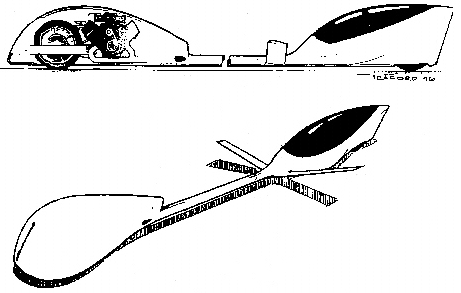
The vehicle is basically two pods linked by a single boom. It is powered by a conventional V-8 of any displacement depending on the class. The front pod contains the engine, fuel, coolant, and the front wheel or wheels (one to three depending on whether you are building a car or bike). The first pod also contains all the fire and scalding hazards.
Driver safety is enhanced with the first pod ten feet away from the driver. The engine is mounted sidewinder style with the torque moment forward on a small but rigid chassis connected to the front wheel(s). As the engine torques it loads the front wheel(s) mounted in front of it for traction. I personally wold use a slipper clutch and a big push start but I'm sure most would run a belt or chain to a transmission and then to the front wheel(s).
The front pod would have a one-piece drop-on 3.5 to 1 fiberglass body with a flat bottom and a belly pan one-half inch off the salt. This would make all the air that strikes the vehicle have to go over adding negative lift and increasing traction. The three front wheels (for a car) or single 26 inch long drum wheel (for a bike) would fill the underside of the vehicle so there would be little air flow underneath. The pod body would be 28 inches high and 28 inches wide for a 350 Chevy unblown and be about 8 feet long.
The next section is the boom. It bolts to the bottom of the engine chassis one-half inch above the salt and is made of 2 X 6 inch thick wall tubing. It is 12 feet long. On the end of it mounts a heavy duty monoshock swing arm that could come from a large dirt bike. The rear wheels steers via center hub steering typical of many motorcycle streamliners. Mounted to a flange over the rear suspension is a mild steel roll cage with expanded safety walls ala the Costello machines. Over the spaceframe rollcage would be a symmetrical blown polycarbonate clam shell streamlined body only 23 inches wide by 30 inches high slightly tilted nose down so the driver has good vision down the length of the vehicle and the course.
A pair of dihedral fins would add stability if you wanted to bolt the driver cockpit to the boom with explosive bolts. In case of a crash you could blast away from the vehicle with the rest of the vehicle tracking away with it's own chutes and the cockpit pod having its own chutes. In this case all the kinetic energy would leave and the pod would be easier to stop. Other than the steering wheel there would be little to injure the driver.
To sum up, this vehicle would be stable because the center of gravity is way ahead of the center of pressure. The safety factor would be greatly increased and the vehicle would be working in its favor to achieve success.
NOTE: Although this design resembles the "Triple Nickel" of more than ten years ago, it was inspired by that great Jocko Johnson concept. The way air is controlled around the vehicle is very different. Jocko's design tried to accelerate the air on an outside venturi and keep the air laminar. The "Single-Plane Force" design lets the air leave one pod and then strike the other.
Go back to the Articles/Reports/Tech page.
Go back to the Main Page.