The Evolution of Sonic Wind
This article discusses the design evolution, from first concept to final construction, of Waldo Stakes dream to build a vehicle faster than any other on the earth. Sonic Wind actually started out as a wheel-driven, land-based challenger before becoming today's rocket sled on ice.
Besides all of the usual hazards of high speed land travel, such as disintegrating tires, air compression, lift, instability, there exists a new danger while traveling supersonic - the shock wave. If you've heard one, you know it's power. Sonic Wind's shock wave will not be miles away, but rather inches away as it reflects off the ground surface and blasts the underside of the craft.
Initial thoughts about how to address this problem were to design his vehicle with a diamond-shaped cross section. With this configuration, the body would come to a V along the bottom edge which would split the reflected sonic wave and angle it away. However this shape also required that Sonic Wind be a motorcycle with front and rear wheels emerging from the body at the bottom of the V. To stabilize the craft at low speeds, Waldo added outriggers at the rear that angled down to the ground at 45 degrees. They had little wheels at the tips and an air foil shape. When Sonic Wind was up to speed, these outriggers would swing up to a horizontal position forming a small wing that would generate downforce to prevent the craft from flying (an important consideration).
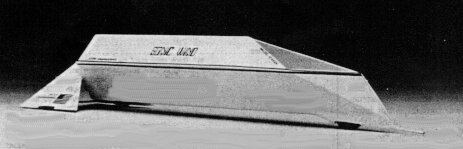
The earliest concept of Sonic Wind shows a slab sided body with a diamond shaped cross section. This configuration would split the sonic shock wave as it reflected off the ground surface.
Sounds like it might work, right? Well, as Waldo thought about it longer, he found a flaw.
That little wing in the rear would be producing a downforce alright, until the reflecting shock wave slammed into it from underneath. Since the wing was horizontal, it would feel the full force of the shock, lifting the craft in the rear and pitching it down in front. Waldo planned to sidestep this problem by scrapping the outrigger/wing configuration. Instead, a large gyro would be placed midship to stabilize the vehicle during slow speeds. It was to be spun up to 30,000 rpm by an external motor just before a run.
Re-examination of the vehicle weight revealed an obesity problem. The power requirements for such a heavy craft would have been enormous, and far too dangerous. Pounds were shaved off, including the heavy gyro, requiring the outrigger wheels to come back. However, this time they were hollow rings which allowed the reflected shock wave to pass through, resulting in little additional lift. This could be accomplished with a hoop design for wheels. The "tire" was a steel sleeve (like a steering wheel cover) that rolled around the hoop on a track. These wheels would not be located exactly side-by-side, but rather staggered so their own shock waves would not join together to form one large one.
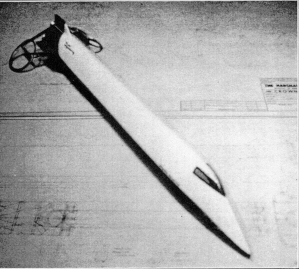
Later design restraints changed the configuration to a cylindrical cross section with rings for wheels. This was the last concept of Sonic Wind as a car with wheels.
By now you're probably wondering where Waldo was going to find the power to drive Sonic Wind through the sound barrier. Waldo decided on the same power that lifts satellites into orbit, a liquid-fueled rocket engine.
Waldo had decided on a square cluster of four rocket engines at the time he met distinguished rocket propulsion engineer Ken Mason. The newly-formed partnership re-examined the propulsion system for possible improvements. The design was based on four LR-101 rocketdyne engines producing 1000 pounds of thrust each. They ran on liquid oxygen and kerosene. That bothered Waldo because in the event of an accident, he could be immersed in a pool of burning fuel. Also, consider what would happen if one of the four engines failed to ignite. The resulting thrust would be uneven causing the vehicle to uncontrollably veer off course.
This mental process of re-examination continued to evolve the design as the four LR-101 engines were replaced with one LR-11 rocket engine. This is a similar rocket to the one that thrust Chuck Yeager through the sound barrier in 1947. It runs on liquid alcohol and liquid oxygen. Both fuels would ten to evaporate away if the tanks should rupture. The LR-11 was half the weight of the cluster of four and it's thrust was on centerline, resulting in no tendency to veer.
Meanwhile, Sonic Wind's body evolved into a cylindrical cross section caused by the use of spherical fuel tanks. The new body was long and sleek, but proved too complex and costly to build. Eventually the fuselage was designed around the fuel tank from an F-104 Starfighter. It is a mere 20" in diameter and has a proven supersonic shape.
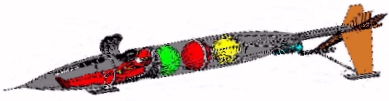
The final configuration of Sonic Wind utilizes the fuel tank from an F-104 jet fighter.
The final calculations proved that no wheel could sustain the rotational forces generated during supersond speeds. If the wheel is indeed rolling on the ground, then the top portion of the tire would actually be traveling at Mach 2, twice the speed of sound! If it is not rolling at that speed, then it is merely a skid. Either way, wheels lose. So they were replaced with skates. That's right, a tripod design of ice skates. One under the cockpit where Waldo will ride and the other two will be on the staggered outriggers in back. This latest arrangement will require Sonic Wind to travel over a perfectly flat frozen lake or ice track several miles in length.
Go back to the Articles/Reports/Tech page.
Go back to the Main Page.