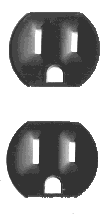
First off, if you have ever taken a look at a generator you will find an outlet like shown. It looks exactly like your wall outlet doesn't it? In fact, it is! If the generator is a 240 volt model, it will also have a another outlet for the 240 volt power. The generator will also have a circuit breaker with a push button reset.
Notice that the plug on the generator is intended to have devices plugged into it. Also notice that it is a socket, meaning that the connections are protected from accidental contact. The rule is that if power can be supplied at a connection, the supplying connector is a socket. Notice that on you appliances, the connector is a plug (since it doesn't supply power).
There are only two safe ways I know of to get the power into your house.
The easiest way is to use an extension cord. But there are two critical notes you need to know about using extension cords.
| Max length of wire in feet for 120 volt, 2% max voltage drop allowed | ||||||
|---|---|---|---|---|---|---|
| Current and power for 120 VOLT | Max extension cord length for given wire size | |||||
| Amps | Watts | #14 | #12 | #10 | #8 | #6 |
|
1 |
120 |
450 |
700 |
1100 |
1800 |
2800 |
|
5 |
600 |
90 |
140 |
225 |
360 |
575 |
|
10 |
1200 |
45 |
70 |
115 |
180 |
285 |
|
15 |
1800 |
30 |
47 |
75 |
120 |
190 |
|
20 |
2400 |
NO! |
36 |
57 |
90 |
140 |
(The data above might look messed up if you are not using Netscape)
| Max length of wire in feet for 240 volt, 2% max voltage drop allowed | ||||||
|---|---|---|---|---|---|---|
| Current and power for 240 VOLT | Max extension cord length for given wire size | |||||
| Amps | Watts | #14 | #12 | #10 | #8 | #6 |
|
1 |
240 |
900 |
1400 |
2200 |
3600 |
5600 |
|
5 |
1200 |
180 |
285 |
455 |
720 |
1020 |
|
10 |
2400 |
90 |
140 |
225 |
360 |
525 |
|
15 |
3600 |
60 |
95 |
150 |
240 |
350 |
|
20 |
4800 |
NO! |
70 |
110 |
180 |
265 |
(The data above might look messed up if you are not using Netscape)
From the above tables, a few things should be pointed out:
Voltage drop can be calculated using Ohm's Law which is given by... Voltage drop = Current (amps) x Resistance (Ohms)
Let's take an example where you might want to use a 200 foot, 14 gage extension cord to run a 1000 Watt flood lamp:
A 3.6% voltage drop is above our recommended 2% max voltage drop given in the table above (for 120 volt). Either the wattage of the lamp must be reduced, or a larger size wire (12 gage) must be used. The larger size wire has less resistance per foot, so the voltage drop will be less.
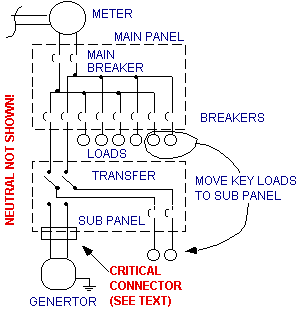
The only safe way to power items in your house without using an extension cord is to have a Double Pole Double Throw (DPDT) transfer switch and sub panel installed. It's an expensive proposition, but is the only legal way to connect a generator to your house wiring!
The diagram shows the addition of the DPDT transfer switch. Note that the loads you have determined to be necessary in an emergency must be moved from the main breaker to the sub panel. When the transfer switch is in the normal position, power is routed through the switch to the circuits attached to the sub panel.
When power is lost and generator power is to be used, notice that the switch must be moved to the "generator as source" position. Once the switch is moved, the desired loads may get power from the generator connection. Even if main power is restored, the desired loads are isolated, and will continue to receive power from the generator until the switch is returned to the normal position.
Notice that there is a special connector shown on the diagram. This is the only place that you will find a plug with exposed contacts mounted on a piece of equipment in your house (except your computer). It is a connector that is panel mounted with a recessed set of male contacts (like a plug, not a socket). Remember from the text above that anything that can be the source of power has a socket. Since the opposite ends of the transfer switch are wire to connector and the source in the main breaker panel, the connector can never be delivered power from the main.
We are going to quickly mention a very dangerous method for connecting your generator to items in your house. Our intent is discourage you from using this practice!