Part IV.
VI. .Argument from The Sublime.VI. Argument from the SublimeVII. From Consciousness
VIII. The Moral Arguemnt
IX. The Existential Argument
X. Argument form abstract values
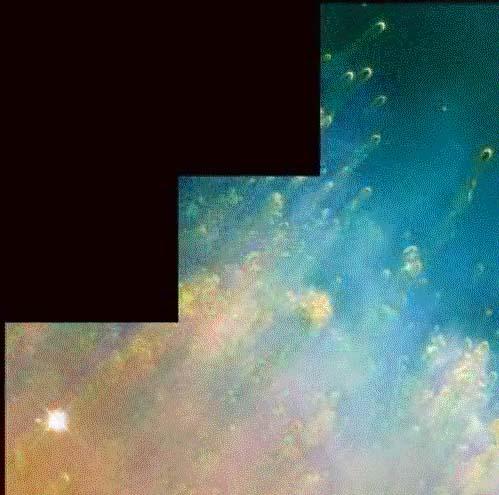
A) Aesthetic and Sublime clues to transcendenceIt always used to sound so stupid to me when people would say "O, look at the beauuuuutiful sun set, how can people deny that there's a God? (my Mother used to say that). Than after becoming a Christian I saw a really great sunset one day, the sky decked out in orange, pink, Gold, peach, cobalt, cerillian, and all punctuated by the most delicate safferin strips. It suddenly occurred to me why anyone would think that. Becasue we are the type of beings that are capable of appreciating beauty. It is not merely that aesthetic appreicasion is beyond the ability of a dead randum universe to produce, but that it spurrs us to consider higher things. We realize from the appreciation of these things, art, mustic, poetry, literature, nature, that there is a realm of the sublime which transcends the mundane world of reductionism. I don't necessarily mean a supernatural realm--it could be a "realm" of our emergent qualities. But the fact that we can appreicate these things indicates that there is more to reality than merely the realm of science, technology, and the that to which reality is reduced by technocratic natrualists who can't appreciate higher possbilities.
The Internet Encyclopedia of Philsophyhttp://www.utm.edu/research/iep/s/sublime.htm
"Sublime" refers to an aesthetic value in which the primary factor is the presence or suggestion of transcendent vastness or greatness, as of power, heroism, extent in space or time. It differs from greatness or grandeur in that these are as such capable of being completely grasped or measured. By contrast, the sublime, while in one aspect apprehended and grasped as a whole, is felt as transcending our normal standards of measurement or achievement. Two elements are emphasized in varying degree by different writers, and probably varying in different observers: (1) a certain baffling of our faculty with feeling of limitation akin to awe and veneration; (2) a stimulation of our abilities and elevation of the self in sympathy with its object.1) The sublime implies transcendence.That all people, given the right exposure, can appreciate the sublime, beauty in nature and art, in such a way as to seek some realm beyond that of the mudane physical is a direct implication that something more exists to be found. While this is not a proof of God in and of itself, it might be logica to infur from this sense of transcendence that reality is more than just the physical realm, and therefore, even though this is a highly subjective notion, if one finds that God satisfies this urge best of all, than God is probably the object of our longings for the sublime.
Peter Suber's Infinite ReflectionsAll college address at ST. John's College in Oct. 96
published St John's Review XLIV 2 (1998) 1-59
http://www.earlham.edu/~peters/writing/infinity.htm
The Sublimity of the Infinite2) Mathematical links subliminity of the infinite to the transcendentI am profoundly grateful that understanding infinity does not deprive it of its majesty. If the infinite were only interesting because of the paradoxes it generates, and the absorbing academic issues raised by the need to resolve them, then it would not be studied any more than self-reference, a prolific but more pedestrian engine of paradox. But the infinite is also majestic, one might say infinitely majestic.
An hour under a clear sky at night, looking up, gives some sense of this. The depth of space is a wild blue yonder, not a true, perceived infinity.[Note 34] But it inspires contemplation of the true infinite, and the slightest brush with that idea is breath-taking, invigorating, expanding, lifting, calming, but also agitating, alluring, but also distant and magnificently indifferent. One reason to study mathematics is that you can get these feelings in broad daylight or indoors.
There are many ways to become precise about these feelings, and many ways to praise and honor the infinite. I'd like to use Kant's term: it is sublime.[Note 35]
Peter Suber's Infinite ReflectionsAll college address at ST. John's College in Oct. 96
published St John's Review XLIV 2 (1998) 1-59
http://www.earlham.edu/~peters/writing/infinity.htm
Just for comparison, Cantor had a different set of numinous feelings about the infinite. He was not only a great mathematician, but a very religious man and by some standards a mystic. Yet his mysticism was supported by his mathematics, which to him was at least as strong an argument for the mathematics as for the mysticism.[Note 36] Apart from claiming divine inspiration for his work, we don't know exactly what spiritual views he linked to his mathematics, but his theorems[Note 37] give support to the following. Measured in meters, we are tiny specks compared to the universe at large. But measured in dimensionless points, we are as large as the universe: a proper subset, but one with the same cardinality as the whole. Similarly, measured in meters, we may be off in a corner of the universe. But measured in points, the distance is equally great in all directions, whether universe is finite or infinite; that puts us in the center, wherever we are. Measured in days, our lives are insignificant hiccups in the expanse of past and future time. But measured in points of time, our lives are as long as universe is old. We are as small as we seem, but simultaneously, by a most reasonable measure, co-extensive with the totality of being in both space and time. This is truly (as Blake put it) "[t]o see the world in a grain of sand and a heaven in a wild flower, hold infinity in the palm of your hand and eternity in an hour."[Note 38]

B. How do we get from the Sublime to God?
1) The realization that we are the kind of beings that can sense the sublime
This appreiciation, though culturally bound, and though it is an aquired taste, stems form our basic nature as personally aware centers of consciousness. This is espeicially true in the way that art makes us think of transcendence. Why should the cold universe be able to produce centers of conscious awareness from dead matter? The structure for awareness must exist in the universe, and since the object of our awareness seems to be a longing for the sublime we can infurr that the answers lies in the sublime, in God.
2) Sublime as Co-determinate of Transcendent Reality
The Internet Encyclopedia of Philsophy
James McCosh writting of Archibold Alison's theories
on the Sublime
http://www.utm.edu/research/iep/text/mccosh/mc-42.htm
The conclusion, therefore, in which I wish to rest is, that the beauty and sublimity which is felt in the various appearances of matter are finally to be ascribed to their expression of mind; or to their being, either directly or indirectly, the signs of those qualities of mind, which are fitted, by the constitution of our nature, to affect us with pleasing or interesting emotion." There is a singular mixture of truth and error in this statement: truth, in tracing all beauty and sublimity to the expression of mind; but error, in placing it in qualities which raise emotion according to our constitution. Beauty, and sublimity are not the same as the true and the good; but they are the expression and the signs of the true and the good, suggested by the objects that evidently participate in them. {316}
3) God is co-determinate of Transcendence
If there is a higher reality there must be something real about it. To transcend the world is to obtain something of some higher realm. But an empty higher realm is meaningless. Since we are the kind of beings who can percieve the trasncendent we must have been created in such as way that we are capable of understanding the trasncent. If beuty is a sign of the good than the sublime must be a sign of the source of the good. Since we are personally conscious beings capable of reading the transcendent in a sunset we must have been created by a conscious being who is cabable of putting it there. C) Objection answered.
All The basic objections deal with reducing the phenominon to some naturalistic explaination and naturalizing it.
1) Fear , Terror and beauty
The skeptic might argue that the sublime is merely the resut of feeling overwhealed by the huge or awed by the beautiful and is therefore merely a stemulous response. The Internet Encyclopedia of Philsophy http://www.utm.edu/research/iep/s/sublime.htm
The element of magnitude in beauty was noted by Aristotle, and given by him a prominent place in tragedy. But the earliest extant determination of the sublime as a distinct conception is in the treatise ascribed to Longinus, but now supposed to be of earlier date (first century C.E.). In modern philosophy, it was given special prominence by Edmund Burke in his Essay on the Sublime and Beautiful (1756) and Henry Home in his Elements of Criticism who sought a psychological and physiological explanation. According to Burke, it is caused by a "mode of terror or pain," and is contrasted with the beautiful (rather than being part of the beautiful). Kant also distinguished it as a separate category form beauty, making it apply properly only to the mind, not to the object, and giving it a peculiar moral effect in opposing "the interests of sense." He distinguished a mathematical sublime of extension in space or time, and a dynamic of power. Most subsequent writers on aesthetics tend to bring the sublime within the beautiful in the broader sense insofar as its aesthetic quality is closely related to that of beauty. a) Can view sublime in saftey
Suber:
"As long as we are physically safe when viewing the sublime immensity, Kant argues, it helps us know our moral dignity and nonphysical invulnerability undiminished, even accentuated, by our forceful acknowledgement of our physical smallness and frailty."[Note 42]
b) Can't be reduced to any one of these elments Clealry the sublime is not reduceable to just fear, terror, or beauty. If so, why would these three (really two) very different things bring on the same response? And agian this is missing the mark. The real question is why are we the sort of beings who can exeprince this sense? Aniamals in nature opporate to a large extent by pattern recognition. We should not be surprized to find that we did evolve a sense of the sublime, we are after all physical creaters and we evolved. On the other hand why would be evolve such a highentend sense of it? And moreover, since it is not reduceable to any one of these things, but may be triggered by them (as well as by mathematics and absractions) than it is transcendent in itself beyond any of these reductionist accounts. 2) Pattern recognition
Of course the reductionists will tell us that beauty and aesthetics began as some form of communication, it helped us determine who to mate with and how to avoid posion berries or something. To take that line is merely silly. It simpley reduces these things to less than they are. If we catch a glipse of the sublime we do understand that "something is afoot in the universe" (uh, Godwise).
a) Not reduceable to immensity or beauty
The Recognition of certain states of being, or tensions produced by being dwarfed in immensity bring on the sublime.
Peter Suber's Infinite Reflections All college address at ST. John's College in Oct. 96
published St John's Review XLIV 2 (1998) 1-59
http://www.earlham.edu/~peters/writing/infinity.htm
Kant's theory of the sublime does not rest on these Cantorian theorems. His chief thesis for our purposes is that, "That is sublime in comparison with which everything else is small."[Note 39] Clearly the infinitely large is a perfect fit for this definition.[Note 40] The sublime is not an easy notion, and the best approach to it may be via negativa, showing how it differs from something familiar, the beautiful. Sticking only to those differences which bear most on the sublimity of the infinite, Kant says that the beautiful concerns a bounded object while the sublime object can be unbounded; the beautiful is compatible with charms while the sublime is not; the beautiful attracts the mind while the sublime both attracts and repels it; and the beautiful "seems as it were predetermined for our power of judgment" while the sublime is "incommensurate with our power of exhibition, and as it were violent to our imagination, and yet we judge it all the more sublime for that."[Note 41]
The infinitely large meets these criteria almost by design. The infinitely large is unbounded, incommensurate with our powers of imagination, and to engage and satisfy us it no more needs charm than spring water needs sugar. It is so large that some of its proper subsets are just as large, a property shared by no finite magnitude.
What triggers the feeling of the sublime most is immensity. Immensity in turn makes us feel a tension between two aspects of ourselves. On the one hand it makes us feel the inadequacy of our senses and imagination. On the other it makes us feel that there is more to us than senses and imagination, whose adequacy cannot be brought into question by immensity, no matter how spectacular or infinite. This second dimension of ourselves is not conception but moral vocation. While physically the immensity dwarfs us into insignificance, this very fact highlights that within us which is not dwarfed.
The Internet Encyclopedia of Philsophy James McCosh writting of Archibold Alison's theories
on the Sublime
http://www.utm.edu/research/iep/text/mccosh/mc-42.htm
But there is a higher element than all this in beauty; an element seen by Plato and by those who have so far caught his spirit,-- such as, Augustine, Cousin, MacVicar, and Ruskin, but commonly overlooked by men of science and the upholders {315} of the association theory. The mere sensations or perceptions called forth by the presence of harmonious sounds, colors, and proportional forms, is not the main ingredient in the lovely and the grand. Beauty, after all, lies essentially in the ideas evoked. I hold by an association theory on this subject. But the ideas entitled to be called aesthetic should be of mind, and the higher forms of mind, intellectual and moral. There was, therefore, grand truth in the speculation of Plato, that beauty consists in the bounding of the waste, in the formation of order out of chaos; or, in other words, in harmony and proportion. There was truth in the theory of Augustine, that beauty consists ill order and design; and in that of Hutcheson, that it consists in unity with variety. Alison had, at times, a glimpse of this truth, but then lost sight of it. He speaks with favor of the doctrine held by Reid, that matter is not beautiful in itself, but derives its beauty from the expression of mind; he holds it true, so far as the qualities of matter are immediate signs of the powers or capacities of mind, and in so far as they are signs of those affections or dispositions of mind which we love, or with which we are formed to sympathize. He thus sums up his views: "
b) Therefore, not reduceable to patterns The idea in the pattern recognition argument is that patterns that trigger the sense of the sublime key us in to the feelings of fear or beauty that we have experinced in the past and almost hypnotically cerate the sense of awe. Nevertheless the concept is comlpex and cannot be reduced to merely a sring of patterns. This argument makes sense in thinking of music or visual effects, but form the sense of aloneness in nature or the night sky we are reaction to more than juat pattern recognition. IT can also affect us with new pattterns or with non -physical phenomena such as mathematics.
3) Chemical determinism
a) Functionalist can't make good on their claims The brain/mind reductionists that try to say that consciousness is nothing more than chemicals in the brain (brain function) are simpley missing the point. Here is a long (I mean really long long long) boring dry but excellently scientific article showing that these guys are no where near figuring out what consciousness is, and that the complexity of the brain is still so vast we can look in wonderment at the sunset and dream of trasncendent possibilities, and commune with nature and sense God's reality without fear that we are nothing more than an accidently produced batch of neurons chemicals. Lantz Miller (who is not a Christian and it not a religious article) The Hard Sell of Human Consciousness (part I). (See also the answers below on Consciousenss arguent which draw upon Miller's work)
b) Reduction loses phenomena To reduce the sublime to mere chemical determinism or brian functionalism loses the phenomena. When we try to analyze or disect the sublime we lose the charictoristics that trigger it. These attempts merely ignore what is being experienced. 4) Evolutionary function One of the major arguments is that we appreciate beauty as an evolutionary function so that we will seek out the better mates and have good genes. But this is super reductionism that ignores all kinds of phenomena. I do not get horny looking at sunset s or studying set theory, I do sense the sublime on those occassions. The sublime is a value added proposition and there is basically no reason for it in evolution.

A. Human Consciousness Imply's Conscious Structure in Universe.
The nature of consciousness is such that it could not be the production of dead matter or blind chance. This is so not only because of the complexity but due to the very nature of what consciousenss is. Conscious awareness is the antithesis of dull dead matter. It is the living, volitional, aware, self-oriented nature of consciusenss that prevents its being anything but the result of a prior conscious structure. David Chalmers, Philospher from University Arizona, argues that Consciousness is a basic force of nature, like electromagnatism. IT cannot be reduced, it cannot be explained by constituate parts. If this is so than there must be a conscious awareness within the fabric of the unierse. Naturally this awareness would be very differnt form ours. We are not talking about a "personality" to the universe, but we are talking a prior sturciture of violitional awareness that plans and that is responsible for the conscious awareness in us. If this is the case this consciousness must be the volitional agent which "set" the values of the anthropic principle. Be that as it may, it is at least arguable that this conscisusnes sin us could not be the result of mere dead matter or a mere emergent property of dead matter; there must be a mind that gives rise to our minds.
Of course in recent decades science has tried to reduce the value of cognative awareness by expalining it away. I has tried to reduce consciousness to mere cognative function or brain function. Our consciousenss, it is said, is merely the result of chemical combinations firing in certin patters accross the synampse of the brian. Becasue it has the arua of scientific research this has been taken as sceintific fact by a great many people. But it is far from fact as the rest of this argument will demonstrate.
B. Major objection: Consciousness is merely Brain Function
This notion has become a total commonplace among Internet atheists. This is the idea that our consciuness is merely cognition and therefore is reduceable to chemical patterns in the brian. A huge of explosion of brian/mind research over the last decade has cast the arua of a Scientific mystique over this view so that today it is commonly accepted as proven scientific fact. Nothing could be futhre from the truth.
C. Funcitionalist Lack data to Make Good Their Calims 1) Functionalist Claims based upon ideology rather than data
Dualism: An Empiricial TEST?
Or how a double success could be a failure
by Peter King
Lecuturer University North London
http://users.ox.ac.uk/~shil0124/mystuff/dualism.html
"The rejection of what I've called full-blooded dualism is in fact an assumption made by `cognitive scientists', neurophysiologists, and the like, not a conclusion drawn from their work. That this is not noticed by many philosophers is more than a little worrying. Happily, the philosophical fashion that, for example, encouraged the sneering use of `Cartesian' as an insult, often by those who have hardly taken the trouble to read or think about Descartes, shows some sign of passing. The sooner the better."
2) Study perametures Veg no real definition of consciousenss.
a) Researchers Cant' agree on definsitions of consciousenss or what they study
Lantz Miller, Negations, No. 3, Winter 1998/99. p147
While Dennett's and Michie's ambitions are swallowed by the very vacuum their ambitions create by voiding their object of definition, the general vacuum arising from the lack of consensus on what consciousness researchers as a whole are discussing merely makes each contributor not add to any whole; thus, she or he is speaking in a virtual void. The problem came to fore when Chalmers (1995) presented his "easy/hard" scenario in a symposium of articles addressing his approach. Lowe (1995) and Velmans (1995) outright contend with the definition, as it were, that Chalmers set forth; Shear (1995) less contentiously but more adventurously expands on the usage that the contributors were urged to follow.
Lowe takes issue with Chalmers' characterizing consciousness in terms of "the sensuous, or phenomenal, or qualitative character of experience." (267) Lowe finds that experiences may validly be either perceptual or sensational in character; though grounded in its phenomenal character, a perceptual experience is also affected by its representational (intentional) content (thought being purely intentional without sensuous content). Lowe also lashes at Chalmers' idea of cognitive information, which lacks the notion of conceptual content. With these alleged misunderstandings, Chalmers' whole system of easy/hard problems collapses, Lowe asserts, for not addressing anything real. Velmans faults Chalmers for consigning "awareness" to "phenomena associated with consciousness, such as the ability to discriminate, categorize, and react to environmental stimuli; the integration of information by a cognitive system," (258) while "consciousness" should be relegated to "experience."
Velmans finds that this terminology is already theoretically loaded, for it implies that "information processes associated with consciousness are themselves in some sense `sentient.'" (258) Shear presents certain traditions in eastern thought "removing attention from all phenomenal objects of consciousness... leaving consciousness alone by itself." (64) Such an assumption about what consciousness is would mean the researcher holding the assumption could not mean the same as Chalmers does with the same word, so their theories could not refer to the same thing so, together, would be meaningless.
b) Conscoiusness studies have Veg Objectives
Miller, Ibid.151
"The lack of systematic approach and the ad hoc, chaotic scrambling to assert theories with hardly or barely a nod toward clarification of what is being discussed only induce the question of just what are consciousness researchers attempting to get out of a theory... now that it has been seen (§1.2) how little progress has been made toward either identifying the object of study in consciousness studies, not to speak of community consensus on this identity, theorists' leaps to create new universes, as it were, simply suppressing the tendency of contemporary jadedness unleashes the question, "What's the hurry? Is the anxiety to manipulate and control some niche of the universe so overwhelming that we cannot first calmly learn and characterize what we want to manipulate before we mess with it? Why are we so anxious to manipulate these niches?"
3) Brain/Mind Reductionists Way ahead of themselves--premature calims
Miller, Ibid.
"Consciousness researchers remain so unsettled on just what they want to talk about that some of the visions of grandeur of vanquishing the human mind and spirit might sound a tad presumptuous, like making plans of travel to other galaxies before inventing the wheel. In 1994, Francis Crick projected that by the turn of the century, scientists --perhaps himself in the pack-- will have found "the general principle of neural correlates of consciousness, which has now been abbreviated to NCC." (11) Now that our scientific australopithici have their acronym, they only have to invent the wheel in enough time to get to the galaxies in the next year. Veering ever closer to the stars, one astrophysicist cum consciousness commentator has projected humanity progressing from "consciousness" interconnected via television to the race's mind literally and directly linked via computers until human consciousness is somehow incorporated into one vast machine that transports consciousness bits through wormhole relay stations to other galaxies "(Darling 1993).
4) No causal connection between brian/mind proven--data proves nothing.
Lantz Miller, Negations, no. 3, Winter 1998/99, "The Hard Sell of Human Consciousness,"
Similarly, in dismissing Crick's assertion that synchronous firing of neurons at 40 Hz frequency correlates with consciousness, Greenfield writes: Just because consciousness and synchronized activity between the thalamus and the cortex can both occur in the absence of sensory stimulation does not mean that one causes the other, that consciousness arises wholly from that synchronized activity. (133)
Certainly, Greenfield has also not shown that just because schizophrenics and drug users have altered neural assemblies (and supposedly gestalts) and altered consciousness, that one causes the other, that consciousness or whatever gestalts are arise wholly from that neural assembly.
Often good at confessions, Greenfield does finally admit "there is still the nagging question of how the combination within a neuronal group (its epicenter) really is the equivalent of, for example, our consciousness of an orange. The answer there has no real, empirically proven answer." (130) Yet she makes no atonement for this trespass against our credulity (just as she never fulfilled her initial contrition for lack of definition). Admitting there is a hole in your theory as big as your neighbor's you just dismissed does not plug anything. That there are such holes (along with a lack of clear reference to anything) in her theory --the same sort of holes as those in the theory with which she contrasts her own,12 brings up the question of what motivates her theory, as well as her colleagues': A prompt from ground-level inquiry-- or, What is this sort of thing we are dealing with? In sum, pure inquiry shows no evidence of being at work here.13
D. Functionalists only study brain function have not touched consciousness
1) Experience is hard problem of consciousness
David J. Chalmers
Dept. philosphy U. Arizona
http://www.u.arizona.edu/~chalmers/papers/facing.html
The really hard problem of consciousness is the problem of experience. When we think and perceive, there is a whir of information-processing, but there is also a subjective aspect. As Nagel (1974) has put it, there is something it is like to be a conscious organism. This subjective aspect is experience. When we see, for example, we experience visual sensations: the felt quality of redness, the experience of dark and light, the quality of depth in a visual field. Other experiences go along with perception in different modalities: the sound of a clarinet, the smell of mothballs. Then there are bodily sensations, from pains to orgasms; mental images that are conjured up internally; the felt quality of emotion, and the experience of a stream of conscious thought. What unites all of these states is that there is something it is like to be in them. All of them are states of experience.
a) Brin/mind bait and switch: reduce phenomena to something else. Charlmers again:
"The ambiguity of the term "consciousness" is often exploited by both philosophers and scientists writing on the subject. It is common to see a paper on consciousness begin with an invocation of the mystery of consciousness, noting the strange intangibility and ineffability of subjectivity, and worrying that so far we have no theory of the phenomenon. Here, the topic is clearly the hard problem - the problem of experience. In the second half of the paper, the tone becomes more optimistic, and the author's own theory of consciousness is outlined. Upon examination, this theory turns out to be a theory of one of the more straightforward phenomena - of reportability, of introspective access, or whatever. At the close, the author declares that consciousness has turned out to be tractable after all, but the reader is left feeling like the victim of a bait-and-switch. The hard problem remains untouched. "
b) Dennett Bait and Swtich Ibid.
"His predictions would only corroborate that consciousness is indeed made up of modules but would say nothing about the whole that other parts of his text keep implying exists, even while he overtly denies their existence. In an ironically telling passage, he reveals why he denies it: "Postulating special inner qualities that are not only private and intrinsically valuable, but also unconfirmable and immeasurable is just obscurantism." (450) With his methodological assumption, he must deny qualities he assumes are univestigatable.30 But his text throughout states or implies there is an emergent entity beyond the "quasi-understandings," a "seems" that must be somehere in the brain; apparently, he does not address this "seems" because it is univestigatable. But his text posits it. Therefore, the text is guilty of obscurantism --even a doubly-embedded obscurantism, because it does not acknowledge its buried postulation."
2). Functionalists merely reduce concept of consciousenss to things they can study.
Charlmers
"Why are the easy problems easy, and why is the hard problem hard? The easy problems are easy precisely because they concern the explanation of cognitive abilities and functions. To explain a cognitive function, we need only specify a mechanism that can perform the function. The methods of cognitive science are well-suited for this sort of explanation, and so are well-suited to the easy problems of consciousness. By contrast, the hard problem is hard precisely because it is not a problem about the performance of functions. The problem persists even when the performance of all the relevant functions is explained. (Here "function" is not used in the narrow teleological sense of something that a system is designed to do, but in the broader sense of any causal role in the production of behavior that a system might perform.)"
3) Dennett Never Deliniates Conscousness
Miller. 145
"Dennett (1991) paradoxically first allows himself not to delineate consciousness, then proceeds through his tome to deconstruct the consciousness that he never delineated, saying that what appears as a single flow or "Joycean machine" (220) is actually an illusion created by several processes within the brain arising in rapid succession, in what he calls "multiple drafts" (111). In a variation of the fox and grapes tale, Dennett handicaps/sabotages his tool in advance, so it cannot reach the fruit, then turns and says the fruit does not even exist.26 One wonders why even bother building the tool (perhaps because so many others are building one, and one must appeal to them?). The problem nags; he never delimits the one thing he wants to show is not one thing, so the consciousness he is attacking is a defanged straw person from the start."
E. Problems with Dennett 1) Dennett Not true to Data
Miller,
But his model/metaphor of multiple drafts does not do its alleged job even in the context of the metaphor itself. The image of the metaphor is of a contemporary drafting of an article or book: Professors often send early drafts out, usually through email, to colleagues for review and comment, so the final published version that comes out in the journal is only an anticlimax, since all the readers have read it. Furthermore, it has gone on to change since then. In consciousness, too, there is no definitive draft: at any one moment, signals are coming from visual processing, memory, and other places, so that even the sequence of time itself is an illusion, and there is no one central or final processing place where all these signals come together and pass through some kind of filter into the consciousness arena (what he labels the "Cartesian theater").
Of all the experimental examples he cites, the most telling may be color phi phenomena: When two dots of different colors, spaced apart, are presented to subjects in rapid succession like a little movie, they appear like one dot moving back and forth27 --moreover, the color of the dot appears to change when the apparent dot is halfway between dot 1 and dot 2. Two Cartesian-theater-style explanations can account for the apparent time-warp: the "Orwellian," which holds that the history of the second dot's color was "rewritten" for the consciousness theater after the fact, and the "Stalinesque," which contends the pathways to consciousness fill in the missing information between the two dots. Dennett contends these two interpretations are both experimentally indeterminate, and as they are the only two Cartesian theatrical explanations, such theatrics cannot be the case. Time, as it appears in consciousness, is not necessarily related to time in the real world; the brain has its own ways and purposes in processing information. But Dennett, striving in his metaphor to capture this never-quite-definitive, multiply- and simultaneously-existing (many drafts are circulating at any given time) reality, never discusses the crucial basis of the metaphor: there is, for all its drafts, one work.
2) Dennett ignores data for Mind (Which mens it does it exist)
Ibid.
In fact, in perhaps an inadvertent paradox, Dennett keeps implying that there is some kind of emergent entity over and above (perhaps between?) all these drafts, though he never acknowledges it. Most tellingly, while deflating critics of strong AI by attacking the allegedly small size of their imaginations, Dennett states, "They just can't imagine how understanding could be a property that emerges from lots of distributed quasi-understanding in a large system." (439) Though one might think Dennett would certainly deny what it sounds like he just said, the words say that somewhere there is emerging some kind of whole over and above these widely distributed multiple drafts or subparts of consciousness. For something to emerge, it must come from somewhere and then exist in another place. Less explicitly, Dennnett's prose elsewhere keeps waxing pregnant with this same entity or process at least one step beyond the multiple drafts, but he never carries this burgeoning to term:
Referring to a certain optical illusion in which pink is seen in the white space between red lines of a grid, Dennett inscrutably says, "You seem to be referring to a private, ineffable something or other in you mind's eye, a private shade of homogenous pink, but this is just how it seems to you, not how it is." (329) Dennett does not add that the simple word "seems" does not merely appear via ink and paper and promptly wipe out the entire problem many authors are concerned about, but the word represents something --possibly very complicated --happening in the brains of humans.
Yes, this pink seems to be here, and I seem to experience a steady flow of time and consciousness --from a set of data and input more discontinuous than that for a movie. But just because there is a discontinuity in the input from all these multiple drafts and quasi-understandings does not make this "seems" that emerges somehow unworthy of our consideration and thus necessitate our turning the spotlight only on the multiple drafts themselves. To the contrary, the scenario makes the "seems" all the more amazing, even more begging us to account for it instead of turning our backs on it. In a curious twist of scholarship, Dennett finds that by adding "just" to this magnificent "seems" he has unearthed, he can then convince us we need not tremble when he tosses it out, saying it is "not how it is"28 --with no justification for an epistemology that would have a brain that would generate a "seems" and yet somehow that brain activity is not worthy of study. Apparently, Dennett intends only to study the aspect of the brain amenable to his method and simply dismiss the rest of it --hardly a theory of the whole brain and mind.29
3) Dennett Contradicts Himself
Miller.145-46
"This spottiness in the theory is reflected in Dennett's waxing and waning, hemming and hawing throughout the book, on whether he really is presenting a theory. Chapter after chapter, he refers to his "theory" and even, as the work proceeds, "developing our theory of consciousness as we go," (282) or "here is my theory so far." (253) But then he wavers: "My main task in this book is philosophical: to show how a genuinely explanatory theory of consciousness could be constructed." (256) But then at the end, he demonstrates a confidence in the model as theory by presenting several hypothetical experimental situations that would test the theory (thus presumably being falsifiable, thus scientific (Popper 1959) --certainly an assertion that this model is a theory. Yet this elusiveness has the effect of, on the one hand, asking to be excused from the rigors of clearly or distinctly stating the theory and what it applies to while, on the other hand, asserting predictive powers from pieces of what is said to inspire the fear and respect of a full-blown, entrenched theory."
4) Denntt's reductionism ignores complexities.
Miller, 146
"Dennett finds a way to shirk definitions and delineations and talk about a wide range of experiments on mental phenomena with the assertion they fall within consciousness while dismissing a whole range of "seeming" as not consciousness, all with the tenor and omniscience of authority of a predictive theory. By this means, he does not have to state that even if the predictions he makes prove true after experimentation, we still do not have a theory about a sizeable part of the brain that is generating "seeming": Thus, accurate predictions will corroborate only that Dennett has characterized some properties about the "quasi-understanding" part of the brain but not about that emergent/"seeming" part. Instead, he jettisons that latter part --which, by the fact he acknowledges it is functioning because it does "seem," must exist-- into the realm of mysteriousness and inexplicability, just as he criticizes other philosophers for wallowing in mystery and "wonder tissue.'"
F. .Existential Argument for Mind/Consciousness: Marcell (Not reduceable to brain) 1) Subject /object Dichotomy
Gabriel Marcel and the mystery of being. Marcel views two levels of conscious thougth. One can think about another person and objectify that person. But one cannot objectify oneself. The personal consciousness cannot be penitrated by scientific study because to attempt it would always necessitate objectification and ruling out of the subjective elements Which make up the meaning of human experience. He calls this awareness of personal consciusness "second level thought." My place as empistemologial questioner might be taken by a machine, but as a subject I apprehend a certain mystery to being which cannot but be objectified and therefore lost in any kind of scientific analysis. If I am ask 'what am I?' I can approach this as a psychologist or scientist, but must always leave out the view point of the questioner. But if I ask about myself I must consider the view point of the questioner which asks the question; which is always a subjective viewpoint, the quetioner who asks the question. I cannot objectify myself in that sense.
"My fundamental sitaution however is to be present in the world, not as an ego in a particualr sitaution, but as a subject being in the world. My relation in being is to be in relation open to the other; the intersubjective. "
2) Consciousness always subjective cannot objectify self.
Chalmers goes on to argue that science can never reduce experience or subjectivity because it is irreduceable, and to get around that they reduce it to brian function (cognative skills) and deny that subjectivity has any importance.
The philosopher Frederick Copleston (summarizing Gabriel Marcel) makes the same argument:
"Supposse that I am asked what am I? I can reflect upon this problem from the outside, as it were, from the point of view as a psychologist, for enstance. I then make of the question a 'problem.' But in so doing I leave out of account the quetioner to the extent that the questioner cannot be objectfied as the object of the psychologist. There is something which escapes analysis. If however, I mean to ask about the totality of my existence I must consider the self that asks and considers the question. And I cannot objectify myself as questioner. In other therefore to consider the totallity of my existence I must make use of another method of reflection than the method of objectification." -- Contemporery Philosophy, Maryland: Newman Press, 1956, 167-168.
"I aspire to an absolute committment, to absolute loyalty. I may first aspire to this within the sphere of human relations. But reflection shows me that this involves the invocation of the absolute. 'Thou' who is the ground of all being and value and who alone makes eternal fidelity possible. Thus in the exploration of the relationships which arise on the plane of intersubjectivity I 'discover' as the personal transcendent absolute and I become conscious of the orientation of my personality toward the absolute Thou, God. I am open to being from the start; and the conscious appropriation of this openness leads form the transcending of egoism in communion with others to personal self relating, in adoration and prayer, to God...I come to see the [relationships of intersubjectivity] their metaphysical significance within the context of my existence as a person. I see that I become a human person only thorugh self-transcendence, only with actual communication with other human beings and with God." --Copleston, 171.
[In that argument we can find analogues with Schleiermacher's feeling of utter dependence and Martin Bubber's I and Thou]
"my existence I must consider the self that asks and considers the question. And I cannot objectify myself as questioner. In other therefore to consider the totallity of my existence I must make use of another method of reflection than the method of objectification." -- Contemporery Philosophy, Maryland: Newman Press, 1956, 167-168.
G. Conclusions:
Charlmers concludes that the irreducibility of consciousness is probably the same as that of electro magnatism when Maxwell discovered that it could not be reduced to mechanicalfunction because it was a fundamental force of nature. Chalmers argues that consciousness is probably a fundamental force of nature as well. To my knowldge Charlmers is not a Christian. But one must wonder, how could a cold unvierse of dead matter and randum chance possess a fundamental force that gives rise to awreness and consciousness? That would seem to imply that some elment in the universe is conscious? If consciousness is a fundamental force like electro magnatism than it would have to be a part of the unified field. That is a strong indication of the existence of God, because it who, if not God, is this foroce of consiousness written into the template of the universe?
Now of course the village atheists will say that this doesn't prove "the Christian God" or that it merely proves that we are God because we are personal. It is probablly the case that we can logically assume that consciousness is bestowed upon us form a higher source. If Consciosuenss is a basic force and part of the unvierse the nature of consciousness itself dictates that it be God who can control and plan the universe. This is so because the notion of a conscious universe that just happens to be and yet has no control over itself is absurd. The Fact of consciousness fits the concept posited thus, it is more logical to assume that this the case.
A. Universal Moral Law The Apostle Paul tells us that there is a universal moral law written upon the human heart. We can see evidence of this universal law throughout the world. Now scoial science is quick to tell us that moral codes of all cultures differ throughout the world; some are so drastically different as to allow for multiple marrages, in some cultures gambling and even cheating each other are expected, and in a few cultures there doesn't seem to be any notion of right and wrong.But we shouldn't expect that all the moral codes of the world would be uniform just becasue there is a moral law. The evidence of a universal law is not seen in structured belief systems but in the humanity of humans.People in all cultures have concepts of right and wrong, even they may attach different kinds of significance to them. There are a few cultures that are actually pathological examples, but in the main most people are capable of being good, exhibit a basic human compassion, and feel moral outrage at cruelty and injustice.
It is this sense of moral outrage and the ability to empathize and to feel compassion that marks the moral law best of all. In Nicagua in the 1980s members of the contra army fighting the Sandinistas conducted a campaign of terror to prevent the people from supporting the revolutionary government. To enforce a sense of Terror they cut off the heads of little girls and put them on polls for all to see (see Noam Chomsky Turning The Tide...Champsky's example comes from United Nations Human Rights Report in 1984). There is something about this act, reguardless of our political affiliations which fills us with anger and revultion; we want to say it is evil. Even those who believe that we must move beyond good and evil are hard pressed not to admitt this sense of outrage and revultion, yet if they had their way we would not be able to express anything more than a matter of taste about this incident for nothing is truely evil if there is no universal moral law.
Moreover, the nature of the moral unverse is such that we are capable of elivating basic moral motions to the level of ethical thinking. We understand by this that we must diliborate about moral conditions and to do that we must have free moral agency, a sense of the meaning of duty and obligation, and a notion of grounding for moral axioms. All of these things are without foundation in the realitivist scheme but they are part and parcell of what ethical thinking is about. Before trying to link the universal moral law to the existence of God we must first explore the objections to it.
B. Objections 1) Philological argument There are no root words for good and evil universally shared by all cultures, as there are for gender and other things. Answer: notions of good and evil are metaphysical constructs based upon religious notions. We should not expect cultures that understand God in different ways and have different cogmolical and metaphysical schemes of the universe to share the same terms for designation of good and evil when they do not share the same metaphysics. But, this is actually a greater argument for the univresal moral law, because despite different metaphysical schemes of the universe there is still an underlying humanity, which was recognized by people in clutures as diverse as Ghadi in India and even head hunters in Barnio.
2) Genetic Origin of Morality
This seems like a really overwhalming objection. The notion of "herd instict" has been around as an explaination for morality for a long time. But, in the 1970s E.O.Wilson invented the theory of sociobiology, which basically said that our genes determine everything in an attempt to mate, and what seems like our own ideas and concerns are all really a ploy my our gene pool to further itself. Morality, in this context is just an attempt to aid the pack. Even self sacrafice is just an attemptt to save some part of the gene pool. IN the 1980s sociobiology became known as "naturalistic psychology" and under the lead of Richard Dawkins became an overwhealming force; thousands of websites exist to support sociobiology, and there is no real adequate Christian response. This seems like such an overwhealming flood time of support that there doesn't seem much hope for the moral argument. Answer: The genetic argument really doesn't defeat the notion of a universal moral law, but it is problematic. The moral law "written on the heart" (Romans 2:7) could well be genetic at its root. Those Chrsitians who have no trouble understanding that God used evolution as a method of developing life can easily imagine that the moral law in encoded into the evolutionary process and is found from the ground up. The problematic part is that it bluts the thrust of the causality argument. Perhaps there is a basic humanity to humans which recognizes moral motions, but how to use that as a proof of God's creation when it coudl as easily be the product of evolution? More on this at the end of the argument.
a) sociobiology enshrining values of reductionism and consequentualist ethics. Firt Things, May 98, 59
The Social Meaning of Modern Biology: From Social Darwinism to Sociobiology. By Howard L. Kaye. With a new epilogue by the author. Transaction. 208 pp. $19.95 paper.
"Sociobiology is a secularized form of natural theology, Kaye explains: an attempt to "translat[e] our lives and history back into the language of nature so that we might once again find a cosmic guide for the problems of living." But the attempt fails, he argues, because in order to derive moral guidance from things like genes, sociobiologists first have to attribute to them various cognitive and moral attributes (e.g., "selfish genes"). In short, the sociobiologist first reads his own moral program into nature and then, unsurprisingly, discovers it from nature.
b) Reductionism of Sociobiology negates ability to discuss ethics.
(from First Things )
"Moreover, Kaye argues, these attempts at moral guidance are logically incoherent, given sociobiology's reduction of human beings to "mechanisms," "programmed" by natural selection. What, then, can it mean to talk about choice and values? Evolutionary psychology avoids some of the cruder reductionism of the older sociobiology. But by attempting to unmask all thought and feelings as genetically programmed survival strategies, Kaye warns, it may still "have a corrosive effect on our moral principles, social order, and even our souls."
c) Sacraficial (moral) genes is confussion of members and sets.
Val Dusek, Science As Culture (Website) "Sociobiology Sanitized: the Evolutionary Psychology and Enic Selectionism Debates"
http://www.shef.ac.uk/~psysc/rmy/dusek.html
Despite the new name, the general lessening of totally off-the-wall speculation, far-fetched animal analogies to very distantly related species, and the avoidance of grossly sexist remarks, evolutionary psychologists present the same theories as the sociobiologists. Central to the work of most of them is the genic selection theory, claims that genes, not organisms are selected. It is most well known as selfish gene theory in popularizations by Richard Dawkins. This doctrine, genic selectionism, has been criticized by biologists such as Gould and Lewontin, but many journeyman biologists accept the theory, even attributing the details of the theory to Dawkins himself, when he was only popularizing certain trends in genetics and theories of Hamilton and others.
The debates concerning evolutionary psychology have revived the debate about genic selectionism. Part of the debate concerns whether genes alone are selected, as Dawkins claims, or whether individual organisms and species (and perhaps also groups) are selected as well....
This fits with the theory of kin selection, in which and individual can reproduce some of "its" genes by sacrificing itself for a relative which carries a proportion of the altruist's genes. Lewontin has criticized Dawkin's theory by claiming that it confuses classes with individuals. The genes which are reproduced by the relative are not physically identical with the sacrificed individual's genes, but are simply similar, the same kind of gene. Lewontin counters Dawkins claim that an extraterrestrial, to gauge earthly intelligence would ask "Do you understand the theory of natural selection?" with the Platonic question "Do you understand the difference between a class and its members?"--which, according to Lewontin, Dawkins, in his "caricature of Darwinism" flunks. Sober and Lewontin have put the distinction in more philosophical jargon, distinguishing genotokens from genotypes. (Sober and Lewontin, 1982, p. 171)
d) Other scientific objections and ethical problems
Dusek:
Lewontin, Gould, and some other writers have emphasized against selectionism a number of random and non-selective factors in evolution. These include 1) purely random recombination 2) genetic drift, in which random sampling errors in reproduction change the distribution of genes in a population 3) so-called non-Darwinian evolution, which involves the random mutation of the third letter in some DNA code words, in which two or more words are synonyms which code for the same amino acid, and hence the difference in the third letter makes no difference in the resultant organism, and is not selected for (a significant theory Dennett does not even mention) 4) structural constraints, such as basic body plans, which may become far from optimally adaptive, but which are too difficult to change by piecemeal natural selection without making many other features of the organism maladaptive. 5) geological or astronomical catastrophes such as the asteroid collision causing mass extinctions. 6) species selection, in which differing rates of extinction, and, more importantly, speciation (branching) produce more species in some lineages than in others.....
There is [in Dennett] a discussion of the naturalistic fallacy in ethics, but no further discussion of scientific reduction. Apparently all that Dennett means by "draining the drama" from the problem is to deny that awful ethical consequences directly follow logically from selfish gene theory. But this ignores the more indirect ideological consequences in terms of cosmologies or models of nature that in turn can have ethical effects. An interesting sidelight of this is that Dennett, like Dawkins holds the Dawkinsian vision of all lower organisms. The are robots, but we, in Dawkins words can rebel against our genes. Surprisingly Dennett, the militant denier of dualism and of non-naturalistic mind, draws as strong a line between humans and other animals as does Descartes.
What Dennett would have to counter is Lewontin and Sober's argument that when selection coefficients of genes are context-dependent and selection acts on gene complexes, the artificially constructed selection coefficients of genes do not play a causal role. (Sober and Lewontin, 1984). It is true that if one claims that what is selected are not genes but replicators as the later Dawkins does, then whole genomes, incorporating all the contextural effects of genes on each other, might be the object of selection. This would preserve the restriction of selection to the genic level, but it would give up the atomization of modular traits with which evolutionary psychologists work.
On the other hand Dennett, surprisingly, does not dismiss the "selfish gene" image as a "mere metaphor" as do many scientists (somewhat in bad faith) but claims that if corporations can have interests, then so can genes (neglecting that corporations are made up of individuals who have interests but genes are not) (p. 328). Perhaps Dennett holds a view which "dissolves" the issues concerning reductionism in relation to levels of selection, but he nowhere argues for it of even states it clearly.
Although Dennett chastises B. F. Skinner and E. O. Wilson for assuming that their opponents must be religious mysterians, Dennett himself accuses Steve Gould of all people of having secret religious motivations, based on the fact that Gould often quotes the Bible as literature the way he does Shakespeare. Ironically, the one "Biblical" passage in Gould that Dennett quotes is in fact not from the Bible but from a familiar African American song.
Similarly Dennett grossly misrepresents the anthropologist Jonathan Marks, portraying him as a new Bishop Wilberforce, denying humans ape ancestry. In fact Marks pointed out the worse than shoddy treatment of data by C. G. Sibley and J. E. Ahlquist in their claims concerning hybridization of human and ape DNA. Dennett makes it sound as if Marks criticisms of Sibley and Ahlquists data was roundly condemned by the scientific community, as evidenced by an apology in the American Scientist. What Dennett neglects to note is that there was a lawsuit threatened against the magazine threatened by one of the criticized authors because Marks review suggested excessive massaging of the data. Despite the quality of Sibley and Ahlquists earlier raw data on bird classification based DNA, it is generally agreed that their work on human-ape relationships was worthless, and molecular evolution anthropologist Vincent Sarich has suggested that even the published versions of their bird conclusions is valueless, despite the value of the voluminous but unavailable raw data. Because of Sibley's eminence the human molecular evolution community has been unwilling to criticize the work, for fear of harm to the reputation of the field. This is far from the sort of replay of the Huxley-Wilberforce debate in which Dennett and other evolutionary psychologists wish to portray themselves as involved.
Interestingly several of the leading sociobiologists and popularizers of evolutionary psychology, such as E. O. Wilson, Randy Thornhill, and Robert Wright hale from Alabama. One can speculate that the religious fundamentalist atmosphere of the American Deep South may have led those who defected to Darwin to find in Darwinism a cosmic world-view answering the same questions that the dominant religious view claimed to answer. Robert Wright (1988) is quite explicit about this.
CONCLUSION
The notion that human beings have evolved from other animals and are a part of biological nature is tremendously important. It is unfortunate and misleading that the evolutionary psychologists make it appear that a commitment to evolution and to the importance of natural selection necessitates a commitment to pan-selectionism, genic selection and the "selfish gene." We have seen how Wilson and now Dennett attempt to identify their opponents with anti-evolutionism. Even Barbara Ehrenreich dubs her opponents the "New Creationists." The split between selfish gene evolutionary psychology and cultural constructionism in anthropology can only prolong the delay in the development of a genuinely evolutionary view of humanity. "Evolutionary psychology" by preempting the field of evolutionary accounts of human nature and potential helps to prevent a non-reductionist biosocial account of humans.
3) The Inhumanity of humanity Many skeptics point out the extreme cases of the holucost in which normal law abiding citizens, chruch goers and Christians, did the most horrid things to babbies and old people and suffered no pangs of guilt over it. Moreover, we have seen on the evening news in Bosnia, in Ruwanda, and other places the most inhumane treatment of helpess victims which surely demonstrates that there is no moral law.
Answer: The explanitory power of the moral argument is demonstrated in this argument. The other side of the moral argument equasion is that we are not able to live up to the moral law. There are times when we turn it off, when it can be circumvented. Urges and temptations, ideology, socialization, many things can divert the basic motivations of compassion. If it was simpley genetic and the instictive urge to save the gene pool than why are we so bad at keeping it? While certain exptreme examples where the moral law is circumvented do not disprove that there is no moral law (because speical circumstances interveened) our anguish (ours not that of those whose consciences were ceared but that of those who look in horror at their deeds) demonstrates, along with our feelings of failure at living up to the mark, that there is a moral law. But it if is genetic why are we unable to live up to the standard that we feel passionately should be met?
C. Explanitory Power argues for God How can these moral motions demonstrate that God is the origin of such motions when there are also such strong indications that is genetic? Isn't this merely assuming God as an explaination when none is required?
That we feel such moral motions, both for compassion, and outrage over injustice, is better explained by an appeal to the God hypothosis since it demonstrates the depths of human depravity in man's fallen nature.So much of what we term "evil" is "over the top" and pointless, while the nobel aspects of humanity cannot be reduced to mere behaviors. Morality is more than mere behavior, it is also diliberation, moral agency,and the ability to understand constitutative frameworks which emody self and our deepest values. This is so much more than just behavior, an attempt to save the gene pool. That is take is merely enshirining the ideology of consequentialist ethics. See also my take on the Fall of Humanity and what this means on the Gospel page.
Without the notion of God a merely genetic morality reduces to behavioral urges and becomes relative and discardable. Yet the outrage and feelings of compassion remain. These are reduced to unimportant empiphenomena without God. This means that we are actually expalining away the phenomena. God is curcial as an postulate of practical reason; without metaphsysical assumtions we cannot derive an ought from an is (Hume). But if we think of this observation in terms of the explainitory power of the God hypothosis that hypothosis becomes more than just a useful fiction. Since God expalins morality and human nature better than any other view, in so far as it is honest about human depravity and nobility, we have a strong indication of the validity of the God hypothosis.
1) Regulative principle of practical reason (Kant)
We have this urge to condemn withoutrage human attrocities and to extend compassion and justice. As with the Holocaust, we know it is evil; merely saying that it violates our genetic code isn't enough! But without assuming God as a regulative principle the alternative is that it does reduce to mere behavior and the moral outrage is groundless; yet we never lose it. That does't prove there is a God, but it at least justifies the notion as a regulative principle.
2) Regulative prcinciple has explanitory power
Both in explaining why we have these moral urges and yet can't live up to them, and in explaining why we need a regulative principle, why we can't just say it's not right or let it go.
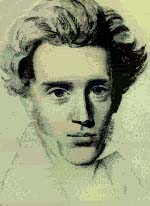
Keirkegaard
This is an,uh, you know, existential argument...there is a think line between this argument and no. V above. This could be a subset of that one, but they do differ in that this argument does not turn on religious experience per se, but upon purely existential experiences. IT is distilled from the thinking of four major theistic existentialists: Keirkegaard, Tillich, Marcel, and Jaspers, as read through the lense of Frederck Copleston.
A. Personal encounter "...God is discovered by the individual in the movement towards the free realization and appropriation of rather than as the terms of impersonal objective argument. To say this is not to say this is not to say that the act of self relating to God as 'my truth' is for them an irrational act or a purely capricious choice. Keirkegaard indeed may tend to give this impression on occassion. But Jaspers emphaizes the insecurity and evancent charter of finite existence and what may be called the experience or apprehension of the comprehensive, of the evolving being provided that one does not understand 'experinece' here as meaning privilaged mystical experience or anything approaching direct contact with God....IN his eyes (Marcel) exploration of those forms of experience which involve us as a person leads one to God..."
Copleston, Contemporary Philosophies, Westminster Maryland: Newman press, 1956,173.
B. Existential Thinkers 1) Soren Keirkegaard and objective uncertainty
SK's theory of truth is that of "objective uncertianty." For him, scientific demonstration, and mathematics, is merely hypothetical turth. It has no real bearing on our situation as humans, it does not involve us in an understanding the meaning of our being, and without that we are not truely ourselves. He traces three stages in the development of the self: The aesthetic, the moral, and finally, blief.
"We are left with the leap of faith The passionate appropriation by the individual of an 'objective uncertainty.' The truth that matters is my truth...the truth which I have chosen, to which I have committed myself, for which I venture all, and by which I choose to live, rather than public property truth achieved as the conclusion of logical argument."
--Copleston, 153.
This may sound totally subjective and it might lead some to charge that it is a mere pretense. But SK Was totally committed to his faith and clearly believed that was real. He hated Descartes and felt that his doubt was phony. But if one could actually prove the existence of God who would need faith? The proof of God for Sartre is at the other end of the leap of faith, where one unities with one's source in God and becomes truely oneself, and for SK this was a reality that really works.
2) Paul Tillich and the object of ultimate concern
Tillich believed that everyone shares the same basic ultimate concerns--death, justice, meaning and significance to life. When we confront our ultimate concerns truely we realize that there is an object of our ultimate concerns, which is God.
3) Karl Jaspers and apprehension of the transcendent
Jaspers was trained as a psychiatrist and came to philosophy while already invovled in a flurishing career in psychotherapy. His argument begins with a discussion about the limitations of scientific study. Any particular science is limited in and by itself in that is bounded by its own subject matter. Science is negated from every yeilding an understanding of being, since to study being science would have to objectify it. Science could study beings, and does, but being is not merely study of beings, and cannot be objectified because to be is to be a subject and not an object. Being inherently contains its own subjective dimensions.
To understand being is to understand our own limits in finitude. We also move toward the transcending of this limit when we confront our own being--death for example--but not just death in generl, rather, my own death. At such a moment I become aware of myself as grounded in being and the presence of being as the grounding of all beings. I become aware of the transcendent as the negatively apprehended compliment of limits. I cannot obtain scientific assurence of the transcendent but I affirm it in the exercise of liberty. Jaspers emphasizes the symbolic character of the world and of all events. the passing of the finite triggers the realization of the lasting value of the transcendent. (Copeleston, 162-165)
4) Gabriel Marcel and the mystery of being.
Marcel views two levels of conscious thougth. One can think about another person and objectify that person. But one cannot objectify oneself. The personal consciousness cannot be penitrated by scientific study because to attempt it would always necessitate objectification and ruling out of the subjective elements Which make up the meaning of human experience. He calls this awareness of personal consciusness "second level thought." My place as empistemologial questioner might be taken by a machine, but as a subject I apprehend a certain mystery to being which cannot but be objectified and therefore lost in any kind of scientific analysis. If I am ask 'what am I?' I can approach this as a psychologist or scientist, but must always leave out the view point of the questioner. But if I ask about myself I must consider the view point of the questioner which asks the question; which is always a subjective viewpoint, the quetioner who asks the question. I cannot objectify myself in that sense.
My fundamental sitaution however is to be present in the world, not as an ego in a particualr sitaution, but as a subject being in the world. My relation in being is to be in relation open to the other; the intersubjective.
"I aspire to an absolute committment, to absolute loyalty. I may first aspire to this within the sphere of human relations. But reflection shows me that this involves the invocation of the absolute. 'Thou' who is the ground of all being and value and who alone makes eternal fidelity possible. Thus in the exploration of the relationships which arise on the plane of intersubjectivity I 'discover' as the personal transcendent absolute and I become conscious of the orientation of my personality toward the absolute Thou, God. I am open to being from the start; and the conscious appropriation of this openness leads form the transcending of egoism in communion with others to personal self relating, in adoration and prayer, to God...I come to see the [relationships of intersubjectivity] their metaphysical significance within the context of my existence as a person. I see that I become a human person only thorugh self-transcendence, only with actual communication with other human beings and with God." --Copleston, 171.
[In that argument we can find analogues with Schleiermacher's feeling of utter dependence and Martin Bubber's I and Thou]
C. Objections. 1) This argument doesn't prove anything.
Answer: Got me there.
2) This is just fantasy time, wishful thinking, that doens't prove God exists.
Answer: That's right, and it's also wrong. It's not a demonstrative proof, that's for sure. And it is very akin to the religious experience argument. It's a rationale, a personal proof for those who find it convincing. But why should anyone find it conviencing? The more philosophical types among us will note immediately that it takes seriously the problem of being at its most fundamental level; it does not objectify being or dismiss it as an aray of sese data or a scientific problem to be studied and disected. IT is by its very nature something that only the individual can choose to affirm in his own experience of being human, this is what is meant by the existentialist when they speak of "self authentication." And only in self authentication can one affirm the nature of what it is to be who i am and to be human. It is also on this level that we find God, the level of personal faith. There is a strong indication in these four thinkers that to seriously come to grips with this understanding palces us very close to experiencing God on an existential level.
It's not a demonstrative proof but it is a proof of sorts, at least form the standpoint that one is offered a rationale for the logic of having faith. Skeptics are alwys asking me on the net "why should anyone believe?" Or "why have faith?" The answer is faith is self validating in a way that "demonstrative proofs" cannot be. Scientific information is always changing, and "facts" of science are limited to the nature of the inquarry and the methods of investigation. They invovle an exclusion of the dimension which means the most to us; that of what it is to be human in the world. Logical demonstration is always arguable, and both leave room for doubt. If it could be proven beyond a doubt that God exists, it would still leave the quetion of God's nature, and wheather or not God even knows we exist. But an existential apprehension leaves no room for doubt. To validate faith in this way, to committ to faith removes doubt.
Now, I have failed by a long shot to do justice to these thinkers. Each of the four is a profound figure and deserves the fullest attention of the reader. I urge everyone to read their books and consider their ideas. In three of the four (all but Jaspers) we find some of the greatest intellects of the Christian tradition, and in the four, including Jaspers, some of the greatest of the greats of existentialism.
A. Abstract values not just products of the mind
The Sort of values I'm talking about can be narrowly defined for the purpose of this argument. Let's take primarily the value of justice. Most people would tend to think of just ice as merely a human invention, something that results from biology and necessity. While there is a biological component in that we require a ceratin degree of cooporation for survivle, and we could very well have invented the concept to fill the very real need, steming from social contract, there is also something real and something trasncendent about Justice, akin to the sublime.
1) Justice not located merely in the human mind.
Justice has a real analoge in the world. There are real cases of injustice and they outrage us, and there are concepts of justice which require a logical coherence that exceeds the necessary requriement for social contract. We can continue to observe developments related to theories of jutice.
2) Not located in the world
Yet justice is not a real thing, we cannot go to where they keep the justice. It is not located physically in the world.
